


Every business wants to build stronger customer relationships and stay ahead of competitors. That is one reason why your business needs custom mobile app development in today’s digital market. Investing in custom mobile app development helps companies create experiences that match their goals instead of relying on generic software. Consumers now expect brands to be available anytime and anywhere. Mobile applications make that possible.
From placing orders to tracking services, people prefer businesses that offer quick and convenient mobile experiences. A well-designed app creates trust and keeps customers engaged. According to recent industry reports, smartphone users spend more than four hours daily on mobile apps. Businesses that invest in mobile-first strategies often see higher customer retention and stronger revenue growth. The opportunity is no longer limited to large enterprises.
Small and medium businesses also benefit from having dedicated mobile solutions. I recently spoke with a local retailer that struggled with repeat customers. They launched a custom loyalty app with personalized offers and instant rewards. Within six months, repeat purchases increased noticeably. Their app became their strongest customer communication channel.
Businesses now face increasing competition in every industry. A unique mobile application helps brands stand out by offering personalized features, better performance, and greater convenience. Instead of adjusting your business around software limitations, your software adapts to your business.
Importance of Mobile Apps for Businesses
Mobile technology has changed how people discover, shop, communicate, and receive services. Customers expect businesses to respond instantly. Mobile apps bridge that expectation while improving daily operations.
1. Customers Expect Instant Access
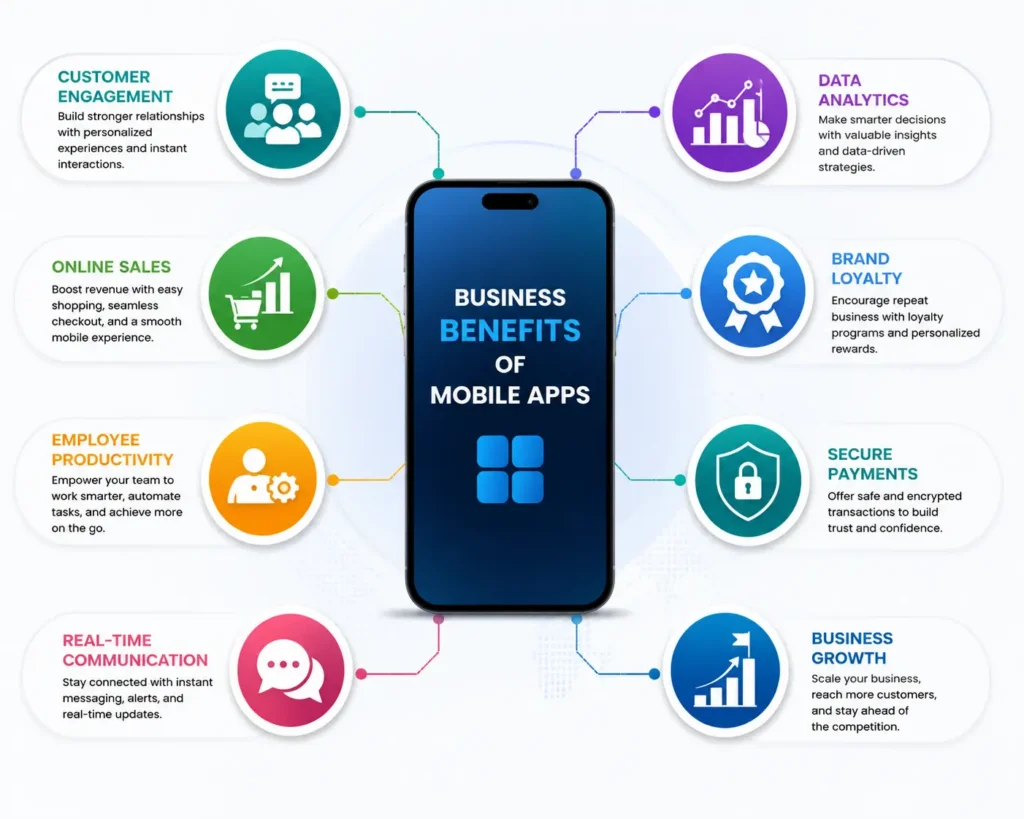
People prefer businesses that make every interaction simple. Whether they book appointments, order products, or request support, mobile apps reduce waiting time and improve satisfaction. Mobile apps also allow businesses to send relevant notifications at the right moment. Instead of waiting for customers to visit a website, brands can proactively communicate promotions, reminders, and updates. This approach helps improve customer engagement while building long-term loyalty.
2. Mobile Apps Support Business Efficiency
Modern organizations rely on digital tools to automate routine work. Employees can access business information remotely and complete tasks faster through mobile applications. A well-planned solution can increase business productivity by reducing paperwork, improving communication, and automating repetitive processes. Teams spend more time serving customers instead of managing manual workflows.
For example, a logistics company can track deliveries in real time. Sales teams can update customer information during client meetings. Restaurant staff can process orders without returning to a desktop system.
3. Mobile Apps Drive Long-Term Growth
Business success depends on delivering consistent customer experiences. Mobile applications help companies collect valuable customer insights that improve future decisions. Businesses understand buying habits, preferred products, and user behavior through analytics. These insights support better marketing campaigns and smarter business planning.
Many organizations now consider mobile applications a core part of digital transformation for businesses. Rather than treating apps as optional tools, they become valuable business assets that support innovation and expansion.
4. Mobile Apps Build Stronger Customer Relationships
Customers appreciate convenience and personalization. Mobile apps create direct communication between businesses and users without relying entirely on email or social media. Personalized recommendations, loyalty rewards, secure payments, and easy support improve the overall customer experience with mobile apps. Satisfied customers often become repeat buyers and brand advocates.
Brands such as Starbucks continue to demonstrate how personalized mobile experiences encourage customer loyalty. Their app combines rewards, payments, ordering, and promotions into one seamless experience. Customers return because every interaction feels simple.
Explore more: Business app development cost guide
Custom Mobile App Development: What is it?
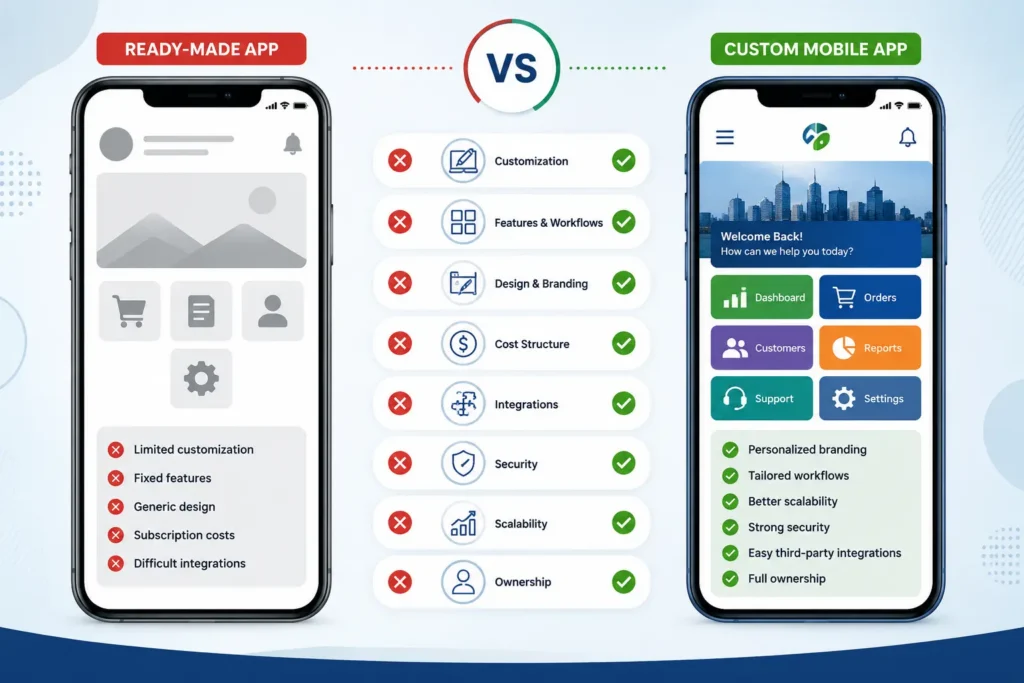
Many businesses begin by asking whether they need a standard application or a tailored solution. Understanding the difference helps make better investment decisions. Custom mobile application development refers to designing and building an application specifically for one business. Every feature, workflow, and interface supports unique business requirements instead of serving a general audience.
Unlike pre-built software, a custom application grows alongside your company. It integrates with existing systems and adapts as business needs change. One of the biggest discussions today focuses on the custom app vs ready-made app decision. Ready-made applications offer faster deployment and lower initial costs. However, they often include unnecessary features while lacking important business-specific capabilities.
Custom applications provide flexibility from the beginning. Businesses control the user experience, branding, security, and future enhancements without depending on third-party limitations. This approach creates highly efficient custom mobile app solutions that align with operational goals and customer expectations.
What Makes a Custom App Different?
Every business operates differently. A manufacturing company needs different workflows than a healthcare provider. A retail business has different customer expectations than an educational platform. Custom applications reflect these differences through carefully planned functionality.
Common custom mobile app features include:
- Personalized dashboards
- Customer portals
- Secure payment integration
- Inventory management
- Appointment scheduling
- Push notifications
- CRM integration
- Business analytics
- AI-powered recommendations
- Offline functionality
These features improve both customer satisfaction and employee efficiency.
Explore more: Why enterprises need a B2B app development company
Supporting Business Expansion
Growth creates new challenges. Businesses require technology that supports increasing customers, products, and operational complexity. Custom-built applications become scalable mobile applications because developers design them with future expansion in mind. New modules and integrations can be added without rebuilding the entire platform.
Many successful companies started with simple applications before expanding into larger digital ecosystems. Uber, Airbnb, and Amazon continuously improved their mobile platforms based on customer feedback and business growth. Organizations investing in business mobile app development often achieve greater flexibility than businesses relying solely on packaged software.
Why Businesses Choose Dedicated Development
Choosing the right development partner makes a significant difference. Experienced professionals understand business goals before writing code. Many growing companies partner with providers offering bespoke mobile app development services because they want tailored solutions instead of generic products.
These services usually include business analysis, UI/UX design, development, testing, deployment, and long-term support. The right team focuses on solving business problems rather than simply building software.
Explore more: Guide to car rental app development cost
Benefits of Custom Mobile App Development
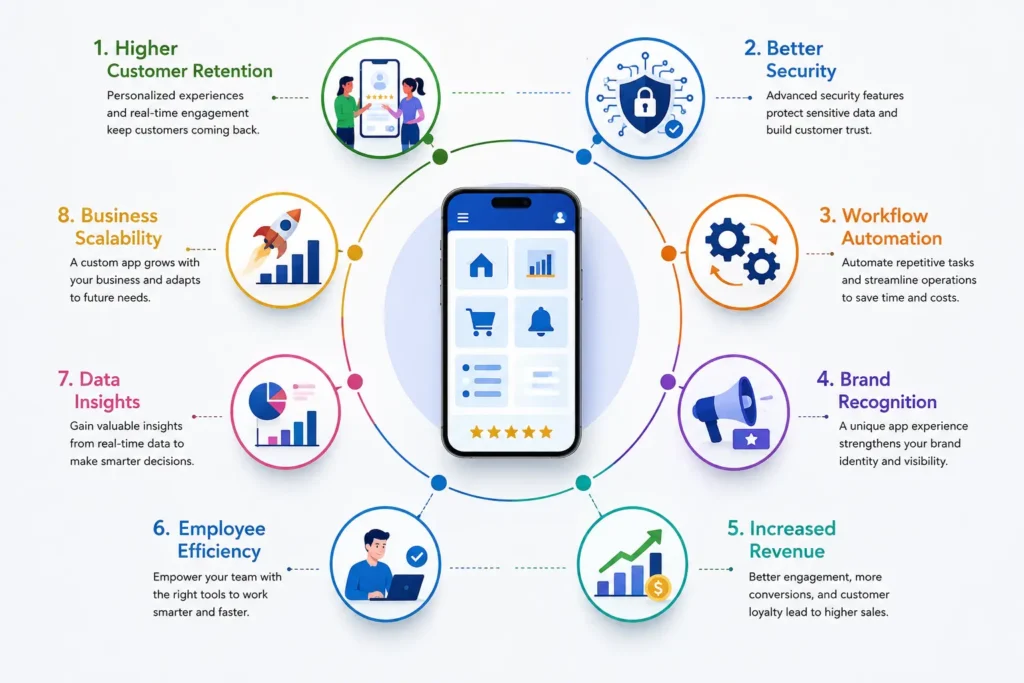
A well-planned mobile application creates value beyond customer convenience. It supports operations, strengthens your brand, and prepares your business for future growth. The benefits of custom mobile app development become more visible as your business expands.
1. Delivers Solutions That Match Your Business
Every company has unique goals and workflows. A custom business app fits those requirements instead of forcing your team to change existing processes. For example, a healthcare provider may need appointment scheduling and patient records. A logistics company requires route tracking and delivery updates. Building only the features your business needs improves efficiency and usability.
2. Supports Better Performance and Security
Security remains a major concern for every organization. Customer information, payment details, and business records require strong protection. Professional developers implement advanced mobile app security practices such as encrypted data storage, secure authentication, role-based access, and regular security updates. These measures reduce risks while increasing customer confidence.
3. Creates Better Return on Investment
Many business owners focus only on the initial app development cost. However, long-term value matters far more than upfront expenses. A custom application reduces manual work, improves customer retention, and creates new revenue opportunities. Over time, these improvements contribute to a stronger mobile app ROI because the application continues delivering measurable business value.
4. Supports Enterprise-Level Operations
Large organizations often require multiple integrations and advanced workflows. Enterprise mobile app development enables businesses to connect ERP systems, CRM platforms, inventory software, payment gateways, and internal communication tools into one streamlined solution. Instead of managing disconnected systems, employees work within a single digital ecosystem.
Steps in Custom Mobile App Development
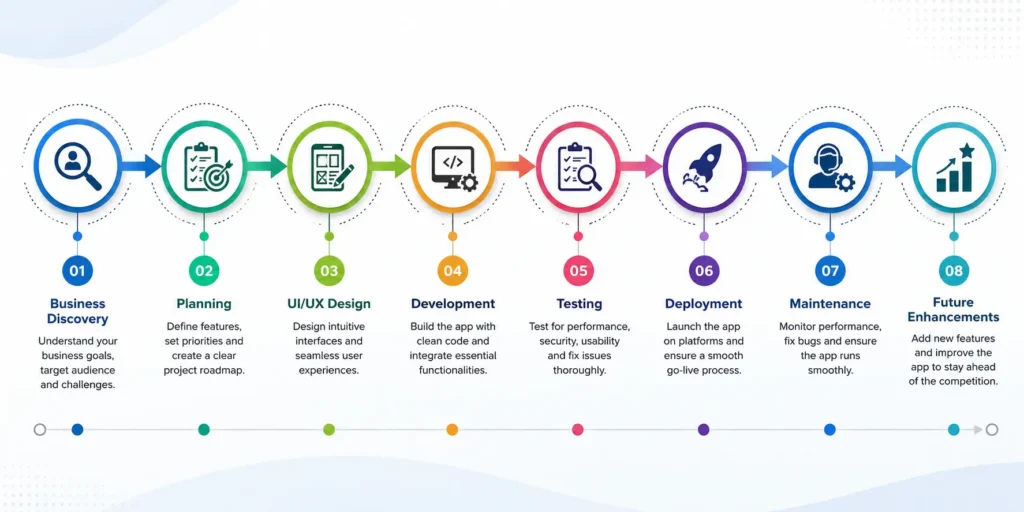
A successful application follows a structured process. Every stage contributes to building a reliable product that supports business goals.
1. Business Discovery
The project starts with understanding customer expectations, business challenges, and project objectives. Developers identify target users, required features, and technical requirements before development begins.
2. Planning and Design
The team creates wireframes, user journeys, and interface designs that prioritize usability. Good design keeps navigation simple and encourages users to complete important actions.
3. Development
Developers begin coding using the selected technology stack. Depending on project requirements, businesses may choose native mobile app development for maximum performance or hybrid mobile app development to support multiple platforms efficiently. The overall mobile app development process includes frontend development, backend development, API integration, and quality assurance.
4. Testing
Testing identifies bugs before launch. Teams verify performance, security, usability, compatibility, and responsiveness across multiple devices.
5. Launch and Continuous Improvement
Deployment marks the beginning rather than the end. Regular mobile app maintenance ensures compatibility with new operating systems, fixes security issues, improves performance, and introduces new features based on customer feedback. Businesses investing in continuous improvement create future-proof mobile applications that remain competitive for years.
Explore more: How to find the best mobile app development company
Factors to Consider in Choosing a Custom Mobile App Development Company
Selecting the right technology partner influences project quality and long-term success. A strong portfolio alone should not be the only deciding factor.
1. Industry Experience
Choose a company with experience delivering mobile application development for business across different industries. Review previous projects to understand their design quality, technical expertise, and problem-solving capabilities. Ask for client references whenever possible.
2. Technical Expertise
A reliable development partner should understand modern frameworks, cloud technologies, AI integrations, analytics, and scalable architecture. Businesses planning international expansion often evaluate a custom mobile app development company because of its experience managing enterprise-scale digital products across diverse industries. Discuss technical capabilities before signing any agreement.
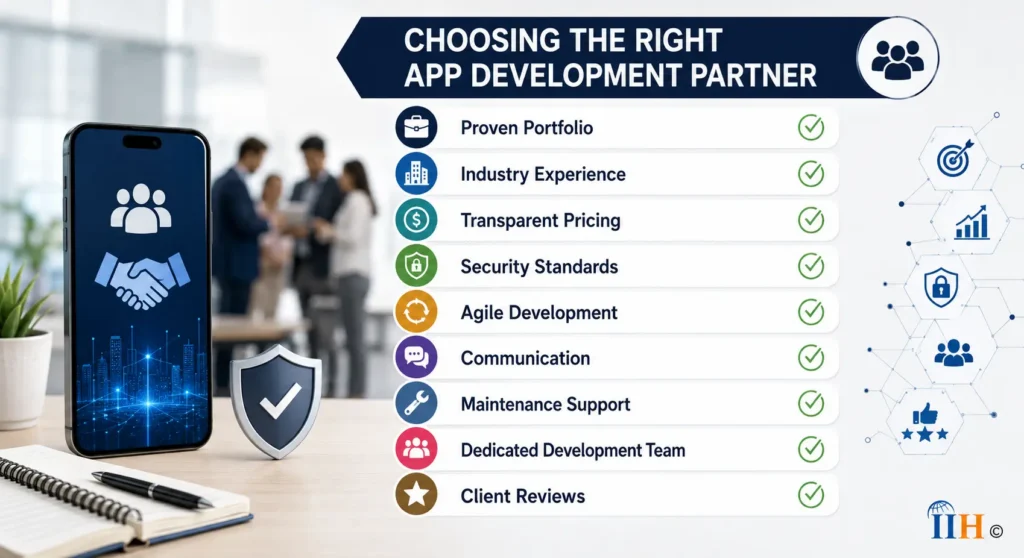
3. Transparent Communication
Good communication prevents misunderstandings and delays. Choose a team that provides regular updates, milestone reviews, and clear documentation throughout the project.
4. Scalability and Long-Term Support
Your application should continue evolving as your business grows. Look for development partners that offer long-term support, performance optimization, security updates, and feature enhancements. Many successful businesses also hire top dedicated developers to extend internal teams during future upgrades and ongoing product development. A reliable technology partner becomes a long-term business asset rather than a short-term vendor.
5. Focus on Long-Term Business Value
The best development companies understand business strategy instead of simply writing code. They recommend technologies that support business growth through mobile apps, improve operational efficiency, and prepare organizations for changing customer expectations.
Explore more: How AI-powered mobile applications help UK businesses stay competitive
Conclusion
Technology continues to reshape customer expectations and business operations. Companies that invest in tailored digital solutions gain stronger customer relationships, greater efficiency, and long-term competitive advantages. If you are still wondering why your business needs custom mobile app development, consider your long-term goals instead of short-term savings.
A well-planned application becomes a valuable business asset that grows with your organization. Whether you need customer-facing services or internal business automation, investing in custom mobile app development gives you greater flexibility, stronger security, and better control over your digital future.