


Choosing the right blockchain technology for your app development can shape your app’s cost, performance, security, and long-term growth. The right choice depends on your business goals, users, data, and technical requirements. Blockchain technology for app development can support transparent transactions, digital ownership, trusted records, and new business models.
However, not every blockchain suits every application. A gaming app may need fast transactions and low costs. An enterprise platform may need controlled access and strong privacy. A financial application may place security and reliability above everything else.
This guide explains the key selection factors and compares leading blockchain networks. It also shows how to match a technology with your app’s actual requirements.
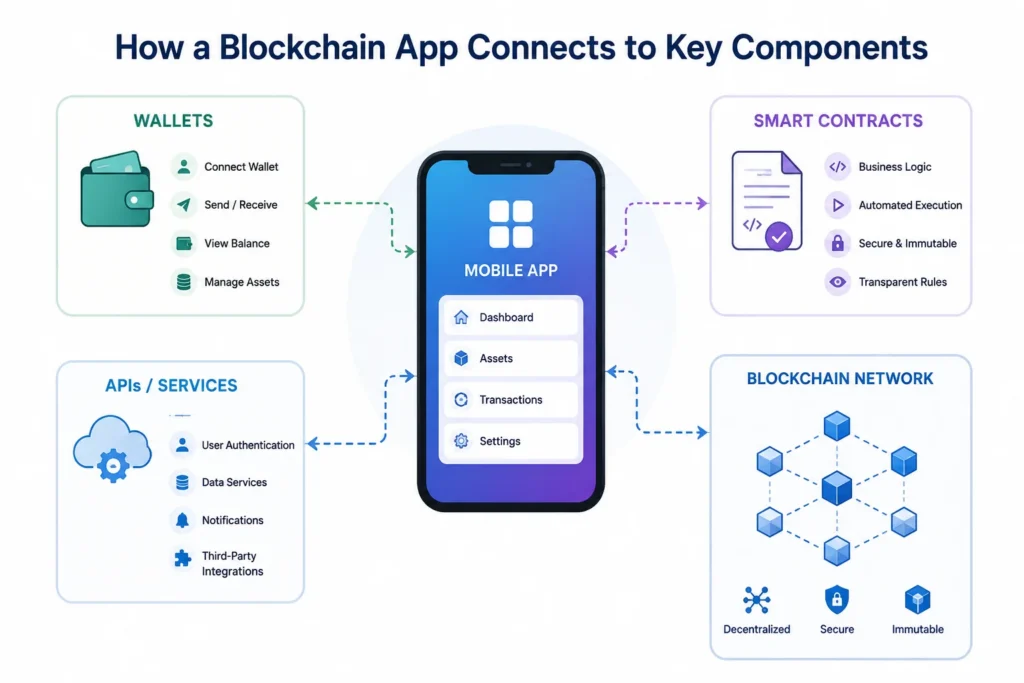
Factors to Consider when Choosing Blockchain Technology for App Development
Choosing blockchain technology starts with understanding what your application actually needs. Avoid selecting a network simply because it is popular or widely discussed.
1. Define the App’s Purpose
Start by identifying the problem blockchain should solve. Blockchain can add value when multiple parties need shared records, verifiable transactions, or digital ownership. For example, supply chain apps may need traceability. Gaming apps may need asset ownership. Financial apps may require transparent transaction records.
If a conventional database already solves your problem efficiently, blockchain may not provide enough additional value.
2. Consider Scalability
Scalability determines how well a network handles growing activity. An app with thousands of users has different requirements from an enterprise platform serving millions. Check how the network performs during busy periods. Also consider whether its architecture supports future growth without creating high costs.
3. Compare Transaction Speed and Fees
Users expect applications to respond quickly. Therefore, transaction speed can directly influence the user experience. You should also examine transaction fees. High network costs can make frequent transactions impractical for consumer applications. A network with lower fees may be more suitable for gaming, loyalty, micropayments, and high-volume applications.
4. Evaluate Security
Blockchain applications can handle valuable assets and sensitive transactions. Strong security should therefore remain a core selection criterion. Review the network’s track record, development activity, testing practices, and security architecture. Smart contract risks should also receive careful attention.
5. Understand the Consensus Mechanism
The consensus mechanism determines how transactions are validated and added to the network. Different mechanisms offer different balances between decentralisation, speed, energy use, and security. Your choice should match your application’s priorities.
Explore more: Blockchain application development guide
6. Check Smart Contract Support
Many blockchain applications depend on smart contracts to automate business rules. Check the programming languages, development tools, testing frameworks, upgrade options, and audit ecosystem available for the network. A mature developer ecosystem can reduce development challenges and make future maintenance easier.
7. Consider Interoperability
Modern applications rarely operate alone. They often connect with payment systems, wallets, APIs, databases, exchanges, and other networks. Strong interoperability can make these integrations easier. It can also give your application more flexibility as the ecosystem develops.
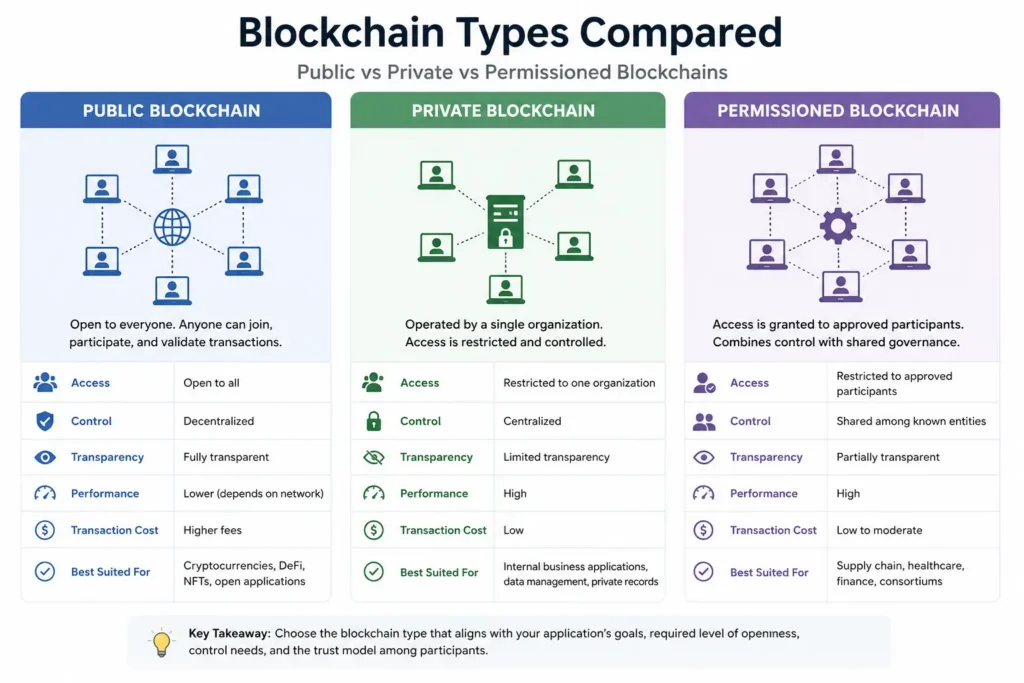
8. Choose the Right Blockchain Type
A public blockchain provides open participation and transparent transaction records. It can work well for consumer-facing applications and open digital ecosystems. A private blockchain restricts network participation. It may suit organisations that need greater control over their infrastructure.
A permissioned blockchain provides controlled access while supporting shared records among approved participants. The choice should depend on who needs access, what data must remain private, and how much control your organisation requires.
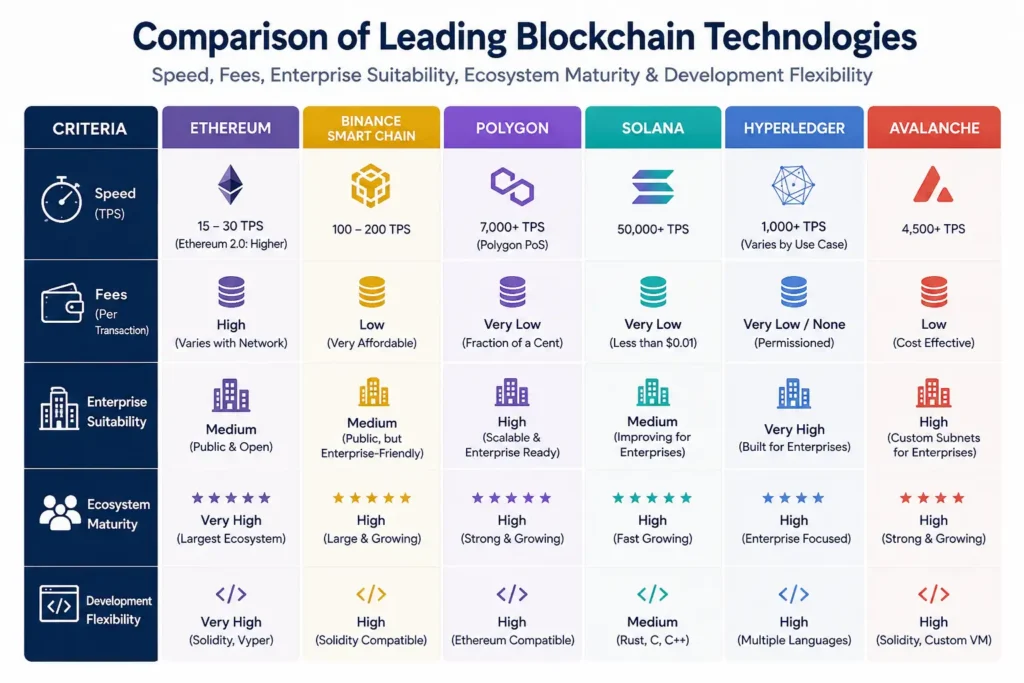
Comparison of Leading Blockchain Technologies for App Development
Several networks have become popular choices for modern applications. However, each one has different strengths.
| Technology | Key Strength | Suitable For | Main Consideration |
|---|---|---|---|
| Ethereum | Mature ecosystem | DeFi, NFTs, Web3 apps | Network costs can vary |
| Hyperledger Fabric | Enterprise control | Business networks | Less suited to open consumer ecosystems |
| Polygon | EVM compatibility and lower-cost transactions | Consumer apps, Web3 platforms | Requires careful network selection |
| Solana | High throughput | Gaming, trading, high-volume apps | Ecosystem and architecture differ from EVM chains |
1. Ethereum
Ethereum offers one of the most established ecosystems for blockchain application development. It has extensive developer tools, wallets, libraries, and community support. It works well for decentralised applications, financial products, digital assets, and other Web3 solutions. However, teams should carefully evaluate network costs and performance requirements.
2. Hyperledger Fabric
Hyperledger Fabric focuses strongly on enterprise use cases. Organisations can create controlled networks where participants have defined permissions. This makes it useful for supply chains, financial workflows, healthcare networks, and other business applications requiring privacy.
3. Polygon
Polygon provides an attractive option for teams seeking Ethereum compatibility with potentially lower transaction costs. Its ecosystem can support consumer applications, digital assets, gaming platforms, and other applications that benefit from EVM-compatible development.
4. Solana
Solana focuses on high-performance blockchain applications. Its architecture supports applications requiring substantial transaction throughput. It can suit gaming, trading, payments, and other applications where rapid processing is important. However, developers should assess its tooling and ecosystem against their team’s skills.
A Blockchain app development company can help evaluate these options against your product requirements rather than selecting a network based only on popularity.
Explore more: Blockchain technology in mobile app development
Highlighting the Differences and Similarities between the Technologies
These technologies share a common goal: they provide distributed infrastructure for recording and validating digital activity. However, their architecture and ideal use cases differ significantly.
Ethereum and Polygon are particularly relevant when developers want access to the broader EVM ecosystem. Developers can use familiar tools and established development patterns across compatible networks.
Solana takes a different technical approach. It focuses strongly on performance and high transaction throughput, which can benefit applications with demanding workloads.
Hyperledger Fabric differs more fundamentally because it targets controlled business environments. It gives organisations greater control over network participation and data visibility.
The biggest differences involve performance, access control, ecosystem maturity, development tools, costs, and application requirements.
Your blockchain framework should therefore support the product instead of forcing the product to fit the technology.
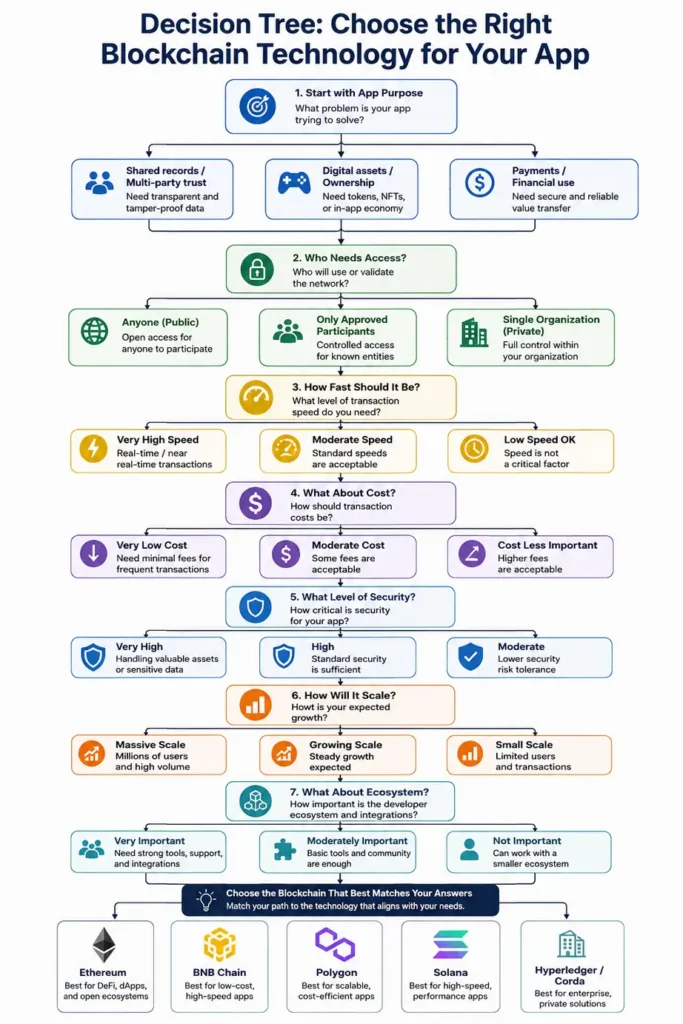
How to Choose the Right Blockchain Technology for Your App Development
The right blockchain technology for your app development should emerge from a structured evaluation process.
Step 1: Map Your Business Requirements
List the features that genuinely require blockchain. Identify transactions, assets, data-sharing requirements, ownership models, and user interactions. This prevents unnecessary blockchain use and helps your development team focus on the areas where distributed technology adds measurable value.
Step 2: Define Your Users
Think about who will use the application. Consumer applications may prioritise simple wallets, fast transactions, and low fees. Enterprise applications may prioritise permissions, privacy, compliance, and integration with existing systems.
Step 3: Select the Blockchain Architecture
Decide whether your app needs a public, private, or permissioned network. This decision affects governance, accessibility, infrastructure, and data management. It also influences your development approach and future maintenance requirements.
Explore more: Blockchain app development cost
Step 4: Evaluate Development Resources
Check whether your developers have experience with the selected network. Review available SDKs, documentation, testing tools, libraries, and community resources. A strong ecosystem can shorten development time and simplify troubleshooting.
Step 5: Assess Long-Term Costs
Do not calculate only the initial development budget. Consider infrastructure, network fees, audits, maintenance, monitoring, and future upgrades. Current 2026 market estimates vary widely. Simple blockchain MVPs often start around $30,000, while complex enterprise platforms can exceed $300,000. Security audits can add thousands of dollars, depending on contract complexity and audit scope.
Step 6: Test Before Committing
Build a proof of concept before making a long-term technology decision. Test transactions, integrations, performance, wallet interactions, and user flows. A small technical test can expose limitations before they become expensive architectural problems.
Step 7: Plan for Future Growth
Your blockchain technology selection should consider where the application may be three to five years from now. Think about user growth, new features, additional assets, cross-chain integrations, regulatory requirements, and potential migration needs.
For businesses that need external expertise, Blockchain app development services can help with architecture, smart contract development, integrations, testing, and deployment.
Future of Blockchain Technology in App Development
The future of blockchain for mobile apps is likely to focus less on blockchain as a headline feature. Instead, users may interact with blockchain functions without needing to understand the underlying technology. Wallet abstraction, tokenised assets, digital identity, loyalty programmes, secure payments, and verifiable credentials could become easier to integrate.
Developers are also exploring ways to improve user experience by reducing transaction friction. Applications can hide complex blockchain processes behind familiar mobile interfaces. Interoperability will remain important as businesses adopt multiple networks and services. Developers will need architectures that can connect blockchain systems with conventional applications.
At the same time, security and regulatory requirements will become more important. Businesses will need stronger controls around identity, data access, asset management, and compliance. A mobile app development firm with blockchain expertise can help businesses combine familiar mobile experiences with blockchain-based capabilities.
The broader direction points toward blockchain becoming an infrastructure layer rather than a feature users consciously notice.
Explore more: Choosing a blockchain app development company
Conclusion
Selecting a blockchain network is an architectural decision, not simply a technology preference. The best choice depends on your app’s purpose, users, security requirements, performance needs, budget, and growth plans. A careful comparison of networks can prevent expensive changes later. Start with the business problem, define measurable requirements, test suitable platforms, and evaluate long-term operating costs.
The most successful blockchain application development projects use blockchain where it creates clear value. They avoid adding complexity simply because the technology is available. With a practical evaluation process, businesses can build reliable blockchain development solutions that support both current needs and future opportunities.