


The travel app development cost depends on features, integrations, platforms, security, and the development team’s location. The cost to build a travel app like Skyscanner can range from around $60,000 to $150,000+ for a production-ready platform. Advanced global platforms can exceed $200,000 when they require extensive supplier integrations, AI, analytics, and high-scale infrastructure. Current 2026 industry estimates place advanced travel platforms within a similar range.
Skyscanner operates as a travel search engine that compares flights, hotels, and car rentals. It connects travellers with trusted booking partners instead of handling every booking directly. Its platform also supports price tracking, flexible searches, saved trips, and comparison tools.
Businesses planning to build a travel app should therefore look beyond the visible mobile interface. The backend, supplier integrations, search engine, booking workflow, payment system, cloud infrastructure, and data synchronisation can account for much of the budget.
This guide explains the major cost drivers, component-level estimates, development strategies, and practical ways to control spending without reducing product quality.
Factors That Affect the Cost of Building a Travel App Like Skyscanner
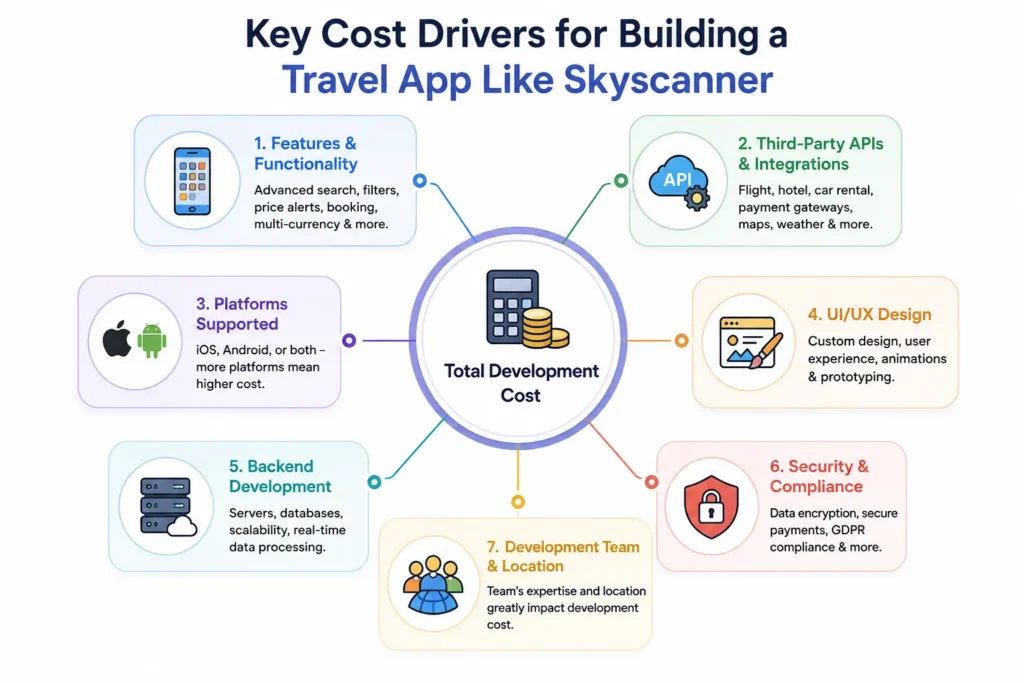
The cost to build a travel app like Skyscanner changes significantly according to the product scope. A simple flight comparison MVP requires fewer integrations than a global platform covering flights, hotels, cars, currencies, and multiple markets.
1. Product Scope and Complexity
A focused MVP might include flight search, filters, user accounts, price alerts, and redirects to booking partners. A larger platform may add hotel searches, car rentals, loyalty programs, personalised recommendations, multilingual support, and advanced analytics.
Skyscanner app features demonstrate how flexible search can become a major product differentiator. Current features include price alerts, saved lists, flexible date searches, and destination discovery tools.
For this reason, businesses should define their first release around specific customer needs rather than copying every competitor feature.
2. API and Supplier Integrations
Travel platforms depend heavily on external inventory. Travel API integration can connect the application with airlines, hotels, aggregators, payment providers, maps, currency services, and other suppliers. A flight booking API can provide schedules, fares, availability, and related flight information. A hotel booking API can provide property details, rooms, rates, availability, and booking information.
Each integration requires development, testing, error handling, authentication, monitoring, and ongoing updates. Current industry estimates suggest major booking integrations can add thousands of dollars and several development weeks.
Explore more: Why travel businesses need a mobile app
3. Platform Selection
Choosing between native and cross-platform development also affects the budget. Building separate iOS and Android applications usually requires more development resources.
React Native or Flutter can reduce duplicated development work when the product requirements suit a shared codebase. However, native development may provide advantages when the application needs platform-specific capabilities or highly optimised performance.
4. UI/UX Requirements
UI/UX design for travel apps requires more than attractive screens. Users need to compare many results quickly and understand prices, timings, stops, ratings, policies, and booking conditions.
A clean search experience can reduce friction during the most important part of the customer journey. Responsive filters, readable comparison cards, clear calls to action, and simple checkout flows can directly influence conversion.
5. Backend, Security, and Scalability
A travel platform must process search requests, user accounts, bookings, notifications, payments, and third-party responses. It also needs reliable caching and database architecture. Security adds another layer of work. Developers must protect personal information, payment data, authentication credentials, and booking records.
Scalability becomes particularly important when search traffic increases during holidays or major travel periods.
6. Development Team Location and Expertise
Team location has a direct impact on hourly rates. A specialist team in the UK or USA generally costs more than an experienced offshore team. Businesses can compare options such as a travel app development company UK or an offshore team based on technical expertise, communication, delivery process, and previous travel projects.
A lower hourly rate does not always mean a lower project cost. Poor architecture, weak testing, and unreliable integrations can increase total expenses later.
Explore more: Complete guide to travel app development
Breakdown of Estimated Costs for Each Component
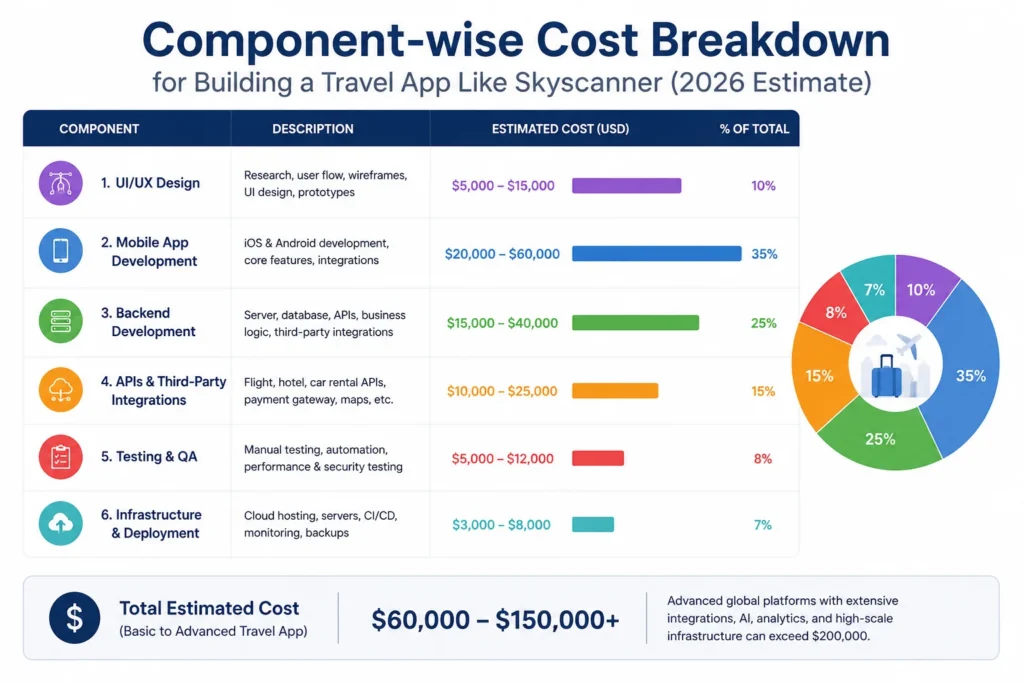
For a realistic 2026 budget, a basic travel booking MVP can start around $25,000, while a multi-service platform can reach $100,000–$200,000+.
The following breakdown provides a practical planning range for a Skyscanner-style product.
| Component | Estimated Cost |
|---|---|
| Discovery and technical planning | $3,000–$7,000 |
| UI/UX design | $5,000–$12,000 |
| Mobile application | $15,000–$30,000 |
| Backend and admin panel | $12,000–$25,000 |
| Flight integrations | $8,000–$20,000 |
| Hotel integrations | $7,000–$18,000 |
| Search and comparison engine | $8,000–$18,000 |
| Payment and booking workflows | $5,000–$12,000 |
| Testing and quality assurance | $5,000–$10,000 |
| Cloud, security, and deployment | $3,000–$8,000 |
These figures overlap because teams often combine related components into development milestones. A practical budget should therefore use the table as a planning guide, not a fixed quotation.
Core Search and Comparison Engine
The search engine forms the heart of a Skyscanner-style platform. It collects results from multiple suppliers and presents them in a consistent format. The system must handle sorting, filtering, deduplication, caching, currency conversion, availability checks, and response-time optimisation. Poor search performance can quickly damage user trust.
A price comparison app also needs accurate price presentation. Users should understand when a displayed fare is estimated, cached, or subject to change.
Flight and Hotel Booking Modules
Flight booking app development usually requires complex fare rules, passenger information, seat data, baggage details, cancellations, and booking confirmations. Hotel booking app development adds property inventories, room types, occupancy rules, cancellation policies, images, amenities, and availability management.
A flight and hotel booking app therefore requires more backend logic than a simple travel discovery product.
APIs and Real-Time Data
Real-time flight data can improve search accuracy and customer confidence. However, frequent data requests can increase infrastructure and API expenses. Third-party API integration also requires monitoring because suppliers can change response formats, authentication methods, pricing models, or availability rules.
A travel aggregator app development project must therefore budget for integration maintenance from the beginning.
Features and Technology
Essential travel app features may include registration, social login, search, filters, sorting, favourites, price alerts, booking redirects, notifications, customer support, and booking history. The travel app development process normally covers discovery, architecture, UI/UX design, development, API integration, testing, deployment, and post-launch support.
A typical travel app development timeline may range from three to five months for a focused MVP. A broader platform can take six to twelve months or longer, depending on integrations and complexity.
Team and Technology Costs
A typical development team may include a product manager, UI/UX designer, mobile developers, backend developers, QA engineers, and DevOps support. A modern stack might include Flutter or React Native for mobile development. Node.js, Python, or similar technologies can support backend services. PostgreSQL or another reliable database can manage structured booking data.
Cloud platforms such as AWS, Google Cloud, or Microsoft Azure can support scalable infrastructure. Businesses seeking mobile application development should evaluate architecture experience alongside pricing. Strong technical planning can prevent expensive changes during later development stages.
Explore more: Travel app development cost guide
Tips for Keeping Costs Down During the Development Process
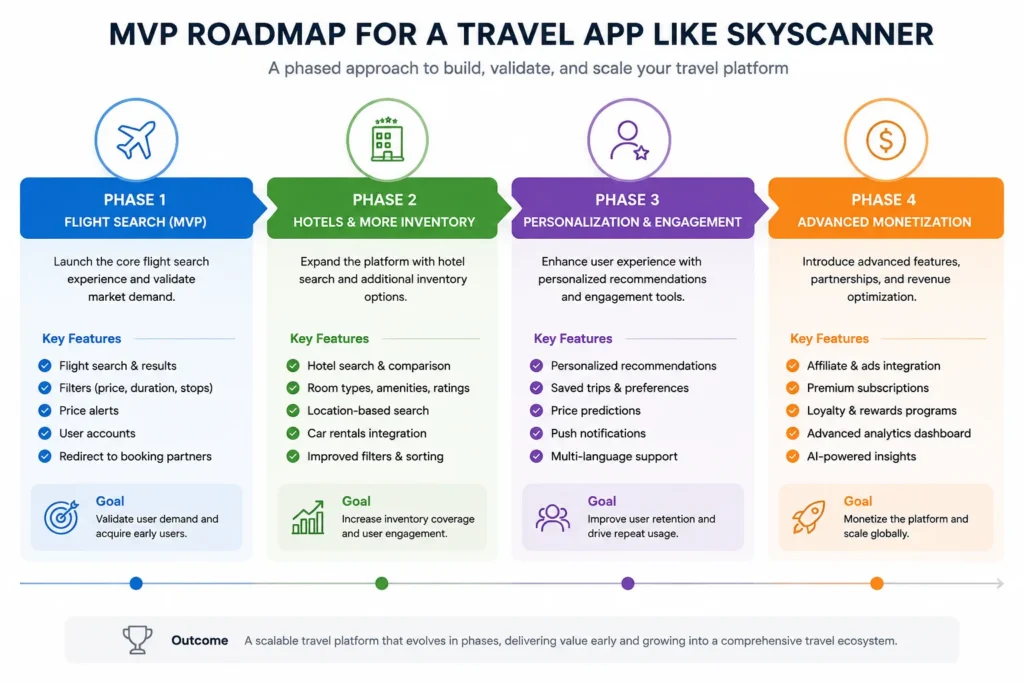
The best way to control the travel app development cost is to prioritise the features that directly validate the business model.
1. Start With a Focused MVP
Do not launch every feature at once. Start with one core booking category and a limited supplier network. For example, an initial product could focus on flight comparison and partner redirection. Hotels, cars, loyalty programs, and AI recommendations can follow after market validation. This approach reduces technical risk and helps teams learn from real customer behaviour.
2. Select APIs Carefully
Compare API coverage, pricing, response limits, documentation, support, and geographic availability before signing contracts. Avoid integrating several suppliers when one reliable provider can support the MVP. Add additional sources when demand and transaction volume justify the investment.
3. Choose Cross-Platform Development When Suitable
Cross-platform development can reduce duplicated work across mobile platforms. However, teams should select this approach based on product requirements rather than cost alone. For businesses that need flexible staffing, options such as hiring skilled dedicated developers can provide direct control over development priorities and long-term product improvements.
4. Invest in Reusable Architecture
Build modular services for authentication, search, payments, notifications, analytics, and supplier integrations. This structure makes future feature additions easier. Reusable components can reduce development time when the product expands into new markets or booking categories.
5. Plan Maintenance From Day One
The travel app maintenance cost can include server expenses, bug fixes, security updates, API changes, operating system updates, monitoring, and new feature support. Industry estimates commonly place ongoing maintenance around 15%–25% of the original development cost annually, although travel platforms can exceed that range because of frequent integrations.
6. Use Analytics Before Adding Advanced Features
Analytics can show where users abandon searches, compare prices, or leave during checkout. This information can guide future investments. Avoid adding expensive AI or personalisation features simply because competitors use them. First determine whether users need those capabilities.
7. Consider the Revenue Model Early
Travel app monetisation can include affiliate commissions, partner referrals, advertising, sponsored placements, booking commissions, premium services, or subscription features. Your revenue model should influence API selection, booking workflows, analytics, and partner management. Planning these elements early can prevent costly redesigns.
Explore more: Online travel portal development cost
Conclusion
A successful Skyscanner-style platform requires much more than a polished mobile interface. Search performance, supplier integrations, accurate pricing, scalable backend services, security, and a reliable booking journey determine much of the final investment.
The cost to build a travel app like Skyscanner can realistically fall between $60,000 and $150,000+ for a production-ready product, while enterprise platforms can require substantially larger budgets. Current 2026 estimates support a broad range based on product complexity and integration depth.
Businesses should define an MVP, validate demand, select reliable APIs, and build a scalable foundation before expanding the platform. With disciplined planning, travel app development cost can remain controlled while the product gains the flexibility needed for long-term growth.