


Businesses across industries use mobile apps to improve operations, reach customers, and create new revenue channels. If you are exploring how to hire app developers, start by defining the business problem your app should solve. The right team can then turn that idea into a practical product roadmap.
The global mobile application market is projected to reach $322.6 billion in 2026 and grow at a 15.5% CAGR through 2033. That growth makes it important to understand what to look for before you hire app developers for a new product.
Hiring the right team is not one big decision. It involves several smaller decisions around skills, technology, budget, communication, and long-term support. This app developer hiring guide walks you through each of them.
Why Hire App Developers?
A mobile app can become an important part of your customer experience or internal workflow. It can simplify repetitive tasks, connect different systems, collect useful data, and make services easier to access. The value depends on how well the product fits your users and business goals. A good development partner does more than write code. They help turn your idea into a solution that can scale as your needs change.
Benefits of Custom App Development
Custom solutions can work particularly well when off-the-shelf software cannot support your processes. The main benefits include:
- A solution built around your workflows: Your app can reflect your actual business processes instead of forcing your team to change them.
- Better system integration: Developers can connect the app with ERP, CRM, payment, cloud, and other business systems.
- Stronger security: Your team can design access controls and security measures around your data and industry needs.
- Personalised experiences: Different users can receive features and information based on their roles and permissions.
- Useful business insights: Reporting and analytics can help managers make decisions using real operational data.
- Room for growth: A well-planned architecture can support new features, users, and integrations over time.
How to Hire App Developers: A Step-by-Step Process
A structured process helps you compare potential partners on more than price. It also reduces misunderstandings before development begins.
1. Define Your App Project Requirements
Start with the business problem rather than the technology. Write down who will use the product, what they need to accomplish, and what success should look like. Your app project requirements should cover the main features, user roles, platforms, integrations, security needs, and expected outcomes. You do not need to prepare technical specifications yourself.
A capable partner can help refine the scope and identify technical dependencies. However, you should understand the product’s purpose before approaching development companies. Also consider whether you need a customer-facing product, an internal tool, or both. This decision will influence the architecture, features, security controls, and development approach.
2. Choose the Right Engagement Model
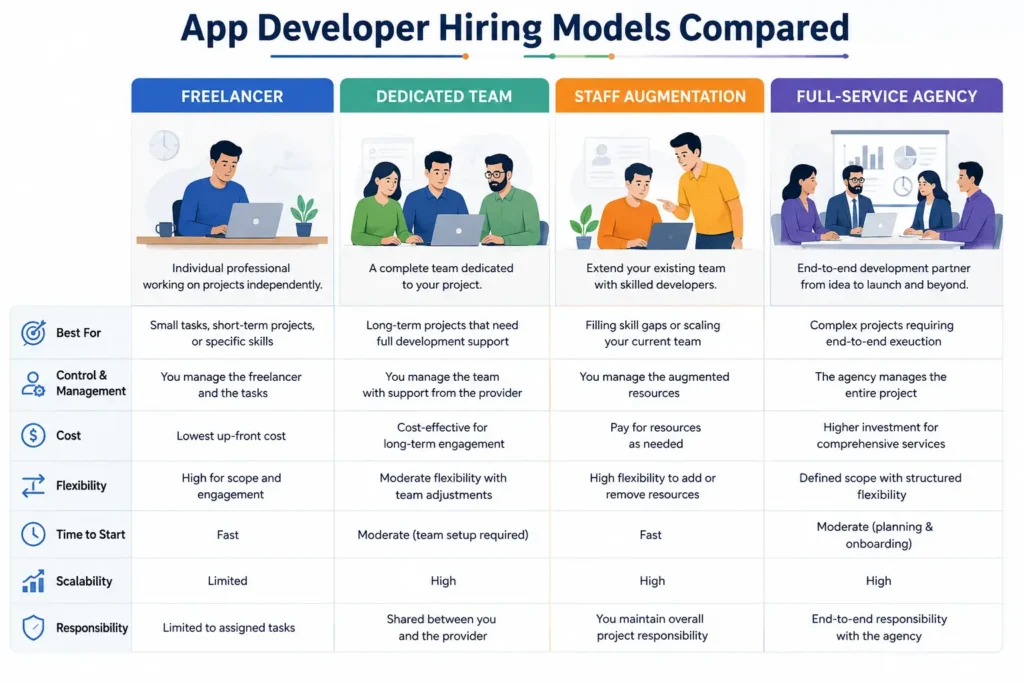
Your hiring model should match the project’s size, timeline, and level of control you need. Common options include freelancers, dedicated teams, staff augmentation, and full-service development companies. Remote app developers can work well when you need access to wider talent pools without maintaining a local team. This model can also suit businesses that already have technical leadership.
For short tasks or limited scopes, freelance app developers may be suitable. However, check their availability before committing to a long project. For larger products, a dedicated team can provide more continuity. This model can include developers, designers, testers, project managers, and other specialists.
Offshore app developers can also help businesses access technical talent in different markets. Cost should not be the only deciding factor. Evaluate communication, time-zone overlap, security, technical experience, and project management.
3. Decide Which Technical Skills You Need
The technology should follow your product requirements rather than the other way around. Your choice may involve native development, cross-platform development, or a combination of technologies. If your users mainly use Android devices, you may want to hire Android app developers with strong Kotlin and Android SDK experience. For Apple users, look for Swift, iOS SDK, and App Store expertise.
Cross-platform app developers can be useful when you want to serve multiple platforms from a shared codebase. Frameworks such as Flutter and React Native can reduce duplicated development work. Your team may also need experience with APIs, cloud services, databases, authentication, payments, analytics, and security. Consider these requirements before comparing candidates.
4. Review Portfolios and Relevant Experience
A strong portfolio can tell you more than a long list of technologies. Look for projects with similar users, workflows, integrations, or technical challenges. Ask potential partners to explain their role in previous projects. Find out what they built, what problems they faced, and how they measured the outcome.
Do not judge a portfolio only by visual appearance. Check whether the applications demonstrate good usability, reliable performance, sensible navigation, and consistent design. You should also review client feedback and case studies. Platforms such as Clutch provide information about reviews, portfolios, service focus, and pricing for mobile development companies.
5. Evaluate the Development Team
The people assigned to your project matter as much as the company you select. Ask who will handle development, design, testing, project management, and technical leadership. When you compare app developers for hire, ask whether the proposed team has worked on projects similar to yours. A team with relevant experience can often identify risks earlier.
Communication also matters. Your developers should explain technical decisions in language your business team can understand. Do not ignore soft skills. Look for people who communicate clearly, ask useful questions, respond to feedback, and take responsibility for their work.
6. Discuss Security, Ownership, and Confidentiality
Security should enter the conversation before development starts. Ask how the team handles authentication, authorisation, encryption, secure APIs, data storage, and third-party services. If your project involves sensitive information, ask about relevant compliance requirements. You should also clarify source-code ownership, intellectual property, documentation, and access to development repositories.
A NDA for app development can protect confidential information during discussions and delivery. Make sure the agreement clearly explains what information it covers and how both parties should handle it.
7. Check the Development and Testing Process
Ask potential partners to explain their mobile app development process from discovery through launch. A clear process should include planning, design, development, testing, deployment, and post-launch support. Ask how they manage requirements when priorities change. You should also understand how they track tasks, report progress, manage risks, and handle defects.
Quality assurance testing should happen throughout development rather than only before launch. Testing may cover functionality, usability, performance, security, compatibility, and device behaviour. A strong process helps reduce avoidable rework. It also gives you better visibility into progress before the final release.
8. Agree on Timeline, Milestones, and Deliverables
Your app development timeline depends on scope, team size, technology, integrations, testing, and approval cycles. Avoid providers that promise a fixed delivery date without understanding the requirements. Break the project into milestones. Each milestone should have clear deliverables, acceptance criteria, and payment terms.
For example, the first milestone could cover discovery and product planning. Later milestones may cover UI/UX design, development, testing, and app deployment. This approach gives both sides a clear view of progress. It also makes it easier to identify delays before they affect the entire project.
9. Set a Realistic Budget
Your app development budget should reflect the product you actually want to build. A low initial estimate can become expensive if important features appear later. Ask providers to separate development, design, testing, infrastructure, third-party services, and ongoing support. This makes quotes easier to compare.
You should also ask what happens when the scope changes. A transparent change-request process can prevent disagreements later. Do not select a partner based on the lowest quote alone. Compare the team’s experience, proposed approach, communication, security practices, and expected long-term value.
What Is the Cost to Hire App Developers?
The cost to hire app developers varies widely because every application has a different scope. Features, platforms, integrations, security requirements, team seniority, and location can all affect the final price.
Current UK market data gives a useful benchmark. Clutch’s August 2026 data places typical UK mobile development rates around £60 – £120 per hour. It lists feature-light projects around £30,000 – £80,000 and more complex applications at higher levels.
For iPhone development specifically, Clutch currently reports typical UK rates of around £70 – £140 per hour. It also lists focused MVPs and prototypes at roughly £25,000 – £60,000.
Android development shows a similar pattern. Clutch reports UK Android development rates around £60 – £120 per hour, with native Android MVPs commonly ranging from £30,000 – £80,000.
These figures should serve as planning ranges rather than fixed prices. Your actual app developer cost will depend on the scope and team you choose.
Explore more: Cost to hire dedicated developers
What Influences App Development Cost?
Several factors can change the final quote:
- Number of platforms: Building separate native apps can increase development and maintenance work.
- Feature complexity: Payments, real-time messaging, maps, AI, analytics, and complex workflows require additional effort.
- Backend requirements: Custom APIs, databases, admin panels, and cloud infrastructure can add substantial work.
- Design requirements: Complex user journeys and custom UI/UX can increase design and development time.
- Security and compliance: Regulated industries often require additional controls, testing, documentation, and audits.
- Integrations: Connecting third-party services or existing business systems can introduce technical dependencies.
- Post-launch support: Updates, monitoring, bug fixes, and new features create ongoing costs.
MVP app development can help businesses test an idea before investing in a larger product. The goal should be to include the smallest useful feature set that can validate the product’s core assumptions.
Best Practices When You Hire App Developers
The best hiring decisions usually come from comparing value rather than hourly rates. A developer with strong technical skills may still be unsuitable if communication and project management are weak. Start by creating a shortlist based on relevant experience. Then compare portfolios, references, communication practices, technical skills, security processes, and pricing.
You should also define how you will communicate during development. Decide who attends meetings, how often updates are shared, and where project documentation lives.
1. Prioritise Skills Over the Lowest Price
A low quote may look attractive at first. However, poor architecture, weak testing, or unclear requirements can create expensive problems later. Choose a team that understands your business goals and can explain its technical decisions clearly. The right partner should also identify risks instead of simply agreeing with every request.
2. Look Beyond Development
Development is only one part of the product lifecycle. Your team may need analytics, monitoring, bug fixes, operating-system updates, security patches, and feature improvements after launch. Discuss app maintenance before signing the contract. Clarify what support is included, how urgent issues are handled, and how additional work is priced.
3. When to Choose a Dedicated Team
Businesses with long-term product plans may benefit when they hire dedicated app developers. A dedicated team can build deeper knowledge of your product and stay involved as requirements evolve. This model can work especially well for products that need regular improvements. It can also provide continuity when the product requires several specialists over time.
4. When an In-House Team Makes More Sense
In-house app developers can be a strong choice when mobile software forms a core part of your business. You gain direct control over hiring, processes, priorities, and technical decisions. However, building an internal team also means managing recruitment, salaries, benefits, infrastructure, training, and retention. Consider the long-term workload before choosing this route.
Explore more: Hire the right developers for your startup
How to Choose a Mobile App Development Partner
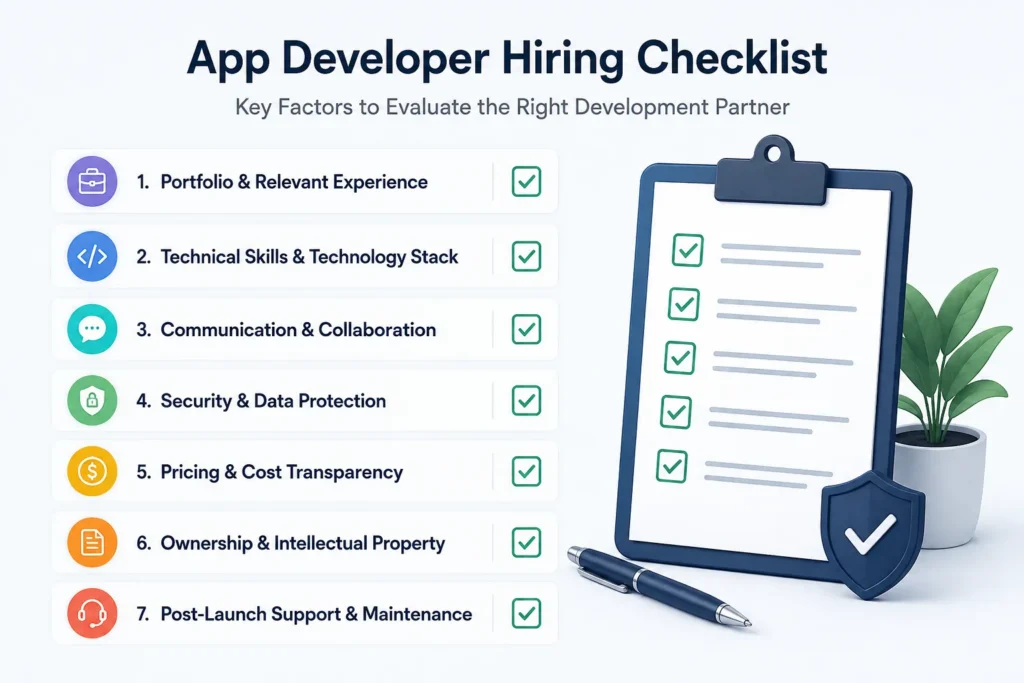
A reliable partner should offer more than coding capacity. Look for a team that can understand your business, challenge weak assumptions, and explain trade-offs clearly. Before signing, confirm the scope, milestones, ownership terms, security responsibilities, communication process, warranty period, and support model.
If you plan to hire app development company, review the team’s discovery process first. A good discovery phase should clarify the product, technical approach, risks, dependencies, and estimated investment.
The right mobile app development team should also remain transparent when requirements change. You should know what changed, why it changed, and how it affects time and cost.
How IIH Global Can Help
IIH Global provides app development services for businesses that need mobile products built around their processes and users. The engagement can begin with discovery, requirements analysis, technical planning, and product design. The team can then recommend suitable technologies based on your product goals. The approach may include native or cross-platform development, depending on performance, budget, user needs, and plans.
A structured delivery approach can help businesses track progress through defined milestones and regular communication. It can also help identify issues before they create significant delays. For businesses that need long-term support, the engagement can continue after launch. Maintenance, optimisation, updates, and feature improvements can help keep the application reliable as user expectations change.
Conclusion
Choosing the right development partner requires more than comparing hourly rates. You need to understand your requirements, evaluate technical and communication skills, define expectations, and plan for support after launch. The best results usually come from a clear scope and an experienced team that understands your business goals.
Take time to compare portfolios, processes, security practices, costs, and long-term support before making your decision. If you are still considering how to hire app developers, start with the business problem, define the required outcome, and then find a team that can build toward it.