


Building a successful online business takes more than uploading products and choosing a theme. A skilled Shopify expert can turn your ideas into a faster, easier store that supports growth. If you plan to hire Shopify expert talent, define the business problem before discussing technical tasks. The right professional should understand your customers, products, sales process, and growth goals. Shopify powers millions of businesses across 175+ countries. It also reports more than 14% of the US eCommerce market share based on 2025 merchant GMV.
A good hire can reduce rework and improve the shopping journey. The goal is to connect platform capabilities with business outcomes.
Why choose Shopify for your online store?
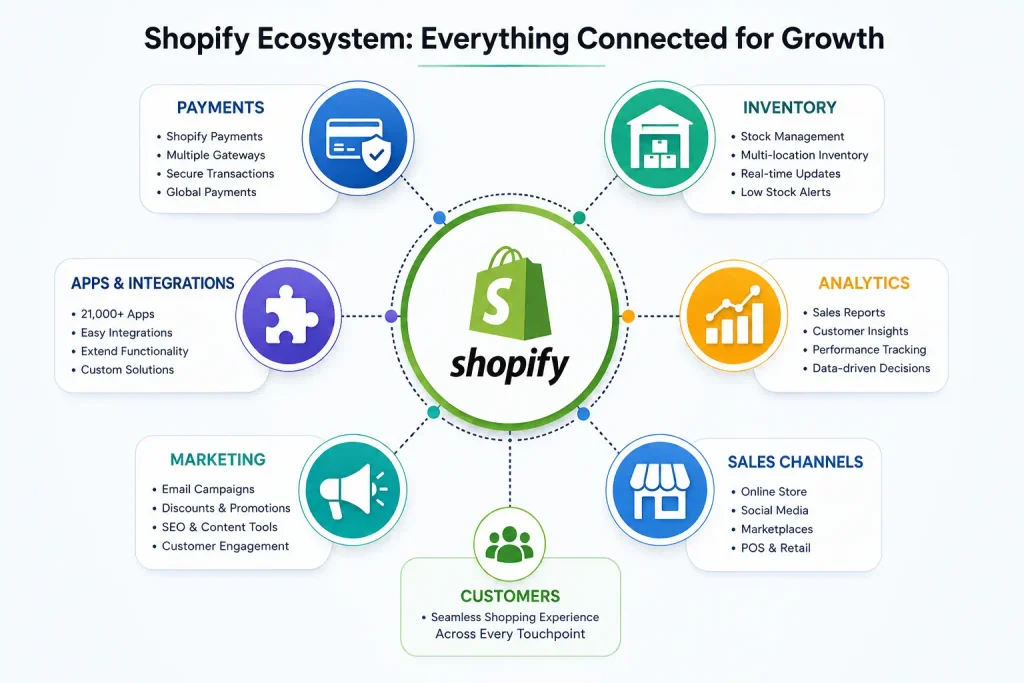
Shopify combines storefront management, payments, inventory, marketing tools, analytics, and integrations on one platform. Shopify store development can start quickly and evolve as requirements become more complex. Businesses can expand through themes, apps, APIs, automation, and advanced commerce features.
Shopify says its App Store has more than 21,000 apps, while millions of merchants use the platform globally. That breadth creates flexibility, but it also creates choice overload. For ongoing work, you may prefer to hire dedicated Shopify expert resources through a long-term engagement.
The platform suits many business models, from new direct-to-consumer brands to established retailers. A Shopify website can support product discovery, content, promotions, and checkout in one journey.
For example, imagine a skincare brand with 500 products. The business has an eCommerce store that needs to handle frequent catalogue updates.
The owner may start with a standard theme and a few apps. Later, the business may need subscriptions, bundles, reviews, international pricing, and better analytics. A skilled specialist can connect those requirements without creating a fragile collection of patches.
Shopify supports multiple sales channels and evolving customer journeys. Shopify reported $14.6 billion in merchant sales during the 2025 Black Friday-Cyber Monday weekend. More than 81 million customers purchased from Shopify-powered brands during that period.
What is a Shopify expert?
A Shopify specialist can design, build, improve, troubleshoot, or strategically guide a Shopify store. Their role can range from front-end work to integrations, performance, conversion improvements, and technical planning.
A capable professional should understand Liquid, Shopify APIs, theme architecture, responsive design, JavaScript, HTML, CSS, analytics, and third-party integrations. Their technical expertise should match your requirements rather than a generic checklist.
You may need different skills at different stages. A designer can improve the interface, while a Shopify developer can handle complex functionality. A Shopify consultant can help with business decisions, platform planning, app selection, and growth priorities.
Explore more: How to choose an eCommerce expert
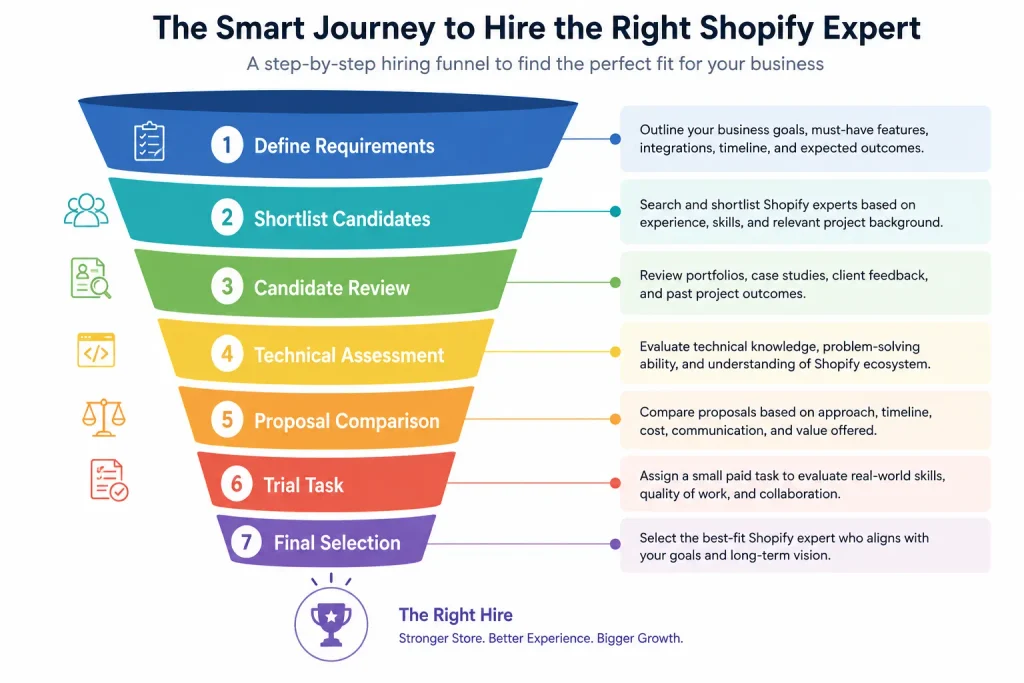
Steps to hiring the right professional
1. Define your business and technical requirements
Start with a clear project brief. Explain what you sell, who you serve, what currently works, and where customers face friction. List required features, integrations, pages, product volume, launch date, and expected outcomes. Include technical issues if you know them. A clear brief helps candidates estimate effort.
2. Decide whether you need a freelancer, agency, or dedicated resource
Your hiring model should reflect project complexity. A freelancer may suit focused changes or a short project. An agency can provide design, development, testing, and project management under one team. Businesses with continuous work may prefer a dedicated resource for ongoing improvements. This can provide deeper product knowledge and faster communication. It works well when your roadmap includes regular improvements.
3. Check relevant platform experience
Strong Shopify experience matters. Review past projects that resemble your store, especially similar products, business models, integrations, and customer journeys. Ask candidates to explain their role in each project. A portfolio can look impressive while representing an entire team. You need to know what the person personally planned, built, tested, and maintained.
Look for measurable outcomes, such as faster pages, higher conversion rates, better mobile usability, or successful migrations.
4. Test technical and problem-solving ability
Do not rely only on certificates or years of experience. Give candidates a realistic scenario based on your business. Ask how they would handle an app conflict, slow product pages, complex product options, or an integration failure. Strong candidates should explain trade-offs in simple language.
A Shopify development expert should also know when not to add custom code. Excessive customisation can increase maintenance costs and create conflicts with future platform changes.
5. Review their development approach
Ask how the candidate handles discovery, design, development, testing, launch, and post-launch monitoring. For custom Shopify development, ask how code will be documented and versioned. Ask whether Shopify theme customisation will follow a maintainable structure.
Discuss staging, backups, quality checks, analytics, and rollback plans before development begins. If the project includes Shopify app integration, ask how the specialist will manage permissions, data flows, API limits, error handling, and app conflicts.
6. Compare proposals beyond price
Request itemised proposals from shortlisted candidates. Compare scope, deliverables, timelines, assumptions, revisions, testing, support, and ownership terms. Do not automatically select the lowest quote. A cheap implementation can become expensive when poor architecture requires repeated fixes.
Current 2026 pricing varies by location and skill level. Published India rates show senior specialists around ₹1,750 – ₹3,500 per hour. Agency rates commonly sit around ₹1,400 – ₹4,200 per hour. Fixed project pricing can reach several lakhs for complex builds. Treat these as planning ranges. Final cost depends on complexity, integrations, migration work, testing, and seniority.
7. Verify communication and ownership
Technical skill matters, but communication can decide whether a project stays on track. Agree on response times, reporting, tools, and escalation paths. Clarify who owns the code, design files, documentation, accounts, and custom assets. Your business should retain appropriate access to critical systems.
For larger projects, consider an expert eCommerce development company that can provide multiple skills and continuity. For smaller projects, one experienced specialist may be more efficient.
8. Start with a controlled project
If possible, begin with a clearly defined task. A small engagement lets both sides test communication, quality, speed, and attention to detail. This works well when you are unsure whether a candidate understands your business. It provides evidence before a large rebuild.
Explore more: Cost of hiring dedicated developers
Additional tips for a successful partnership
1. Set measurable goals
Define success using business metrics, not only completed tasks. Useful measures include conversion rate, average order value, page speed, revenue per visitor, and checkout completion. Choose a baseline before work starts, then compare results after launch. This keeps both sides focused on outcomes.
2. Keep the store simple
Every app, script, and custom feature adds another dependency. Ask whether a feature is essential before adding it – prioritise native Shopify capabilities when they meet the requirement. Use custom development when it creates meaningful value or solves a limitation.
3. Plan for performance and SEO
Ask your specialist to consider image sizes, scripts, app impact, responsive layouts, metadata, structured data, redirects, and crawlability. Performance should remain part of development. Shopify store optimisation should continue after launch. Review analytics regularly and identify pages where users leave, hesitate, or encounter errors.
4. Document the work
Request clear documentation for custom code, integrations, settings, workflows, and third-party dependencies. Documentation makes future changes safer. It also reduces dependence on one individual. If your original specialist becomes unavailable, another professional can understand the setup faster.
5. Use Shopify development services strategically
A long-term partner can help with new features, troubleshooting, testing, performance work, and platform changes. Define the support scope clearly. For example, a monthly retainer might include development hours, monitoring, priority fixes, and scheduled improvements. Avoid vague promises of unlimited support.
6. Build a feedback routine
Share feedback in one place and prioritise requests. Separate urgent bugs from useful improvements and long-term ideas. A monthly review can cover performance, conversion data, campaigns, technical debt, and priorities.
Explore more: Hiring developers for a startup
Conclusion
Hiring the right specialist is ultimately a business decision, not just a technical purchase. Start with clear goals, assess relevant experience, test problem-solving, compare complete proposals, and define ownership.
The best Shopify expert will understand the platform and the commercial reason behind each feature. If you need multiple skills, hire dedicated developers through a structured engagement model. Keep responsibilities clear and assign one person to coordinate decisions. That combination can help you build a store that performs well today and remains easier to improve tomorrow.