


Every business generates vast amounts of data today, but much of this data remains underutilised without the right technology and systems. Machines, vehicles, inventory, equipment, and other connected systems continuously generate valuable data. However, without the right tools and systems, companies often struggle to convert that data into meaningful business outcomes.
This is where IoT application development is revolutionizing today’s businesses. By connecting physical devices through intelligent applications, companies can achieve real-time monitoring, automate processes, and make faster decisions using operational data. Across sectors such as manufacturing, healthcare, and retail, IoT app development is helping organisations improve visibility, streamline operations, and operate more efficiently. As companies accelerate their digital transformation, partnering with an experienced IoT app development company UK helps build scalable IoT solutions.
What Is IoT App Development?
IoT app development for business purposes involves creating applications that connect devices, sensors, and business systems, allowing them to communicate, collect data, and analyse information in real time. Custom IoT app development differs from conventional software because it enables seamless communication between connected systems.
How IoT Is Transforming Business Operations
IoT solutions for businesses are delivering tangible results across sectors. The technology enables companies to:
- Monitor assets remotely: Track equipment, vehicles, and inventory in real time from anywhere.
- Automate workflows: Replace manual processes with intelligent, data-driven automation.
- Predict maintenance needs: Catch issues before they cause costly downtime.
- Improve safety: Monitor environmental conditions and equipment status to prevent accidents.
- Optimise resource use: Reduce waste and improve efficiency through data-driven insights.
Factories have been among the earliest adopters of IoT solutions, using the technology for preventive maintenance, real-time monitoring, and automated production processes. The clear return on investment, reduced downtime, lower maintenance costs, and improved productivity drive this adoption.
Core Technologies Powering IoT Application Development
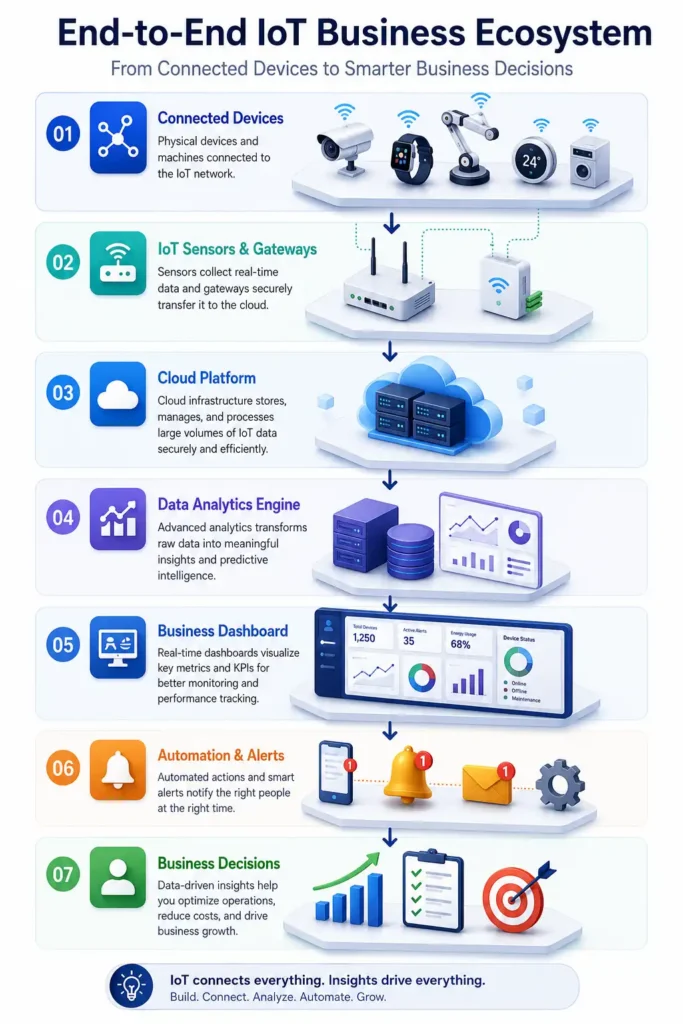
Every successful Internet of Things solution relies on a combination of technologies that enable communication, data processing, and automated decision-making. Modern Internet of Things app development enables the creation of intelligent environments for seamless data exchange.
1. Real-Time Monitoring Sensors
Smart sensors continuously collect data on parameters such as temperature, location, motion, pressure, and machine state. This continuous stream of data provides organisations with deeper insights into their business processes and helps them avoid costly mistakes.
2. Cloud Connectivity
A secure cloud-based IoT platform serves as a central hub where data generated from connected devices is collected, stored, and analysed. The cloud infrastructure allows organizations to gain insights about their operations remotely while enabling scalability when adding more devices.
3. Data Processing and Analytics
The value of raw IoT data is realised only after proper analysis. With the help of modern IoT systems, huge amounts of data are analyzed to find trends and anomalies.
4. Intelligent Automation
The IoT applications can trigger automated workflows according to the preset criteria. For instance, an automated system can create maintenance work orders, send warnings about the depletion of inventory, and report poor performance of the machinery.
How the IoT App Development Process Works
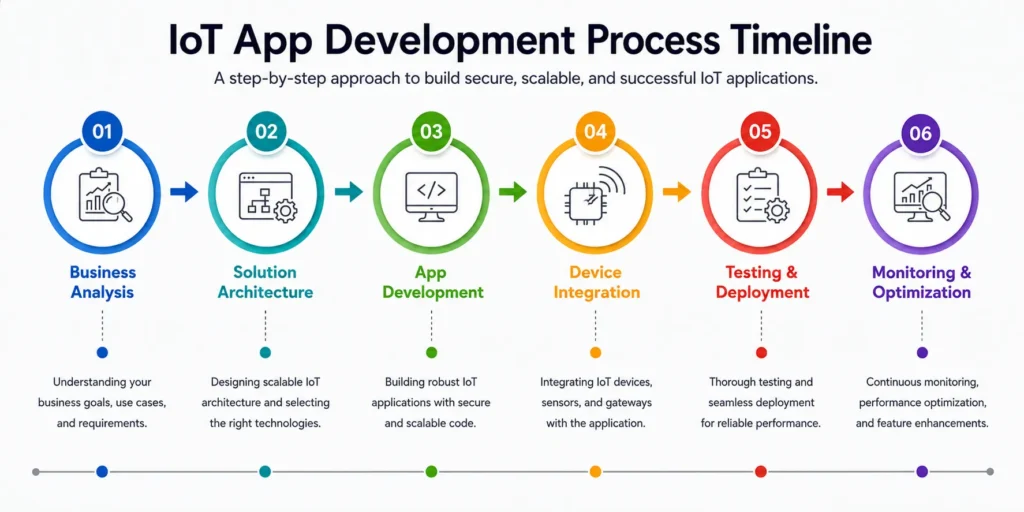
An effective IoT solution for an enterprise is not just about connecting devices; it requires proper planning, architecture, integration, and optimisation.
1. Business Requirement Analysis
The journey starts by determining the purpose, challenges, and expected business outcomes from the solution. This will help decide what features are needed and what devices should be integrated.
2. Solution Design and Architecture
Based on these requirements, developers design the architecture, define connectivity methods, and select suitable technologies. They then build enterprise IoT solutions with secure device connectivity, API integration, workflow automation, and reliable data management.
3. Development and Integration
IoT software development during this phase revolves around connecting devices, designing user-friendly dashboards, connecting with other existing business systems, and providing secure communication in the ecosystem as a whole.
4. Testing and Deployment
Testing is done extensively to make sure that the application works effectively and efficiently in terms of connecting devices, ensuring accurate data, and providing security.
5. Ongoing Monitoring and Optimisation
After that, businesses monitor the performance of the devices and keep on improving their applications.
Key Benefits of Internet of Things App Development
Implementing IoT mobile app development allows enterprises to go beyond conventional observation and create smart systems that enhance efficiency, visibility, and decision-making.
1. Improved Operational Efficiency
IoT-based applications automate tasks, reduce manual intervention, provide real-time visibility, and improve overall business performance.
2. Better Business Process Automation
Through networking between devices, systems, and workflows, IoT enables companies to automate processes, making operations less repetitive and more consistent across the organization.
3. Actionable Business Insights
Through advanced IoT analytics, businesses can recognize patterns, analyze performance, predict demand, and make informed strategic decisions based on real-time operational data.
4. Seamless Mobile Accessibility
In contemporary IoT implementations, workers can control their equipment, be informed about potential risks, and oversee operations from anywhere with the help of safe mobile dashboards. Usually, companies integrate IoT technology into advanced mobile app development solutions.
Challenges of IoT Platform Development
Although the Internet of Things provides many benefits to businesses, successful deployment requires careful planning and a well-defined technology strategy.
1. Security and Data Privacy
Connected devices continuously transmit business-related data, making encryption, authentication, and security updates crucial for the connected ecosystem.
2. Integration with Existing Systems
Many companies still rely on legacy software and hardware systems. Integrating IoT with existing systems can be complex and requires careful architecture planning.
3. Scalability
When an organization grows, it will have more devices connected to the network. IoT solutions need to be capable of managing higher traffic and more devices.
4. Device Compatibility
The Internet of Things ecosystem may consist of various devices of different vendors, which communicate through various communication channels. Ensuring smooth compatibility is critical for enabling remote asset monitoring across diverse devices.
5. Managing Large Volumes of Data
Thousands of devices connected to the Internet of Things generate huge volumes of information each day. Companies require appropriate data management and analytics solutions to support asset monitoring solutions, extract meaningful insights and maintain system performance.
IoT Application Development Cost Considerations
The cost of IoT app development for business operations varies depending on factors such as project complexity, device connectivity, platform capabilities, integrations, and other technical requirements. The estimates below are provided as a general reference only, and actual development costs may vary based on your specific project scope and business needs. Whether you’re developing an industrial IoT solution or planning to hire dedicated mobile app developers, understanding these cost factors will help you estimate your budget more accurately and plan for long-term scalability.
Estimated Development Costs:
- Simple BLE application (such as smart light bulbs): $25,000–$45,000
- Wi-Fi-connected app (smart thermostats, etc.): $50,000–$90,000
- Industrial Internet of Things platform (fleet management, etc.): $120,000+
Main Cost Factors Include:
- Hardware: Development of custom-made hardware or purchase of ready-made modules.
- Firmware: Development of device-level software, which can represent a significant portion of development costs.
- Cloud: Costs grow with increasing amounts of data and number of devices.
- Security: Implementation of adequate security measures takes additional time.
- Integration: Connecting with existing business systems.
Explore more: IoT app development cost guide
Real-World Applications of IoT-Based Application Development
Companies in all sectors have been leveraging the power of IoT for increased transparency, automation of processes, and faster decision-making.
1. Smart Manufacturing
Manufacturers leverage IoT technology for process and machine monitoring, as well as smart manufacturing through proactive maintenance.
2. Asset Tracking
The use of asset tracking solutions enables companies to track vehicles, equipment, inventory, and expensive machinery.
3. Supply Chain Management
IoT provides greater supply chain visibility through monitoring of the products during their transportation and making sure that the organizations deliver and manage their inventories effectively.
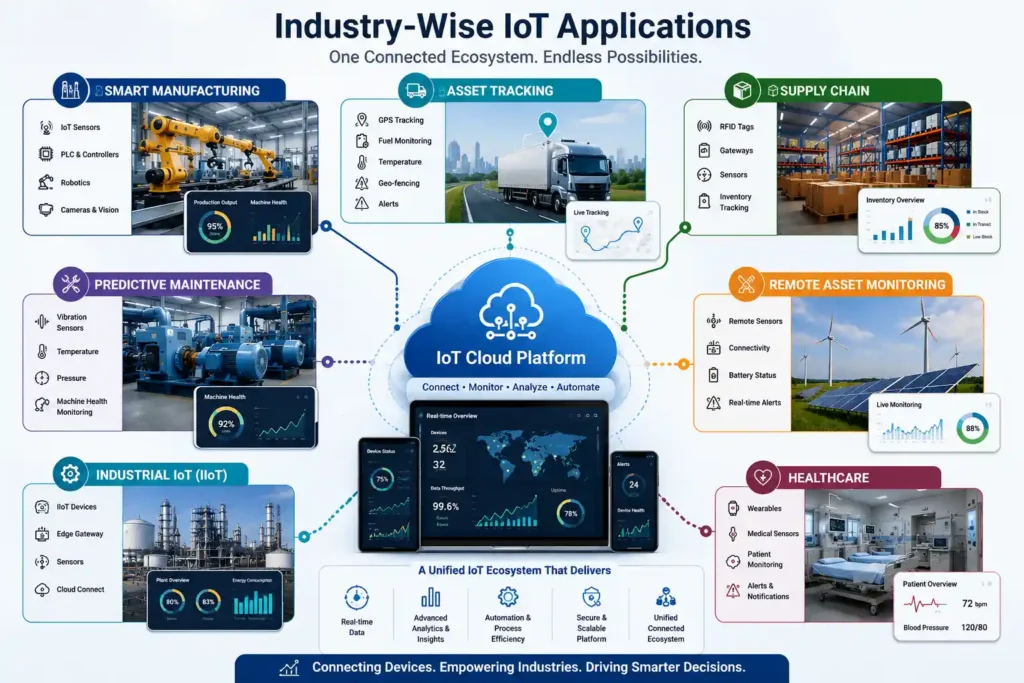
4. Predictive Maintenance
Equipment performance is continuously monitored in terms of performance and identification of possible future breakdowns. This approach to maintenance helps reduce downtime, lower repair costs, and extend equipment lifespan.
5. Remote Asset Monitoring
Remote asset management allows companies operating across different locations to monitor their assets, such as equipment and buildings, remotely for fast action on any problems that arise during operations.
6. Industrial IoT (IIoT)
Industrial IoT (IIoT) has led to a revolution in industries like manufacturing, energy, logistics, and utilities by connecting all the industrial equipment into a single connected ecosystem. This allows businesses to increase efficiency and support data-driven decision-making across complex operations.
7. Healthcare
In healthcare, IoT apps are transforming patient care through remote monitoring and diagnostic tools. Wearable devices collect vital signs and transmit data to healthcare providers, enabling proactive interventions.
Build Future-Ready IoT Solutions with IIH Global
IIH Global is a leading software development company with deep expertise in building custom IoT solutions across industries. As a trusted IoT app development agency USA, we deliver end-to-end IoT applications that drive real business value.
Our IoT services are aimed at addressing the specific requirements of enterprises through compliance with regional regulations and integration with existing systems. Regardless of whether your project requires a basic BLE application or an industrial IoT application, our IoT software development expertise helps deliver flexible, secure, and user-friendly solutions.
Our flexibility also means that we can provide you with mobile application development services by hiring dedicated developers.
Ending Note
As companies keep adopting digital transformation, the Internet of Things (IoT) has become one of the main drivers of operational performance rather than being just an emerging technology. Organizations get increased transparency within their processes through connectivity, real-time data gathering and automation of business processes, which help make quick and smart decisions.
If you wish to increase productivity, decrease operational expenses, enhance customer experience, or scale up your enterprise operations, IoT applications are the way to go! The organizations who choose to adopt the correct IoT strategy now will have a competitive advantage tomorrow!