


Businesses want mobile experiences that load quickly, reach more users, and avoid unnecessary development overhead. This is where progressive web app development can offer a practical option. The progressive web app development cost depends on features, design, integrations, development expertise, and project complexity. Unlike native apps, PWAs can use one codebase across multiple devices. This can reduce duplicate development work while still delivering an app-like experience.
For businesses planning a new digital product, understanding the progressive web app development budget before development starts can prevent unexpected expenses. A clear scope also helps teams decide which features deserve investment and which can wait.
What is a Progressive Web App?
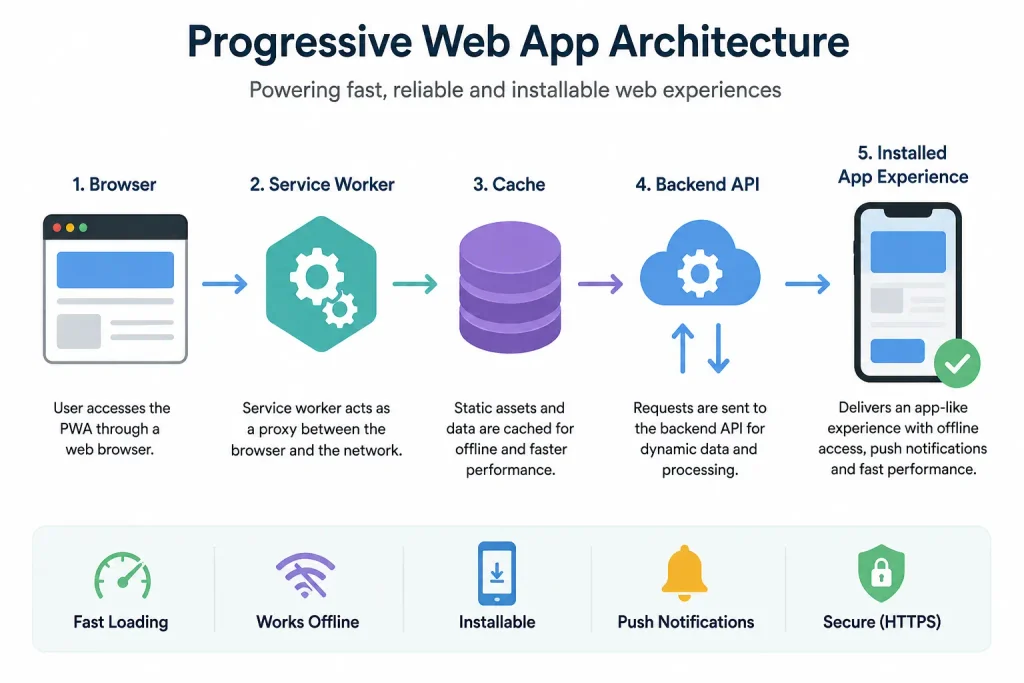
A PWA combines the reach of a website with several capabilities associated with mobile applications. Users can access it through a browser and, where supported, install it on their device.
Modern progressive web applications use technologies such as service workers, a web app manifest, browser caching, and secure connections. These technologies help deliver faster loading, installation, and reliable experiences across different network conditions.
Unlike traditional websites, a PWA can support features such as push notifications and offline functionality. However, browser and operating-system capabilities still vary, so developers must plan around platform-specific limitations.
The Benefits of Progressive Web Apps
The main advantage of PWAs is their ability to provide broad device coverage without requiring separate applications for every platform. A single codebase can support desktop and mobile users while simplifying future updates.
Another benefit comes from cross-platform development. Businesses can avoid building entirely separate web, Android, and iOS products when their requirements fit the PWA model. This can reduce duplicated engineering effort and simplify long-term product management.
PWAs can also support faster user acquisition. People can visit a web address directly instead of searching an app store before trying the product. Businesses can combine this accessibility with mobile-first design and responsive web design for a consistent experience.
The technology can also improve engagement. Faster page loads, installable experiences, and notifications can encourage users to return. The final result still depends on product quality, performance, content, and how well the experience meets user needs.
Explore more: Why PWAs Are the Future of Mobile App Development
Factors Affecting the Cost of PWA Development
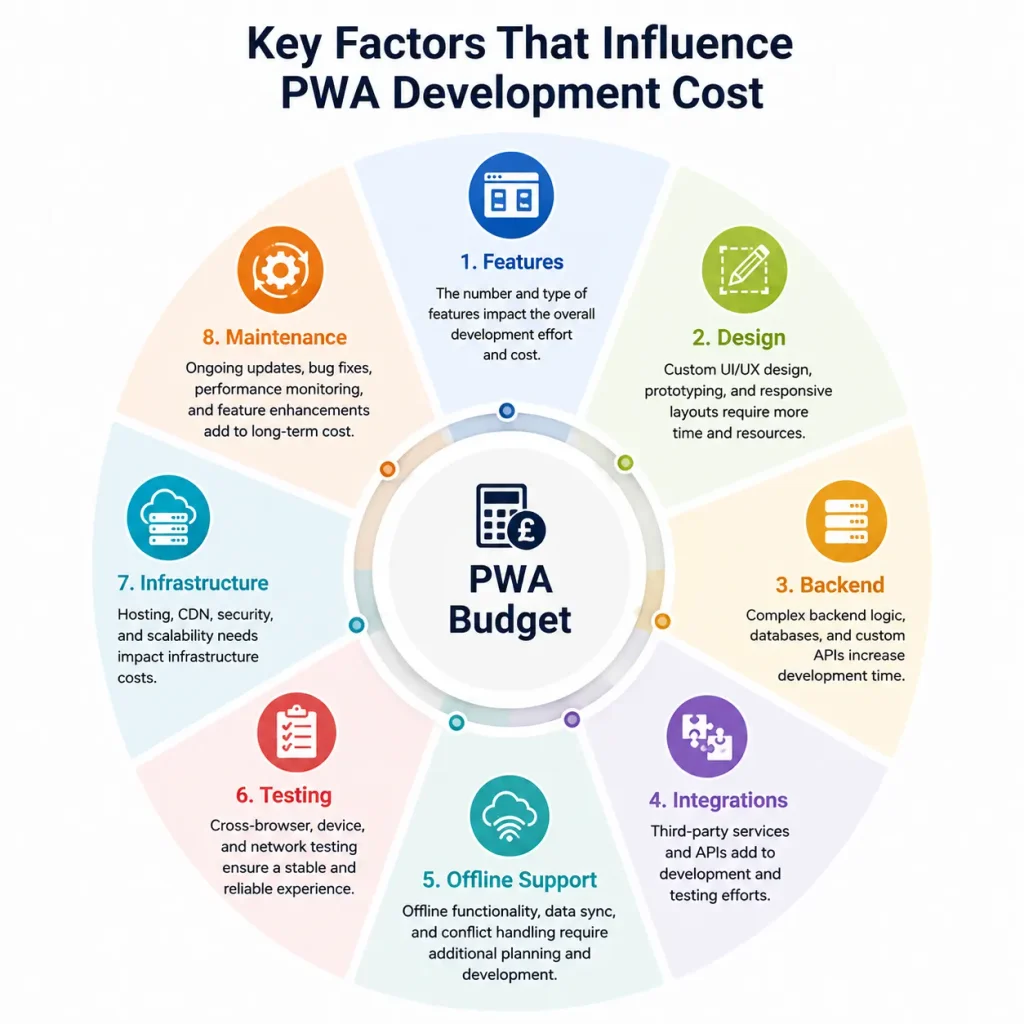
Several elements influence the final budget. Looking only at the number of screens can produce an unrealistic estimate because technical requirements often create much more work behind the interface.
1. Features and Functional Requirements
The number and type of app development features directly affect the budget. User registration, profiles, dashboards, payments, search, booking systems, messaging, analytics, and personalised experiences all require different levels of engineering.
Simple content delivery requires less work than an application involving complex workflows. Businesses should therefore define the essential user journey before requesting a quote.
2. UI/UX Design
Good UI/UX design requires more than attractive screens. Designers need to understand user journeys, navigation, accessibility, responsive layouts, and interactions across different screen sizes. A ready-made interface can reduce initial design hours. A highly customised experience requires more research, prototyping, testing, and refinement.
3. Backend and Third-Party Integrations
A PWA may need connections with payment gateways, CRMs, maps, analytics tools, inventory systems, authentication services, or other platforms. These third-party integrations can increase development and testing requirements.
A project with an existing API infrastructure may cost less than one requiring a completely new backend. Custom databases, business rules, authentication, and complex synchronisation can significantly expand the scope.
4. Offline Requirements
Offline support is not simply a checkbox. Developers must decide what users can view, create, edit, or submit without an internet connection. Basic caching is relatively straightforward. Offline transactions, background synchronisation, conflict handling, and data recovery require more careful engineering. This is one reason development complexity can vary sharply between seemingly similar projects.
5. Team Expertise and Development Location
The team you choose has a direct effect on the budget. Freelancers may suit focused projects, while agencies can provide design, development, testing, project management, and support under one team.
Businesses can also hire application development company teams when they need broader technical expertise. The important factor is not simply the hourly rate. Experience with offline architecture, performance, security, and integrations can prevent expensive rework later.
6. Testing, Infrastructure, and Ongoing Costs
Quality work continues beyond writing code. Testing and quality assurance should cover browsers, devices, screen sizes, network conditions, performance, security, and important user journeys. You should also account for hosting and infrastructure, domain services, monitoring, third-party subscriptions, security updates, and future improvements.
Ongoing maintenance and support help keep the product compatible with browser changes and evolving business requirements.
How Much Does PWA Development Cost?
The PWA development cost varies widely because the term covers everything from a lightweight installable website to a large enterprise application.
For 2026 planning, a simple PWA may fall around $5,000 – $15,000. A mid-complexity application with accounts, dynamic content, integrations, and notifications may range from $15,000 – $45,000. Complex commerce or enterprise products can reach $45,000 – $120,000+ depending on requirements. Recent 2026 estimates show similarly broad ranges, with enterprise projects extending beyond $100,000.
| PWA Type | Typical Cost Range | Suitable For |
|---|---|---|
| Basic PWA | $5,000 – $15,000 | Content, simple services, basic portals |
| Mid-level PWA | $15,000 – $45,000 | eCommerce, booking, customer platforms |
| Complex PWA | $45,000 – $120,000+ | Enterprise systems and advanced platforms |
The progressive web app cost can also change based on team location. Current industry estimates commonly show lower hourly rates in South Asia than in North America or Western Europe.
For businesses comparing proposals, focus on the work included rather than comparing the headline number alone. A lower quote may exclude testing, backend work, documentation, deployment, or post-launch assistance.
The cost of developing a progressive web app also depends on whether you are upgrading an existing website or starting from scratch. An existing system with usable APIs can reduce development work considerably.
A leading PWA development company can help establish the scope, technical architecture, milestones, and realistic budget before development begins. Experienced progressive web app developers can also identify technical risks early.
Businesses seeking more control can consider custom PWA development when standard templates cannot meet their product requirements. This approach generally requires more planning but provides greater flexibility.
For companies already working with an internal engineering team, adding dedicated developers can help increase delivery capacity without rebuilding the entire team.
The progressive web app development pricing model may be fixed-price, hourly, or milestone-based. Fixed pricing works well when requirements are stable. Milestone pricing can work better when the product needs discovery and phased development.
Tips for Minimising PWA Development Costs
Start with a focused product scope. Identify the features users genuinely need during the first release. Avoid spending heavily on secondary functionality before validating the core product.
Use an existing backend when it is reliable and secure. Reusing suitable APIs can reduce engineering time and avoid unnecessary infrastructure work.
Prioritise the user journey rather than designing every possible screen. A clean experience with fewer meaningful features can create more value than a large application with complicated navigation.
Plan integrations early. Payment gateways, CRM systems, analytics platforms, and external APIs can affect architecture. Discovering these requirements late can cause expensive changes.
Choose a team with relevant experience instead of selecting solely on price. Skilled developers can often prevent technical mistakes that create additional costs during testing and maintenance.
Control the development time through clear milestones. Define requirements, acceptance criteria, responsibilities, and testing expectations before each phase begins.
Finally, plan maintenance from the beginning. A realistic budget should include security updates, browser compatibility checks, monitoring, bug fixes, and future feature improvements.
Conclusion
A PWA can provide a practical middle ground between a traditional website and separate native applications. Its single-codebase approach can reduce duplicated development work while supporting installable, responsive, and engaging digital experiences.
However, businesses should not treat a fixed price as the main decision factor. The right budget depends on features, user expectations, technical architecture, integrations, testing, and long-term product plans.
Understanding the progressive web app development scope early makes it easier to control spending and avoid unnecessary features. A well-planned PWA can deliver strong reach while keeping development and maintenance manageable.