


Building a successful fitness app requires more than offering workout videos and tracking daily activity. Businesses need a clear value proposition, useful features, and a payment experience that encourages long-term use. Fitness app development should focus on helping users achieve measurable goals while giving them reasons to return.
A well-planned subscription-based fitness app combines personalised training, progress tracking, expert guidance, and flexible pricing. However, recurring payments depend on more than the initial download. Users must continue seeing value throughout their membership.
This guide explains how to plan, build, monetise, and improve a fitness application that supports sustainable growth and recurring revenue.
Why Build a Subscription-Based Fitness App?
The fitness market offers opportunities for businesses that can solve specific user needs. People increasingly use digital tools to access workouts, monitor progress, and receive coaching outside traditional gyms.
A subscription creates an ongoing relationship between the business and its users. Instead of relying only on one-time purchases, businesses can offer continuous access to training programmes, new content, and additional services.
A well-designed fitness app subscription model can provide several business advantages:
- Predictable income: Regular payments help businesses forecast revenue and plan future investment.
- Long-term customer relationships: Continuous programmes give users reasons to stay connected.
- Flexible service delivery: Businesses can serve users across locations and fitness levels.
- Expandable offerings: New workouts, coaching plans, and nutrition resources can add value.
- Performance insights: Usage data helps teams understand customer preferences and improve services.
However, subscriptions work only when users receive ongoing value. A large workout library alone may not justify monthly payments. Businesses need relevant content, clear progress indicators, and regular improvements.
Essential Fitness App Features That Keep Users Engaged
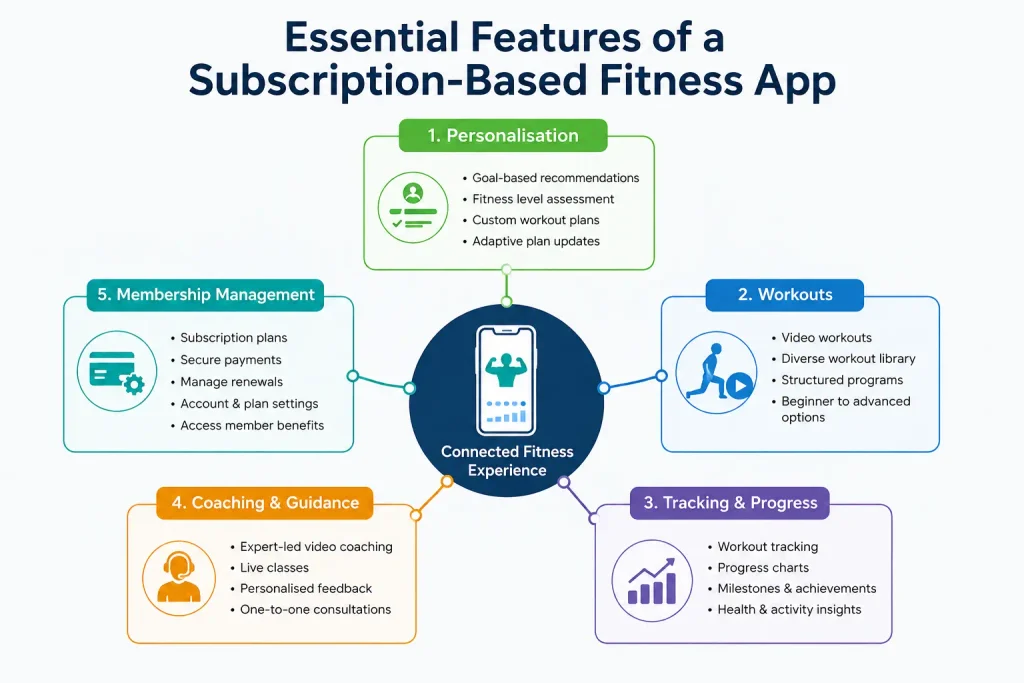
The right fitness app features should support a complete fitness journey. Users need tools that help them start confidently, follow routines, measure results, and maintain motivation.
1. Personalised workout plans
Users have different goals, experience levels, schedules, and physical abilities. Offer plans for weight management, strength training, flexibility, endurance, and general fitness. Let users select their goals and preferred training frequency during setup. Use these details to recommend suitable routines. Review their activity regularly and adjust recommendations when their needs change.
2. Workout tracking and progress monitoring
Reliable workout tracking helps users understand their activity. Record completed sessions, exercise duration, repetitions, weights, and other relevant measurements. Add fitness progress tracking through simple charts and milestone summaries. Users should quickly understand what they have achieved and where they can improve.
3. Video workouts and coaching guidance
Provide clear demonstrations, exercise instructions, and trainer-led sessions. A fitness coaching app may also offer live classes, coach feedback, or one-to-one consultations. Make videos easy to follow on different screen sizes. Include modifications for beginners and users with different fitness abilities.
4. Reminders and progress notifications
Well-timed push notifications can remind users about scheduled workouts, programme milestones, or new content. Avoid sending frequent promotional messages that interrupt daily routines.
5. Membership and account management
Users should be able to view their plan, update payment details, manage renewals, and access membership benefits. Keep subscription terms and billing dates easy to understand.
Step-by-Step Process for Subscription-Based Fitness App Development
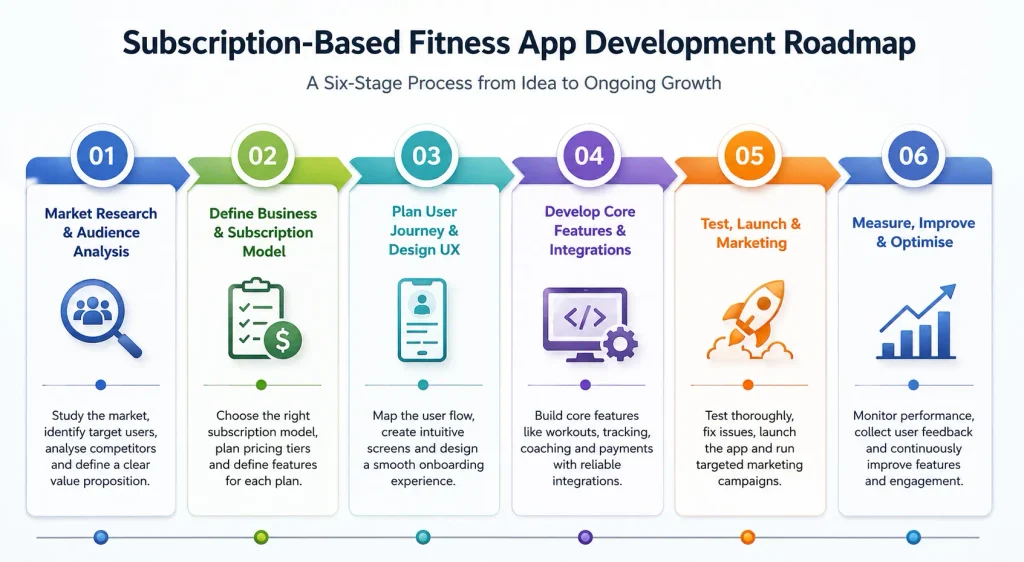
A structured process helps businesses control scope, manage costs, and build an application around real customer needs.
1. Research the market and define your audience
Start by identifying the users your application will serve. You might target beginners, home workout enthusiasts, athletes, busy professionals, or people seeking guided fitness programmes. Study competing apps, their pricing, content quality, reviews, and customer complaints. Look for gaps that your product can address.
Define a clear value proposition. For example, your app might offer short workouts for busy professionals or structured strength programmes for beginners.
2. Select the right business and subscription model
Choose how users will access your content and services. You could offer one membership tier or separate plans for different needs. Define what each subscription includes before designing the payment flow. Consider workout access, coaching sessions, premium programmes, nutrition guidance, and community features.
3. Plan the user journey and interface
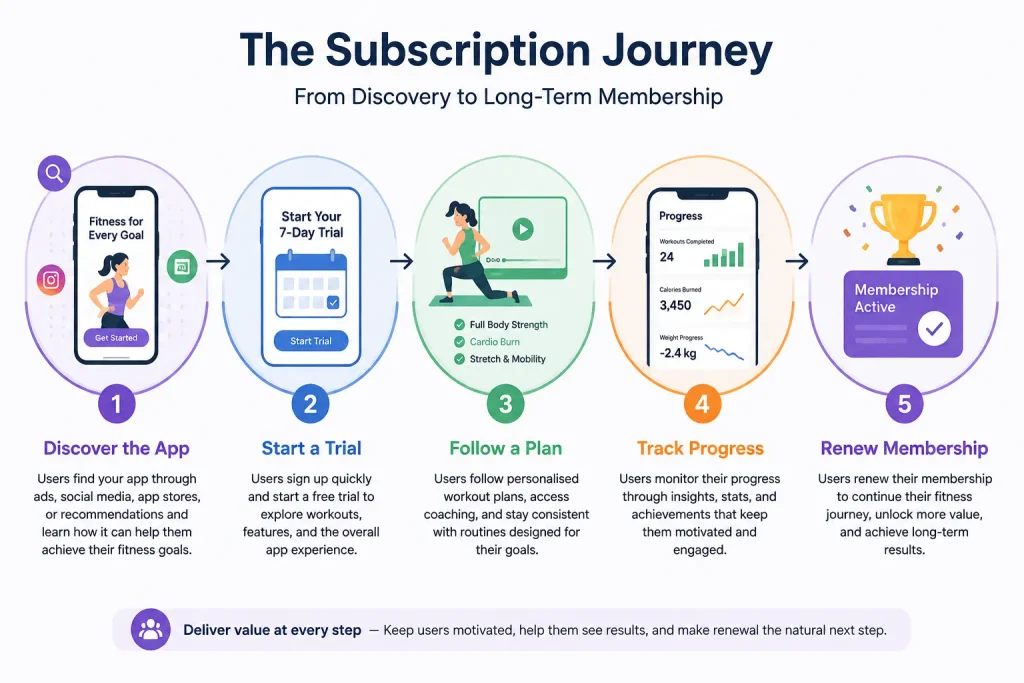
Map the experience from registration to renewal. Keep registration short and explain why each requested detail matters. A smooth user onboarding process should help users select goals, understand the app, and start their first workout quickly.
Avoid asking for unnecessary information before users experience the product’s value.
4. Choose the technology and development approach
Select technologies based on your feature requirements, budget, integrations, and expected user volume. Consider native iOS and Android app development or a cross-platform approach. Plan the backend, content management system, database, analytics, and payment infrastructure. Also consider integrations with wearable devices and health platforms where relevant.
5. Build, test, and launch the application
Develop the core experience before adding advanced features. Test registration, workout playback, progress records, payments, and membership access. Check performance across different devices and network conditions. Review accessibility, privacy controls, and account security before launch.
6. Improve the product after launch
Collect feedback and monitor how users interact with the application. Fix confusing journeys and improve features that customers use regularly. Effective subscription-based fitness app development continues after release. Regular content updates, product improvements, and customer support help maintain membership value.
How to Monetise a Fitness App and Generate Recurring Revenue
A strong fitness app monetisation strategy connects pricing with the value users receive. Avoid charging for features that users expect from a basic fitness tracker. Instead, reserve paid access for services that provide clear, ongoing benefits.
1. Choose a suitable subscription structure
A freemium approach lets users explore basic features before upgrading. Premium members can access advanced training programmes, coaching, exclusive classes, or detailed progress reports. You can offer monthly subscription plans for flexibility and annual subscription plans for users who prefer long-term access. Annual plans may encourage commitment, but explain the total charge clearly.
2. Set prices around customer value
Your fitness app subscription pricing should reflect content quality, coaching costs, competitor prices, and the needs of your audience.
Consider offering three levels:
- Free: Basic workouts, limited tracking, and introductory content.
- Premium: Complete workout libraries, progress insights, and personalised programmes.
- Advanced: Expert coaching, live sessions, or specialist training plans.
Test pricing with real users instead of relying on assumptions. Monitor upgrades, renewals, and cancellations after each pricing change.
3. Make payment and renewal simple
Reliable subscription billing should handle renewals, failed payments, plan changes, and cancellations. Use secure payment services and explain billing terms before purchase.
For iOS applications, Apple provides StoreKit for auto-renewable subscriptions. Its guidelines require ongoing value and clear subscription information. They also require users to understand the price and duration before subscribing.
4. Use trials and additional purchases carefully
A free trial can help users experience premium features before paying. Track free trial conversion to understand how many trial users become paying members. You can also offer in-app purchases for individual programmes, specialist plans, or one-time coaching sessions. Keep these options separate from core membership benefits.
A sustainable fitness app business model should make the subscription valuable on its own. Additional purchases should complement membership rather than make the main experience feel incomplete.
How Much Does Fitness App Development Cost?
The fitness app development cost depends on the features, platforms, integrations, and complexity of the product. A basic workout library costs less than a platform with live coaching, wearable connectivity, and advanced personalisation.
For 2026 planning, published estimates vary considerably. Clutch reports that many mobile app projects fall within the $10,000 – $49,999 range, with typical development rates of $25 – $49 per hour. Fitness-specific estimates can be higher when projects include video, subscriptions, and integrations.
The following ranges provide practical early-stage budget guidance, not fixed quotations.
| App complexity | Indicative development budget | Typical scope |
|---|---|---|
| Basic MVP | $25,000 – $50,000 | Profiles, workout library, basic tracking, and subscriptions |
| Mid-level app | $50,000 – $120,000 | Personalised plans, video workouts, analytics, and integrations |
| Advanced platform | $120,000 – $250,000+ | Live coaching, wearable connectivity, advanced analytics, and multiple user roles |
Actual quotes depend on the development team’s location, experience, and delivery approach. A detailed discovery phase can help turn these ranges into a realistic project estimate.
What affects the development budget?
- Platform choice: Building separate native apps may require more resources than a suitable cross-platform approach.
- Backend infrastructure: User accounts, workout data, content delivery, and membership management require reliable services.
- Video and live streaming: Hosting, encoding, storage, and streaming can increase both development and operating costs.
- Third-party integrations: Wearables, health platforms, and payment services require additional development and testing.
- Security and maintenance: Updates, monitoring, bug fixes, and infrastructure management continue after launch.
Do not spend the entire budget on the first release. Reserve funds for maintenance, content production, customer support, and product improvements.
Explore more: How much does it cost to build a fitness app?
How Fitness App Analytics Helps Optimise Subscription Performance
Launching the app is only the beginning. Businesses need to understand which features users value, where they lose interest, and why memberships end. A reliable fitness app analytics setup connects product activity with subscription performance.
Start with these key measurements:
- Activation rate: The percentage of new users who complete important first steps.
- Workout completion: How often users finish the sessions they start.
- Retention rate: How many users return after their first day, week, or month.
- Churn rate: The percentage of paying subscribers who cancel during a defined period.
- Customer lifetime value (LTV): The estimated revenue a customer generates throughout their relationship with the business.
- Conversion rate: The percentage of free users or trial members who purchase a subscription.
These metrics reveal more than download numbers. For example, high downloads with low activation may indicate confusing onboarding. Strong trial activity with weak renewals may suggest that premium benefits need improvement.
Track fitness app user retention alongside workout activity and membership status. This helps teams identify whether users stop exercising before they cancel. Build an app engagement strategy around useful reminders, fresh programmes, achievable milestones, and relevant recommendations. Focus on meaningful user engagement, not notification volume.
Personalisation can also strengthen customer retention. A personalised fitness experience might recommend shorter sessions when users have limited time or suggest new programmes after they complete a training plan.
The aim is to improve the fitness app revenue model through better service, not aggressive renewal prompts.
How to Choose the Right Fitness App Development Company
The right development partner should understand fitness workflows and subscription products. Technical experience matters, but so does the ability to translate business goals into a usable application.
Evaluate potential partners against these points:
- Relevant experience: Review their work on fitness, wellness, coaching, or subscription-based applications.
- Product planning: Check whether they can help define the MVP, user journeys, and feature priorities.
- Technical capabilities: Ask about mobile development, backend systems, integrations, analytics, and payment implementation.
- Security practices: Discuss data protection, access controls, secure storage, and testing procedures.
- Post-launch support: Confirm how they handle updates, bug fixes, performance monitoring, and future improvements.
Ask prospective teams to explain how they would approach your specific product. Their answers should address user needs, technical risks, delivery stages, and ongoing costs.
A capable fitness app development company should also help you avoid unnecessary features during the first release. Prioritise the core experience, test it with users, and expand based on evidence. Before signing an agreement, clarify ownership of source code, project documentation, third-party accounts, and ongoing support responsibilities.
Explore more: Best fitness app development company
Final Thoughts
A successful subscription-based fitness app needs more than an attractive interface or a large workout library. It must help users build habits, track improvements, and access meaningful guidance.
Start with a focused product, choose a pricing structure that reflects its value, and make membership management straightforward. Use customer feedback and performance data to improve the experience over time. With the right strategy, fitness app development can support a sustainable business built around long-term customer relationships and recurring income.