


After working with hundreds of enterprise teams on AI automation, one pattern is clear that the vendor you choose determines your outcome more than the technology itself. Here is a truth that most AI agent development companies will not say to your face: 90% of AI agent projects that fail do so because of the partner not the technology.
Choosing the right AI agent development partner is therefore one of the highest-leverage decisions your technology leadership will make this decade.
In reality, the models are powerful. The infrastructure exists. The use cases are proven. What doesn’t exist in most vendor relationships is the kind of engineering discipline, product thinking, and honest communication that complex agentic deployments actually demand.
At IIH Global, we have been embedded in enterprise AI implementations since before “AI agent” became a buzzword. We have seen what works in the boardroom and what falls apart six weeks after go-live. This guide isn’t about theory, it’s about the real selection criteria that separate transformative deployments from expensive regrets.
“The right AI agent partner doesn’t just build what you ask for. They challenge what you’ve asked for because they’ve seen where that path leads.”
Why Choosing an AI Agent Development Company Is Harder Than It Looks
Most digital transformation decisions follow a familiar pattern: evaluate vendors on portfolio, price, timeline, and cultural fit. AI agent development breaks that model entirely.
The reason is architectural. AI agents are not software in the traditional sense infact they are decision-making systems. They observe context, plan across multiple steps, use tools, and take actions with real-world consequences: sending emails, triggering workflows, modifying databases, interacting with customers. For instance, a bug in a conventional application fails gracefully. A poorly designed AI agent can fail forward confidently executing the wrong thing at scale.
As a result, this changes what ‘qualified AI agent development company’ means. You’re not hiring someone to write clean code to spec. You’re hiring someone to co-design a system that will operate autonomously inside your business. That requires:
- Deep expertise in LLM reasoning, tool use, and agent memory architectures
- Experience with failure modes unique to agentic systems (hallucination chains, tool misuse, context window limits)
- Honest scoping which is the ability to say “this should not be an agent” when appropriate
- Post-deployment observability and governance practices
What “Qualified” Actually Means in This Context
The AI consulting market has filled with generalists who’ve fine-tuned one model and now sell “AI agent development.” The difference between a genuine partner and a well-marketed generalist becomes painfully obvious at week eight of deployment, not during the sales process. Before engaging any vendor, it is worth starting with a structured AI Consulting Services engagement to define your agent strategy, success criteria, and risk tolerance before a single line of code is written
The 6 Real Mistakes Businesses Make When Selecting an AI Agent Partner
These aren’t hypothetical pitfalls. They are patterns we observe repeatedly across enterprise AI initiatives from mid-market companies to global organizations.
- Optimising for demo quality, not deployment reality
A demo is a controlled narrative. It shows the happy path. What you need to evaluate is what happens at the edge: unexpected inputs, tool failures, API rate limits, malformed outputs. Ask every candidate partner to demo a failure recovery scenario not just the feature highlights.
- Confusing chatbot experience with agent expertise
In practice, building a customer service chatbot and engineering a multi-step autonomous agent that modifies ERP records are fundamentally different disciplines. Many vendors have shipped the former and are pitching the latter. Ask for architecture diagrams of past agent deployments and specifically multi-agent systems with tool integration.
- Treating AI agent selection like an off-the-shelf software purchase
RFPs designed for ERP vendors do not work for AI agent partners. Static functional requirements miss the entire point. AI agents require iterative co-design. A partner who responds to an RFP with a fixed-scope proposal is telling you they don’t understand the problem. Unlike standard AI Integration Services where requirements can be defined upfront agent development actually demands a collaborative, evolving build process where both sides adapt as the system learns.
- Ignoring data governance and model ownership clauses
Who owns the fine-tuned model weights? Who retains your training data? What happens to your proprietary business context if you switch vendors? These questions are often buried in contracts and almost never raised in sales conversations. They should be your first legal checkpoint, not your last.
- Underweighting observability and monitoring capabilities
Moreover, an AI agent operating in production without monitoring is a liability. Ask specifically: How do you log agent reasoning traces? What does your human-in-the-loop intervention process look like? How do you detect and respond to model drift? Vague answers here predict post-launch problems with precision.
- Selecting based on brand recognition rather than domain relevance
A tier-one consulting firm with no healthcare AI deployments is a worse choice for a hospital system than a focused specialist who has shipped six production agents in clinical workflows. Domain knowledge compounds with AI capability which is the intersection is where real expertise lives.
The IIH Global 5-Pillar Framework for Evaluating AI Agent Partners
Based on our experience in delivering AI agent solutions across industries, we’ve distilled partner evaluation into five non-negotiable pillars. Use these in every vendor conversation they will surface signal that standard procurement processes miss entirely.
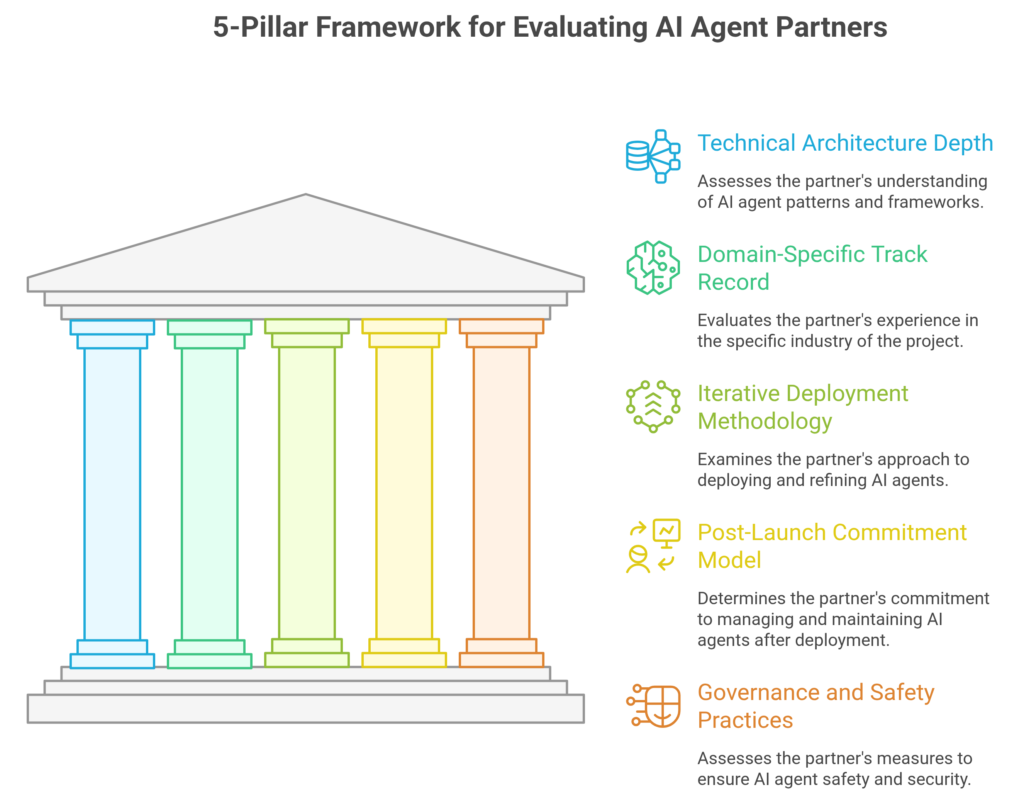
- Technical Architecture Depth
Can they articulate the difference between ReAct, Plan-and-Execute, and multi-agent supervisor patterns? Do they have genuine experience with LangGraph, AutoGen, or custom orchestration frameworks? This conversation reveals whether you’re speaking to engineers or salespeople.
2. Domain-Specific Track Record
Not just AI experience but experience in your domain. An agent for financial compliance has completely different risk profiles than one for marketing automation. Ask for reference clients in adjacent industries and run detailed reference checks.
3. Iterative Deployment Methodology
The best AI agent partners work in short loops: deploy narrow, measure, expand. Avoid any partner who proposes a six-month build before a single production touchpoint. The right methodology assumes the requirements will change because with AI agents, they always do.
4. Post-Launch Commitment Model
Who owns the agent after go-live? Is there a dedicated team, or does the project roll off to a generic support queue? Model performance degrades over time without active management. The post-launch model is as important as the build methodology.
5. Governance and Safety Practices
How do they handle prompt injection attacks as per documented and growing risk catalogued in the OWASP LLM Top 10? What mechanisms exist to prevent agents from taking irreversible destructive actions? And does their design account for human override at scale? A partner without clear answers here should not be trusted with autonomous systems.
The one question to ask in every conversation
After any formal evaluation process, ask this: “Tell me about a project that went wrong, what happened, and what did you do?”
Importantly, partners who’ve shipped real systems have failure stories. They are proud of how they recovered. Partners who haven’t shipped anything real will give you a vague, sanitised answer about “lessons learned” because they have no actual battlefield experience to draw from.
The AI agent development market needs a reckoning on what “experience” means. Proof-of-concept experience and production deployment experience are not the same thing. Businesses must demand the latter specifically, agents operating in production with real consequences, not sandbox experiments.
Actionable Takeaways: Your 7-Step Partner Selection Process
Use this process in sequence. Skipping steps, especially in the early stages, is how expensive mistakes get made.
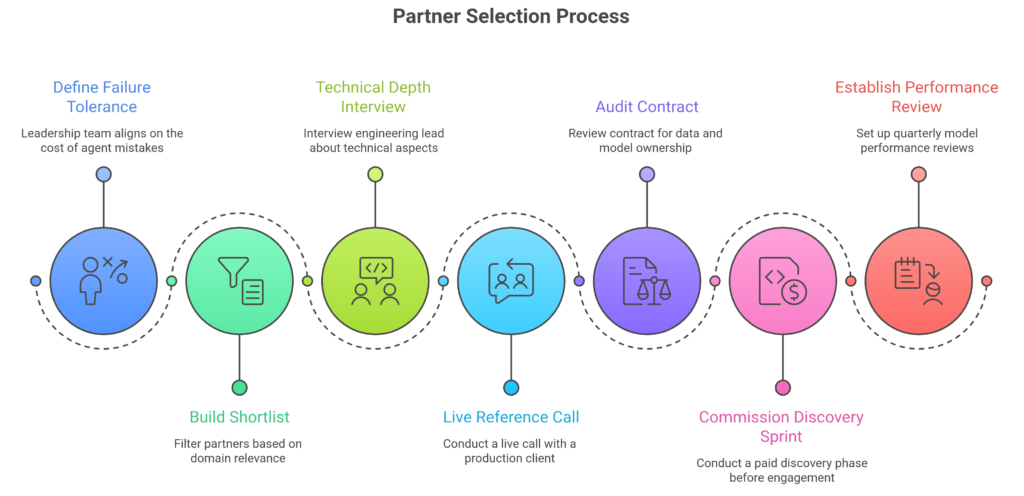
Step 1: Define your failure tolerance first.
Before briefing any vendors, your leadership team must align on: what does an agent mistake cost us? This shapes every architectural and partner decision that follows.
Step 2: Build a shortlist based on domain relevance, not size.
Filter for partners with verifiable production deployments in your industry or in analogous high-stakes environments.
Step 3: Run a technical depth interview with their engineering lead.
Not the sales team. Ask about agent orchestration patterns, failure handling, and how they instrument production systems. The answers will tell you everything.
Step 4: Request a live reference call with a production client.
Not a written case study. A live call where you can ask the hard questions directly.
Step 5: Audit the contract for data and model ownership clauses.
Your legal team must review: training data rights, model weight ownership, and exit provisions before any commercial discussion progresses.
Step 6: Commission a paid discovery sprint before a full engagement.
Any partner worth working with will agree to a bounded, paid discovery phase. It surfaces competence, collaboration style, and hidden complexity before you’re locked in.
Step 7: Establish a quarterly model performance review in your contract.
AI agents degrade. Build the expectation of ongoing measurement and improvement into the engagement structure from day one.
The Bottom Line
Choosing the right AI agent development partner is one of the highest-leverage decisions your technology leadership will make this decade. Ultimately, the economics of the decision are asymmetric: a great partner accelerates your AI roadmap by years, a poor one can set it back just as far while burning significant budget and organisational credibility in the process.
The framework in this guide is not exhaustive. Of course, every organisation has unique risk profiles, technology landscapes, and strategic priorities that should shape the evaluation. But the core principles are universal: prioritise domain-relevant production experience, evaluate technical depth with engineers (not salespeople), build governance into the contract before you sign, and never skip the paid discovery phase.
If you are still early in defining your AI direction, exploring Generative AI Development capabilities alongside agent architecture will give your team the foundational context needed to ask the right questions of any partner you evaluate.t before you sign, and never skip the paid discovery phase.
Read More: Investing in Generative AI for Pharmacy – Key Areas and Benefits
“The best AI agent partnerships we’ve seen share one trait: both sides treated the first project as a long-term relationship stress test, not a one-time transaction.”
Meanwhile, the AI agent landscape is moving fast. However, the window to deploy these capabilities these capabilities ahead of your competition is real. But rushing the partner selection process to capture that window is the one mistake you cannot afford to make.