


The cost of logistics app development depends on many factors, including features, platform, technology, and project complexity. Businesses now invest in digital logistics solutions to improve delivery speed, reduce operational costs, and increase customer satisfaction. Understanding the logistics app development cost helps companies plan realistic budgets while avoiding unexpected expenses.
The global logistics industry continues to embrace digital transformation. Modern applications simplify transportation, warehouse operations, and supply chain management. Companies using digital logistics platforms often reduce manual work, improve delivery accuracy, and gain better visibility across operations.
Whether you manage a startup or an established logistics company, knowing where your budget goes helps you make smarter investment decisions. This guide explains pricing, development stages, essential features, and practical cost-saving strategies in simple language.
Understanding the Basics of Logistics Apps
A logistics application connects businesses, drivers, warehouse teams, and customers through one digital platform. It automates everyday operations while providing complete shipment visibility.
Today, logistics app development supports industries such as eCommerce, retail, manufacturing, healthcare, and transportation. Businesses rely on mobile solutions to monitor deliveries, assign drivers, manage warehouses, and improve communication.
Common logistics applications include:
- Fleet management systems
- Delivery management apps
- Warehouse solutions
- Freight platforms
- Inventory management systems
- Courier tracking applications
A modern on-demand logistics app allows customers to schedule deliveries instantly while businesses assign drivers automatically. These platforms reduce waiting times and improve customer experience. Many businesses also invest in logistics mobile app development because mobile access allows managers and drivers to stay connected anywhere. Mobile applications improve productivity by enabling instant updates and real-time communication.
Several technologies power modern logistics platforms. These include cloud computing, analytics, automation, location services, and mobile notifications. Businesses also use AI in logistics apps to predict delivery delays, estimate arrival times, and optimize vehicle utilization. Another growing trend is IOT in logistics, where smart sensors monitor vehicle conditions, cargo temperature, and equipment health. These devices help businesses reduce losses and improve shipment safety.
Companies also benefit from logistics automation, which reduces repetitive manual work and increases operational efficiency. Automation minimizes human errors while accelerating order processing. An important feature found in almost every logistics solution is real-time vehicle tracking. Managers can monitor drivers, improve dispatching, and respond quickly to unexpected route changes. Modern systems also rely heavily on route optimization, helping drivers choose faster paths while reducing fuel consumption and delivery delays.
As businesses expand, they require a scalable logistics application capable of handling growing users, vehicles, warehouses, and daily shipments without performance issues. Many organizations searching for digital transformation partners also evaluate a top logistics app development company UK because experienced providers often deliver industry-specific expertise and long-term technical support.
Explore now: Why your travel business needs a mobile app
Factors Affecting Cost of Logistics App Development
Several variables influence the final development budget. Understanding these factors affecting app development cost allows businesses to prioritize features without overspending.
1. Feature Complexity
Basic logistics applications cost significantly less than enterprise platforms.
Simple apps usually include:
- User registration
- Order placement
- Notifications
- Basic tracking
Advanced platforms often require:
- Driver allocation
- Warehouse management
- Analytics dashboard
- Automated dispatching
- Multi-admin controls
The more features you add, the higher the overall logistics app development cost becomes.
2. UI and User Experience
Good design improves usability and customer satisfaction. Professional logistics app UI/UX design requires wireframes, user journeys, interactive prototypes, and extensive testing. Although quality design increases initial investment, it reduces user frustration and improves long-term adoption.

3. Platform Selection
Developing Android, iOS, or both platforms directly affects the project budget. Businesses serving wider audiences often choose multiple platforms, while startups sometimes begin with a single operating system before expanding later.
4. Backend Infrastructure
Logistics platforms process thousands of shipments every day. The backend handles user accounts, deliveries, warehouse records, payments, notifications, and reporting. A stronger infrastructure increases development effort but improves reliability.
5. System Integrations
Modern logistics platforms rarely operate independently. Developers often integrate payment gateways, communication tools, maps, analytics platforms, ERP software, and shipping services.
Reliable shipment tracking app functionality also depends on accurate mapping services and live location updates. Later in the project, businesses frequently expand their platforms through on-demand app development solutions, allowing them to introduce additional services without rebuilding the entire application.
6. Security Requirements
Sensitive shipment data requires secure authentication, encrypted communication, and regular monitoring. Security implementation adds development effort but protects both businesses and customers.
7. Development Team
The experience level of developers significantly influences pricing. Many companies choose to hire dedicated mobile app developers because dedicated teams improve communication, reduce delays, and maintain consistent development quality throughout the project.
Several organizations also explore custom logistics app development services USA when they require enterprise-grade platforms designed around unique operational workflows instead of generic software.
Cost Breakdown of Logistics App Development
The total logistics app development cost depends on application size and business requirements.
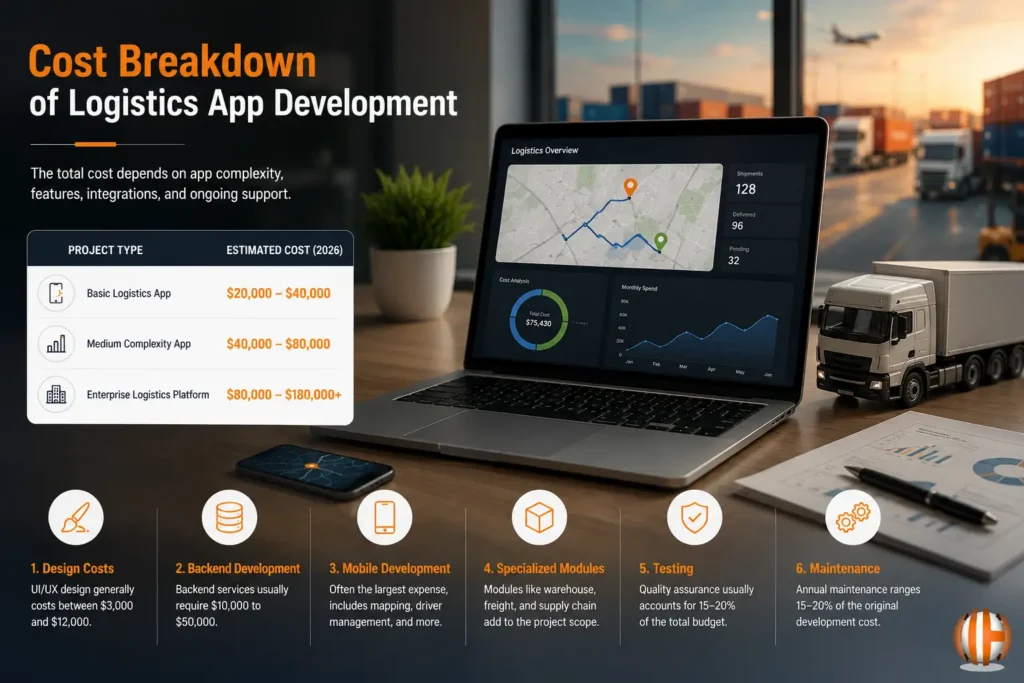
Below are typical market estimates for 2026.
| Project Type | Estimated Cost |
|---|---|
| Basic logistics app | $20,000 – $40,000 |
| Medium complexity app | $40,000 – $80,000 |
| Enterprise logistics platform | $80,000 – $180,000+ |
1. Design Costs
UI/UX design generally costs between $3,000 and $12,000, depending on screen count and design complexity.
2. Backend Development
Backend services usually require $10,000 to $50,000, depending on infrastructure, APIs, databases, and security.
3. Mobile Development
Mobile application development often represents the largest project expense. Businesses comparing the transportation app development cost usually find similar pricing because both solutions require mapping, driver management, notifications, and reporting features.
Likewise, the delivery app development cost depends heavily on tracking capabilities, user roles, payment systems, and administrative dashboards.
4. Specialized Logistics Modules
Enterprise businesses frequently require dedicated operational modules.
Examples include:
- Warehouse management app development
- Freight management app development
- Supply chain app development
Each module increases project scope because developers create separate workflows, dashboards, reporting systems, and administrative controls.
5. Testing
Quality assurance typically represents around 15–20% of the overall budget. Comprehensive testing improves stability before launch.
6. Maintenance
Many companies underestimate app maintenance costs. Annual maintenance generally ranges between 15% and 20% of the original development budget. Regular updates include security improvements, bug fixes, operating system compatibility, and performance optimization.
Explore now: Travel app development cost guide
Tips to Reduce Logistics App Development Cost
Reducing costs does not always mean removing important features. Smart planning helps businesses maximize return on investment.
1. Start with an MVP
Build only essential functionality during the first release. Launch early, gather customer feedback, and improve the product gradually.
2. Prioritize Business Goals
Avoid adding unnecessary features simply because competitors have them. Every feature should solve a real business problem.
3. Build Custom Solutions Carefully
Choosing custom logistics app development makes sense when your workflows differ from standard logistics operations. Custom software requires a higher investment but often delivers better long-term efficiency.
4. Reuse Proven Technologies
Experienced development teams reuse secure components instead of rebuilding common features from scratch. This approach reduces costs without sacrificing quality.
5. Plan Development Properly
A structured logistics app development process reduces expensive revisions later. Proper planning includes requirement analysis, design, development, testing, deployment, and continuous improvement.
6. Invest in Future Scalability
Businesses should build flexible architectures from the beginning. Expanding existing infrastructure later usually costs less than rebuilding an outdated platform.
Conclusion
Understanding the cost of logistics app development helps businesses create realistic budgets while selecting the right technology strategy. Project costs vary depending on features, integrations, platforms, security, and scalability requirements.
A well-planned logistics application improves operational efficiency, reduces manual work, enhances customer satisfaction, and supports long-term business growth. Rather than focusing only on the lowest price, companies should evaluate overall value, development quality, and future scalability before investing.