


The healthcare industry has rapidly embraced digital transformation, and medicine delivery apps have become an essential part of modern patient care. Understanding the medicine delivery app development cost helps businesses plan budgets, prioritize features, and achieve faster returns. Whether you are considering medicine delivery app development for a startup or an established pharmacy, knowing where your investment goes prevents costly mistakes. From feature selection to compliance and technology, every decision influences the overall medicine delivery app development cost and long-term business success.
Patients now expect medicines to arrive at their doorstep with the same convenience as food or grocery deliveries. This growing demand has encouraged pharmacies, healthcare providers, and entrepreneurs to invest in digital solutions. A successful online medicine delivery app does much more than accept orders. It verifies prescriptions, manages inventory, tracks deliveries, supports secure payments, and protects sensitive health information.
However, development costs vary significantly depending on business goals, technical complexity, compliance requirements, and integrations. Understanding these variables helps organizations make informed investment decisions while delivering an excellent customer experience.

The Rise of On-Demand Medicine Delivery Apps
The global digital healthcare market continues to expand as consumers prefer faster and more convenient healthcare services. Mobile-first healthcare experiences have become a necessity rather than a luxury.
Today’s users expect instant prescription uploads, digital payments, real-time delivery tracking, and automated refill reminders. These expectations have accelerated demand for medicine ordering app development across healthcare businesses.
Healthcare providers also benefit from digital platforms. They improve operational efficiency, reduce manual work, increase customer retention, and generate valuable business insights through analytics. Many organizations are also combining virtual consultations with medicine fulfilment through a telemedicine and pharmacy app, creating a complete patient care ecosystem within one platform.
For entrepreneurs entering digital healthcare, choosing scalable architecture from the beginning creates long-term value. A future-ready medicine delivery platform supports additional services like subscriptions, loyalty programs, and AI-powered recommendations.
Factors Affecting the Cost of Medicine Delivery App Development
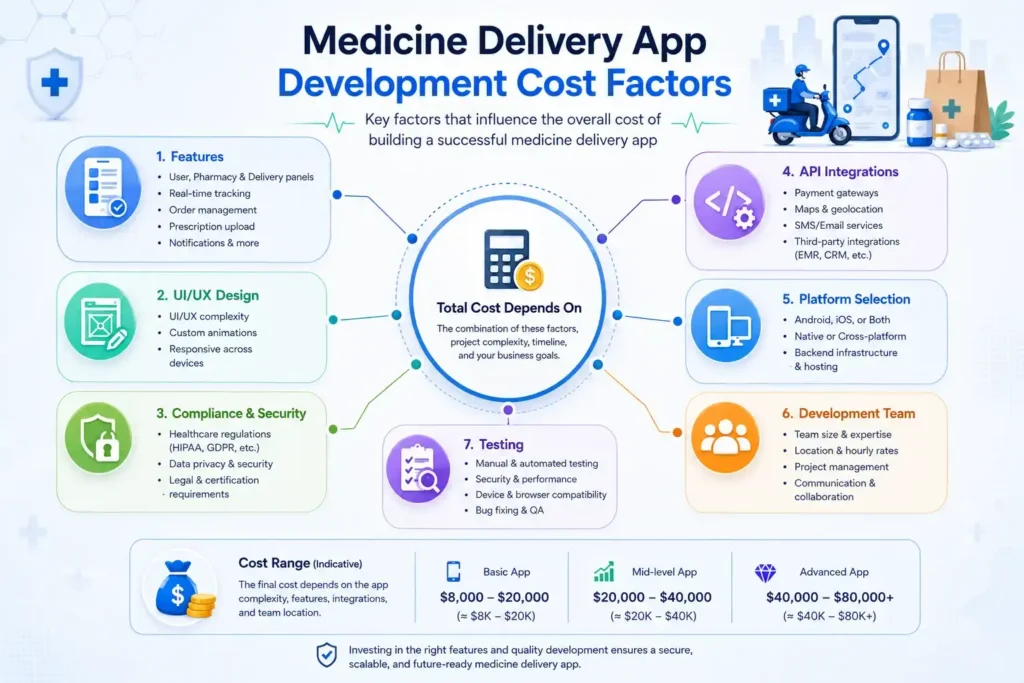
Several technical and business factors determine the final medicine delivery app development cost. Understanding them helps businesses allocate budgets wisely.
1. App complexity
Basic applications include medicine search, ordering, payments, and order tracking.
Advanced solutions may include:
- AI-powered medicine recommendations
- Smart prescription verification
- Multiple pharmacy integrations
- Subscription management
- Voice search
- Analytics dashboards
More advanced functionality naturally increases the cost to build a medicine delivery app.
2. Platform selection
Businesses typically choose:
- Android
- iOS
- Cross-platform
- Web administration panel
Cross-platform development often reduces initial investment while maintaining consistent performance across devices.
3. UI/UX design
Healthcare applications must remain simple for users of all ages. A clean interface reduces user frustration and improves order completion rates. Custom animations, accessibility improvements, and premium branding increase design effort.
4. Third-party integrations
Most applications integrate several external services, including:
- Payment gateways
- GPS tracking
- SMS notifications
- Video consultation
- Cloud storage
- Pharmacy databases
Every integration adds development and testing time.
5. Regulatory compliance
Healthcare applications manage highly sensitive medical information. Security measures such as encryption, secure authentication, audit logs, and consent management require additional engineering effort and influence the cost of healthcare app development.
6. Development partner
Selecting an experienced app development company significantly impacts project quality and long-term maintenance. Instead of focusing only on hourly rates, evaluate healthcare experience, compliance knowledge, and post-launch support capabilities.
Cost Breakdown of Medicine Delivery App Development
Although every project differs, current market pricing provides a practical benchmark.
| Development Stage | Estimated Cost (USD) |
|---|---|
| Business Analysis | $3,000–$8,000 |
| UI/UX Design | $5,000–$12,000 |
| Frontend Development | $10,000–$25,000 |
| Backend Development | $15,000–$40,000 |
| API Integrations | $5,000–$15,000 |
| Security & Compliance | $6,000–$20,000 |
| Quality Assurance | $5,000–$12,000 |
| Deployment | $2,000–$5,000 |
Overall, the typical medicine delivery app cost ranges between $35,000 and $180,000+, depending on complexity. For comparison, the average pharmacy app development cost remains similar for enterprise-grade platforms with advanced inventory and prescription management. Businesses planning an advanced epharmacy app development project should also budget for cloud infrastructure, analytics, monitoring tools, and customer support systems.
Many companies begin with an MVP before investing in enterprise features. This phased strategy improves market validation while controlling medicine delivery app pricing. Organizations seeking long-term scalability often evaluate the top medicine delivery app development company based on healthcare expertise, regulatory knowledge, and successful delivery history rather than hourly pricing alone.
Approximately one hundred words later, businesses expanding into North America frequently explore custom medicine delivery app development services to build region-specific healthcare solutions that align with local regulations and patient expectations.
Explore more: Telemedicine app development cost
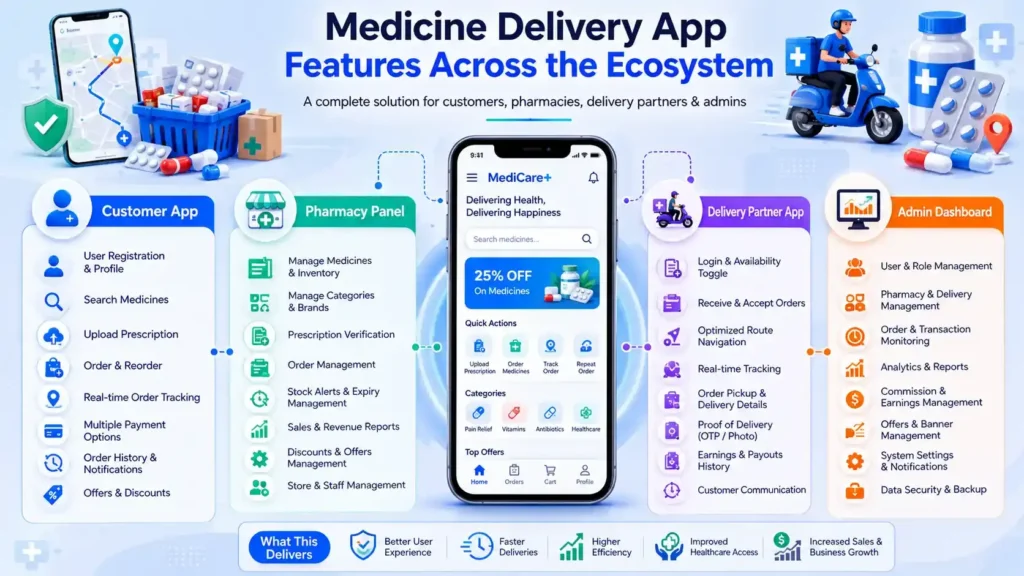
Essential Features for a Successful Medicine Delivery App
Modern healthcare applications require more than ordering functionality. They must deliver a seamless and secure experience.
1. Customer features
- User registration
- Medicine search
- Prescription upload
- Secure payments
- Live order tracking
- Delivery scheduling
- Push notifications
- Order history
- Ratings and reviews
2. Pharmacy panel
An integrated pharmacy management app enables pharmacists to:
- Manage inventory
- Verify prescriptions
- Update medicine availability
- Process refunds
- Track sales
3. Delivery dashboard
Delivery personnel require:
- Route optimization
- Order assignment
- Status updates
- Customer communication
4. Admin panel
Administrators should access:
- User management
- Pharmacy onboarding
- Revenue reports
- Delivery analytics
- Customer support
- Compliance monitoring
A scalable custom medicine delivery app also supports multilingual interfaces, loyalty rewards, coupon management, and marketing automation. Businesses investing in prescription app development should prioritize secure document handling, digital verification workflows, and encrypted patient records. An advanced epharmacy mobile app also benefits from AI-powered search, personalized recommendations, and automated refill reminders that improve customer retention.
Tips to Reduce Medicine Delivery App Development Cost
Reducing costs does not mean compromising quality. Strategic planning delivers better value.
1. Build an MVP first
Launch essential features before expanding functionality. This approach validates business ideas while minimizing initial investment.
2. Choose cross-platform development
Sharing a common codebase reduces development time and maintenance expenses.
3. Reuse trusted APIs
Instead of building every feature from scratch, integrate reliable services for:
- Payments
- Maps
- Notifications
- Authentication
4. Prioritize scalable architecture
Future expansion becomes easier when systems support modular upgrades. This strategy also lowers future online pharmacy app development costs because developers avoid rebuilding core infrastructure.
5. Partner with experienced developers
Many growing healthcare businesses hire offshore dedicated developers to access specialized expertise while managing budgets effectively. Experienced engineers understand compliance requirements, security standards, and scalable cloud architecture.
6. Follow an efficient development workflow
A structured pharmacy app development process minimizes rework through proper planning, design validation, continuous testing, and agile releases. Choosing a recognized health and fitness app development company also reduces project risks because experienced teams identify technical challenges before they become expensive problems.
Conclusion
Medicine delivery applications have become an essential investment for modern healthcare businesses. Development costs depend on features, compliance, integrations, platform selection, and technical expertise. Organizations that begin with a scalable MVP, prioritize security, and select experienced development partners achieve stronger long-term returns.
Whether you are building a startup solution or an enterprise healthcare ecosystem, careful planning helps maximize your investment in medicine delivery app development while delivering a reliable digital experience for patients and pharmacies alike.