


Understanding the mobile app development cost in the USA helps businesses plan realistic budgets and avoid expensive surprises. Whether you are launching a startup, scaling an existing business, or building an enterprise solution, knowing the mobile app development cost USA can improve your investment decisions from day one.
App development costs vary because every project has unique goals, features, technologies, and business requirements. A simple booking app costs far less than a healthcare or fintech platform with advanced security and AI features. The development team, design quality, integrations, and long-term maintenance also influence the final budget.
This guide explains the latest pricing trends, cost factors, hidden expenses, and practical ways to optimize your investment without sacrificing quality. It also provides realistic price ranges based on the current U.S. market.
Understanding the Average Cost of Mobile App Development
The mobile app development cost USA depends on project complexity, supported platforms, required integrations, and the experience of the development team.
A basic application with limited functionality generally costs between $20,000 and $50,000. Medium-complexity applications usually range from $50,000 to $120,000. Enterprise-grade platforms with advanced security, cloud infrastructure, AI, and third-party integrations often exceed $150,000 and can reach $300,000 or more.
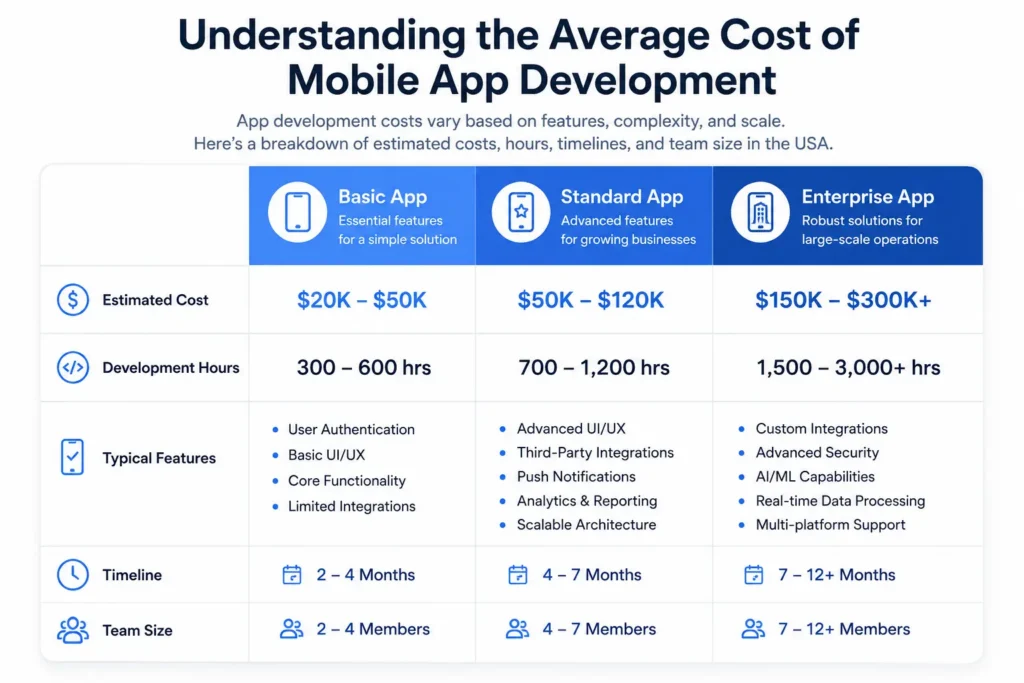
Many businesses ask, how much does it cost to develop a mobile app in the USA? The answer depends on the product scope rather than a fixed price. A food delivery app requires mapping services, payment gateways, and live tracking. A social networking application demands messaging, notifications, and media storage. Each additional capability increases development effort.
A reliable mobile application development pricing guide always considers both development hours and business objectives. Building only essential features first often delivers better returns than launching every planned feature at once. The cost to build a mobile app in the USA also depends on whether developers create separate native applications or use shared frameworks for multiple platforms.
Main Factors that Affect the Cost of Mobile App Development
1. App Complexity and Features
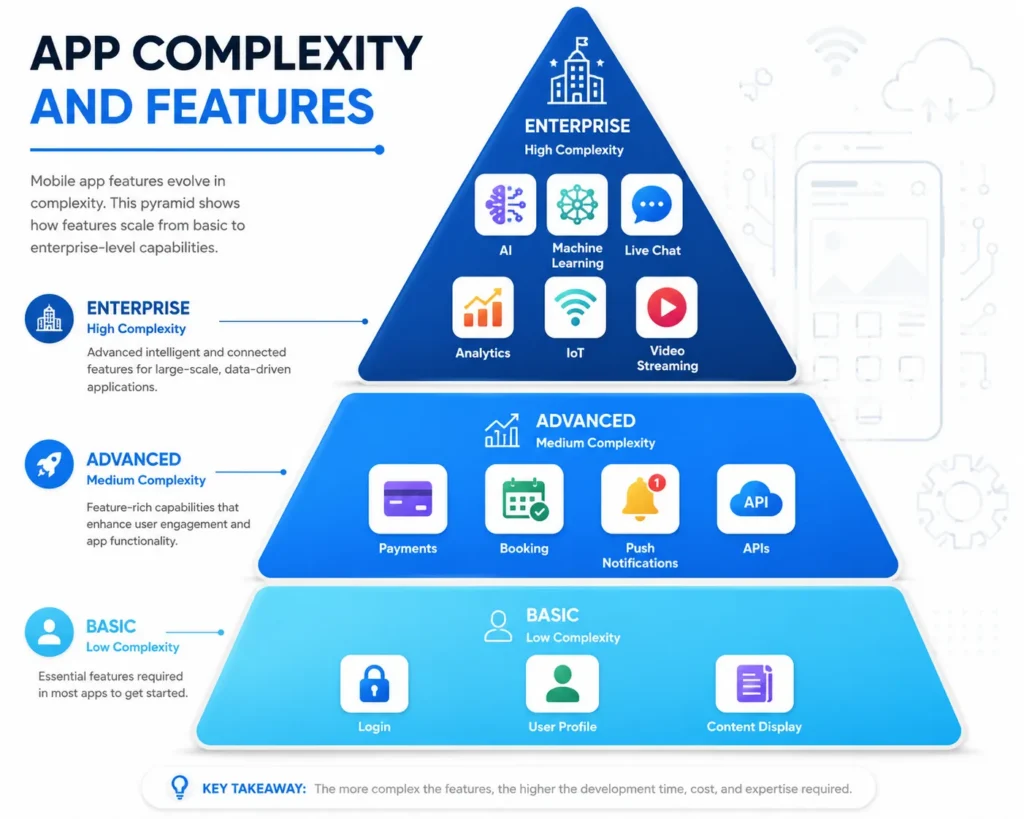
The biggest contributor to mobile app development cost is application complexity. Simple apps include user registration, profile management, and basic content display. Medium-level apps introduce payment gateways, booking systems, push notifications, and APIs. Advanced applications include AI recommendations, live chat, analytics dashboards, IoT connectivity, and machine learning.
These are the primary factors affecting mobile app development cost. Every new feature requires planning, coding, testing, and maintenance. Similarly, the features affecting app development cost include real-time messaging, offline support, GPS tracking, video streaming, biometric authentication, and admin dashboards. Businesses should prioritize features that provide immediate value rather than building everything before launch.
2. Platform Selection
Platform choice directly affects development expenses. The Android app development cost in the USA varies because developers must optimize applications for many screen sizes and hardware configurations.
The iOS app development cost in the USA often focuses on fewer device models, but Apple’s design standards and review process demand high-quality implementation. Choosing one platform first reduces upfront investment. Launching on both platforms increases reach but also raises the development budget.
3. Native or Cross-Platform Development
Another important decision involves native vs cross-platform app cost. Native development delivers maximum performance and deeper device integration. However, it usually requires two separate development teams.
The cross platform app development cost is often lower because developers share a single codebase across Android and iOS. Frameworks like Flutter and React Native reduce development time while maintaining excellent user experiences for many business applications. Companies should select the approach based on performance needs, future scalability, and available budget.
Explore more: iOS app development cost guide
4. UI/UX Design
Excellent design directly influences customer engagement and retention. A polished interface requires research, wireframes, prototypes, usability testing, and interactive design systems. These activities increase development effort but improve customer satisfaction. Businesses that invest in thoughtful user experiences often achieve better conversion rates and lower abandonment rates.
5. Backend Infrastructure
Modern mobile applications depend on powerful backend systems. The backend development cost includes databases, authentication systems, APIs, cloud storage, admin panels, analytics, and security implementation. Applications that synchronize data in real time or support thousands of users require stronger infrastructure. This increases both development and hosting expenses.
6. Development Team and Experience
Team expertise significantly impacts project pricing. Experienced developers solve technical challenges faster and deliver cleaner, maintainable code. Although senior teams charge higher rates, they often reduce long-term project risks.
The current app development hourly rates in the USA generally range from $80 to $200 per hour, depending on expertise, technology stack, and project complexity. Many businesses prefer to hire experienced dedicated developers in USA when building long-term products because dedicated teams provide consistent communication and faster delivery.
7. Business Requirements
Different business goals require different technical solutions. A simple MVP focuses on validating an idea quickly. Enterprise applications prioritize scalability, compliance, integrations, and advanced security.
The MVP app development cost usually falls between $20,000 and $60,000, depending on feature selection. Meanwhile, the startup app development cost remains lower when founders launch with only essential functionality before expanding.
Large organizations investing in enterprise mobile app development often require custom workflows, multiple user roles, and integration with existing software systems. Several businesses also partner with a top mobile app development company USA because experienced agencies offer strategic consulting alongside technical execution.
Explore more: How to choose the best mobile app development company
Additional Costs to Consider
Development is only one part of the overall investment. Businesses should also account for ongoing operational expenses after launch. The mobile app testing cost includes functional testing, automation, security validation, device compatibility, and performance optimization. Thorough testing reduces bugs and improves customer satisfaction.
The cloud hosting cost for apps depends on storage, user traffic, bandwidth, databases, and server resources. As user numbers increase, hosting expenses also grow. Another important expense involves app launch and maintenance costs. Publishing applications, monitoring performance, releasing updates, fixing bugs, and improving security all require continuous investment.
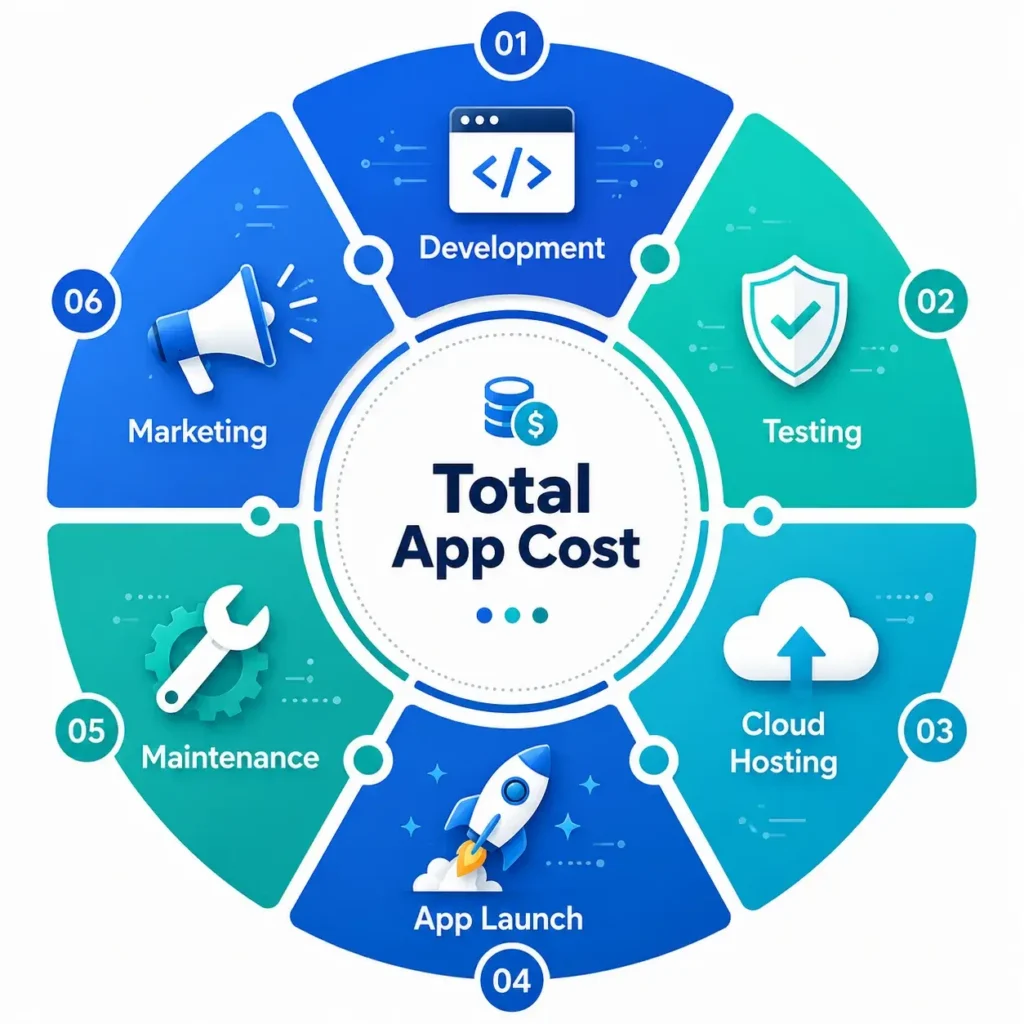
Marketing, analytics platforms, customer support tools, legal compliance, and third-party API subscriptions should also become part of the overall mobile app development budget. Businesses planning a realistic mobile app development estimate should always include these recurring operational expenses instead of focusing only on development.
Many organizations seeking the best mobile app development services USA evaluate long-term support packages alongside initial development pricing because ongoing maintenance influences total ownership costs.
Tips to Reduce App Development Costs
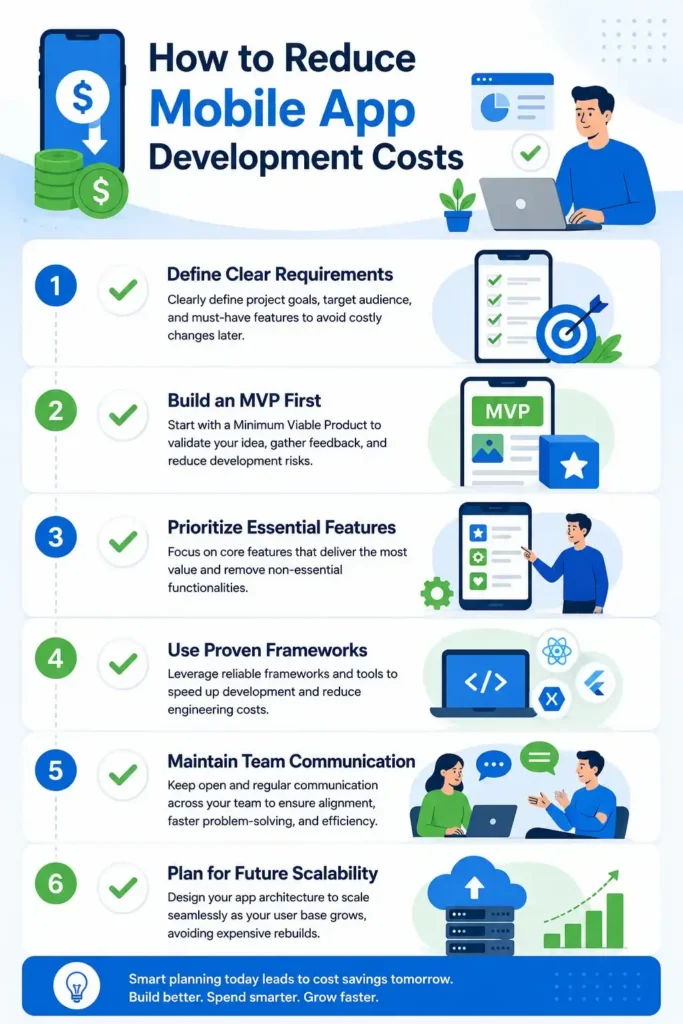
Reducing costs should never mean lowering quality. Instead, businesses should focus on smarter planning and efficient execution.
- Start with clear project requirements.
- Well-defined documentation reduces revisions and unnecessary development work.
- Launch an MVP before building advanced functionality.
- Early customer feedback helps validate ideas while controlling investment.
- Choose features that solve real business problems.
- Avoid unnecessary additions during the initial release.
- Reuse proven technologies whenever possible.
- Existing frameworks often reduce development time without affecting quality.
- Maintain regular communication with the development team.
- Faster decisions prevent delays and reduce expensive rework.
- Plan future scalability from the beginning.
- Small architectural improvements today often prevent costly redevelopment later.
- Finally, compare multiple proposals carefully, the lowest quotation rarely provides the best long-term value.
- Consider technical expertise, communication quality, portfolio, and post-launch support before selecting a development partner.
Explore more: Android app development cost guide
Conclusion
Understanding the mobile app development cost in the USA requires more than comparing price quotes. Businesses should evaluate technical complexity, platform selection, design quality, infrastructure, testing, and long-term maintenance before making investment decisions.
Every successful application begins with careful planning and realistic budgeting. While development costs vary widely, investing in experienced professionals usually delivers stronger security, better performance, and improved user satisfaction.
A thoughtful strategy also reduces future expenses by minimizing technical debt and avoiding unnecessary redevelopment. When evaluating your options, focus on overall business value instead of choosing the lowest quote. Taking this approach helps you manage the mobile app development cost USA while building a scalable product that supports long-term growth.