


The transportation industry has changed rapidly with digital technology. Today, taxi app development helps businesses offer faster, safer, and more convenient ride services. On-demand taxi app development allows passengers to book rides in minutes while drivers receive requests instantly. Companies, entrepreneurs, and fleet owners now invest in on-demand taxi app development to improve customer experience and create new revenue streams.
As smartphone usage grows, modern taxi platforms continue to replace traditional booking methods. Building the right solution requires careful planning, reliable technology, and a user-focused approach.

What is an On-Demand Taxi App and How Does it Work?
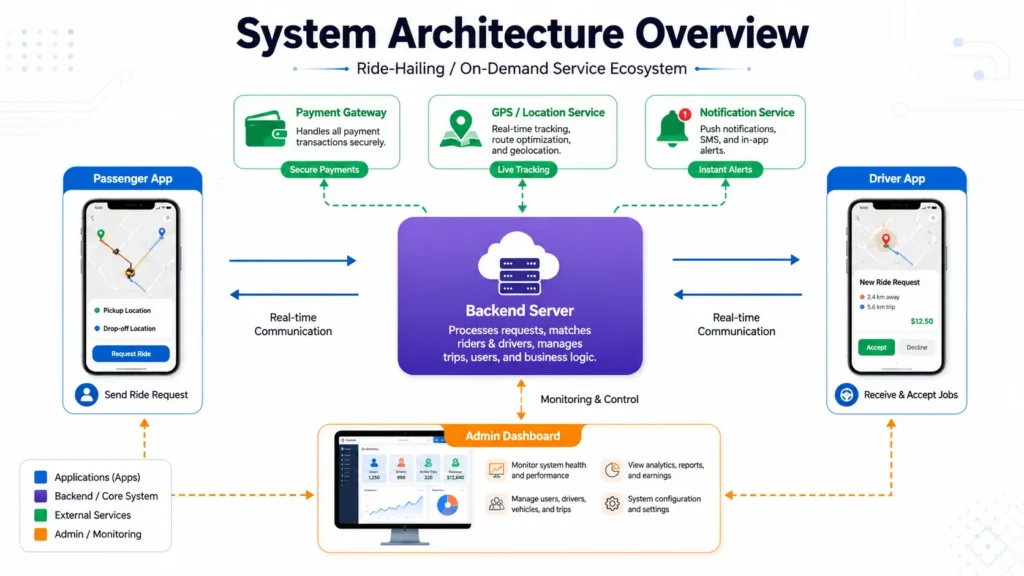
An on-demand taxi application connects passengers with nearby drivers through a mobile platform. The system automates ride booking, driver allocation, navigation, payment, and trip completion. Users no longer need to call a dispatch center or wait for manual confirmations.
The platform usually consists of three connected applications. These include a passenger app, a driver app, and an admin dashboard. Together, they help businesses manage rides efficiently while offering a smooth experience for users.
1. Passenger Journey
Passengers begin by creating an account and entering their pickup and destination locations. The application displays available drivers nearby and provides fare estimation before confirming the booking. Once the booking is confirmed, users can monitor live ride tracking from pickup until the destination. They also receive digital receipts and can rate the driver after completing the trip.
2. Driver Workflow
Drivers receive ride requests based on their current location. They can accept or reject bookings depending on availability. After accepting a ride, navigation guides them to the passenger’s location. The application also records completed rides, earnings, and customer ratings. These insights help drivers improve service quality and maintain better performance.
3. Business Management
Business owners manage daily operations using the administration panel. It controls pricing, user accounts, promotional campaigns, reports, and overall ride management. The system also supports driver management, allowing administrators to verify driver documents, monitor activity, and maintain service quality across the platform.
4. Core Technologies Behind the Platform
Modern applications depend on several technologies working together. GPS, cloud infrastructure, APIs, payment integration, and analytics create a reliable booking experience. Accurate location tracking enables drivers and passengers to find each other quickly. Smart route optimization also reduces travel time while improving fuel efficiency and customer satisfaction.
Many businesses also support secure online transactions through multiple payment gateways. These options increase convenience and improve payment success rates. Customers stay informed through timely push notifications for booking confirmation, driver arrival, trip updates, and payment receipts.
5. Types of Taxi Platforms
Every business has different operational goals. A startup may prefer a simple booking platform, while larger operators need advanced management features. Some businesses choose custom taxi app development because it allows greater flexibility, stronger branding, and easier future upgrades.
Others begin with a white-label taxi app to launch faster with lower development costs. Companies can also build an Android taxi app, an iOS taxi app, or both, depending on their audience and budget.
Why is Taxi App Development Gaining Popularity?
The global demand for digital transportation continues to increase. Customers expect quick booking, transparent pricing, and reliable service. These expectations make taxi app development an attractive investment for businesses entering the mobility market.
Several market reports estimate that ride-hailing services will continue growing steadily throughout the decade. Urbanization, smartphone adoption, and cashless payments remain major growth drivers.
1. Customers Prefer Convenience
Modern users value speed and simplicity. Instead of searching for transportation manually, they can book a ride within seconds using a taxi booking app. Features such as ride history, saved locations, and digital payments improve customer satisfaction and encourage repeat bookings.
2. Businesses Gain Better Operational Control
Digital platforms help companies automate dispatching and reduce manual work. This improves efficiency while lowering operational costs. An integrated fleet management system helps businesses monitor vehicle availability, maintenance schedules, and driver performance from one interface.
3. Growing Opportunities for Entrepreneurs
Launching a taxi startup no longer requires building a massive transportation network from day one. Entrepreneurs can begin with limited vehicles and expand gradually as customer demand increases. A well-designed platform also creates multiple revenue streams through commissions, subscriptions, surge pricing, and premium ride categories.
Explore more: Why your taxi business needs a taxi booking app
4. Flexible Business Models
Taxi platforms now support various transportation services. Companies can operate city taxis, airport transfers, corporate travel, rentals, or intercity rides using the same infrastructure. Some businesses also combine traditional transport with ride sharing app development models to maximize vehicle utilization and reduce passenger costs.
5. Demand for Customized Digital Products
Every transportation business has unique requirements. Branding, pricing rules, service zones, and customer experiences often differ across operators. Businesses looking for long-term growth usually partner with a top on-demand taxi app development company that understands industry-specific requirements and future scalability.
Such providers also deliver on-demand app solutions tailored to business goals instead of offering generic applications. As businesses expand, many also invest in custom mobile app development solutions that integrate loyalty programs, business analytics, CRM systems, and advanced reporting.
When projects become technically complex, organizations often hire dedicated mobile app developers to accelerate development while maintaining product quality.
6. Scalability Drives Long-Term Success
Successful applications must support increasing users without compromising performance. Cloud-native architecture and modular development make future expansion easier. A scalable taxi application allows businesses to add new cities, services, payment methods, and promotional campaigns without rebuilding the entire platform.
Today’s mobility businesses also invest in cab booking app development to serve customers seeking flexible transportation beyond traditional taxi services. Some companies even expand into ride-hailing app development, combining private vehicles and professional drivers within one ecosystem.
Businesses offering comprehensive taxi app development services can further enhance customer retention by continuously adding valuable features based on user feedback.
Step-by-Step Guide to On-Demand Taxi App Development
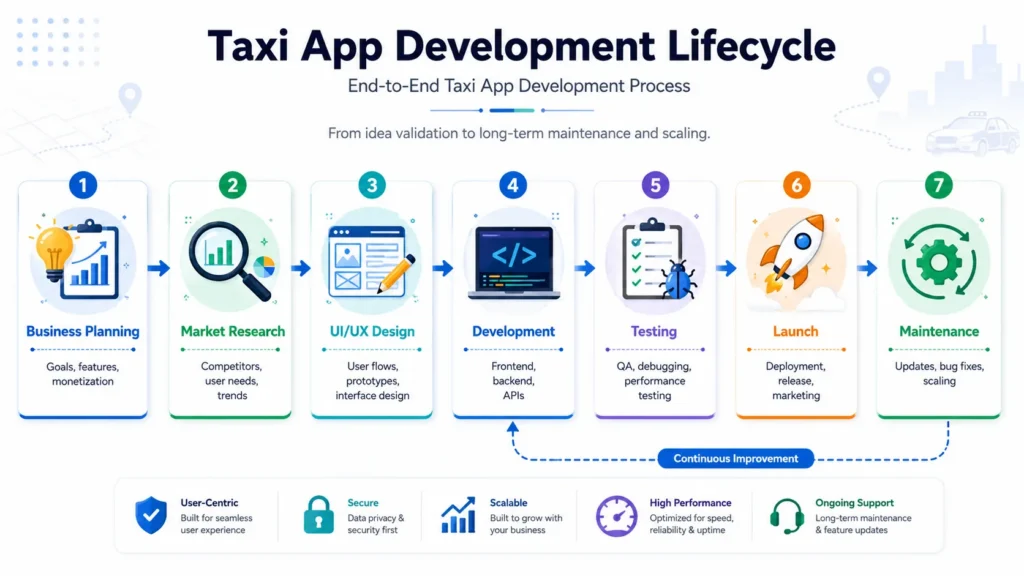
Building a successful taxi platform involves much more than writing code. Every stage should align with business goals and user expectations. A structured approach reduces risks and improves the final product.
1. Define Your Business Model
Start by identifying your target audience and service area. Decide whether you will serve local rides, airport transfers, rentals, or corporate travel. Choose your pricing strategy, commission model, and promotional plans early. These decisions influence the application’s architecture and future scalability.
2. Research the Market
Study your competitors to understand their strengths and weaknesses. Analyze customer reviews to identify common complaints and opportunities. This research helps you design a better taxi app solution that solves real customer problems instead of copying existing platforms.
3. Plan Essential Features
List the features needed for passengers, drivers, and administrators. Prioritize the minimum viable product before adding advanced capabilities. A typical taxi booking application includes user registration, ride booking, payment integration, ride history, ratings, promotions, and customer support.
4. Select the Right Technology Stack
Choose technologies based on scalability, security, and performance. Popular mobile frameworks include Flutter and React Native, while native development uses Kotlin and Swift. Cloud platforms, REST APIs, WebSockets, and mapping services ensure smooth communication between users and the backend.
5. Design an Intuitive User Experience
A clean interface improves customer satisfaction. Users should complete bookings with only a few taps. Simple navigation, readable typography, and consistent design create a professional experience for both passengers and drivers.
6. Build and Test the Application
Development usually begins with core functionality before adding advanced modules. Test every feature across different devices and operating systems. Functional, security, usability, and performance testing help eliminate issues before launch.
7. Launch and Improve Continuously
Launching the app is only the beginning. Monitor user feedback and application performance regularly. Release updates that improve stability, security, and customer experience. Continuous improvements help businesses remain competitive.
Challenges Faced in On-Demand Taxi App Development
Developing a reliable taxi platform comes with several technical and operational challenges. Understanding these issues early helps businesses plan better solutions.
1. Maintaining Accurate Ride Matching
Passengers expect quick driver allocation. Delays often reduce customer satisfaction. Smart algorithms must consider driver availability, distance, traffic conditions, and estimated arrival times before assigning rides.
2. Handling Peak Demand
Ride requests increase sharply during holidays, events, and bad weather. Businesses should build infrastructure that automatically scales during traffic spikes without affecting application performance.
3. Ensuring Data Security
Taxi applications collect personal information and payment details. Strong encryption, secure authentication, and compliance with privacy regulations protect customer data. Security should remain a priority throughout the application’s lifecycle.
4. Managing Driver Quality
Driver behavior directly affects customer satisfaction. Businesses should verify documents, monitor ratings, provide training, and maintain clear operational standards.
5. Balancing Operational Costs
Infrastructure, maintenance, marketing, customer support, and feature upgrades require ongoing investment. Careful planning helps businesses maintain profitability while delivering quality service.
Explore more: On-demand app development cost breakdown
A Closer Look at Successful On-Demand Taxi Apps
Several transportation platforms have changed how people travel. Their success comes from solving real customer problems while continuously improving their products. Leading platforms focus on simplicity. Users can book rides quickly, monitor driver arrival, pay digitally, and review completed trips. Many successful companies also expand beyond standard taxi services.
They introduce premium rides, rentals, delivery services, subscriptions, and business travel options. Strong customer support also contributes to long-term growth. Quick issue resolution builds trust and improves retention. These businesses constantly analyze customer behavior to introduce useful improvements. Regular updates help maintain competitiveness in a rapidly changing market.
New businesses should avoid copying competitors’ features. Instead, they should identify gaps in the market and deliver unique value. A customer-first mindset often creates stronger long-term results than adding unnecessary features.
Conclusion
The transportation industry continues to evolve as digital technologies reshape customer expectations. Businesses investing in on-demand taxi app development can create efficient platforms that improve convenience for passengers and simplify daily operations.
Success depends on careful planning, reliable technology, user-focused design, and continuous improvements after launch. Companies that understand customer needs and adapt quickly will stay ahead in this competitive market.
Whether you are launching a new venture or modernizing an existing transportation service, investing in professional taxi app development creates a strong foundation for sustainable growth.