


Launching a mobile app can help a UK business improve customer service, streamline operations, and create new revenue opportunities. But a successful app is not simply a well-designed interface. It needs to solve a real problem, fit the way people use the business, and deliver enough value to justify the cost of building and maintaining it.
For business owners, the challenge is knowing where to start. Should you build for iOS, Android, or both? Which features are essential for the first release? How much should you budget, and what should you look for in a mobile app development company?
The answers depend on your customers, business model, technical requirements, and long-term objectives.
This guide explains how to approach mobile app development for UK businesses, from validating the initial idea and choosing the right technology to estimating costs, meeting data protection obligations, and planning for ongoing improvements.
The key principle is simple: validate the business need before committing to development. A focused app that solves a specific problem can deliver more value than an expensive product packed with features customers rarely use.
Why Should UK Businesses Invest in a Mobile App?
A mobile application gives customers another way to interact with a business, but its value depends on what it helps them accomplish.
For a retailer, an app might offer personalised product recommendations, saved shopping lists, loyalty rewards, and order tracking. A healthcare or service provider might use one for appointment bookings, reminders, and account management. Meanwhile, a business with a mobile workforce could provide employees with schedules, job details, documents, and real-time operational updates.
These features can improve convenience and reduce repetitive work. However, the commercial benefits are not automatic. They depend on whether customers adopt the app, whether the features work reliably, and whether the product addresses a genuine need.
Before investing, consider the business outcomes you want to achieve:
- Improve customer retention: Make it easier for existing customers to return, manage their accounts, or access services.
- Increase conversions: Reduce unnecessary steps in booking, purchasing, or completing a transaction.
- Reduce administrative work: Automate repetitive tasks such as appointment reminders, order updates, and routine enquiries.
- Improve operational efficiency: Give employees faster access to the information and tools they need.
- Create new revenue opportunities: Introduce digital services, subscriptions, in-app purchases where appropriate, or additional customer offerings.
There is also an important question to answer: does your business actually need a native mobile app?
A responsive website may be sufficient if customers only visit occasionally or need straightforward information. A dedicated app is more compelling when people return frequently, need device-specific features, benefit from personalised experiences, or regularly complete tasks through an account.
The best decision is the one that solves the customer problem with the least unnecessary complexity.
Explore more: AI-powered mobile applications for UK businesses
Define Your Business Goals and Target Audience
Before discussing features with expert developers, establish what the app needs to achieve and who will use it. This gives the project a clear direction and helps prevent scope from expanding without a corresponding business benefit.
Set measurable business goals
Start by identifying the problem behind the project.
For example, a company receiving a high volume of appointment-related calls might develop an app that lets customers manage bookings themselves. Its objective would not simply be to launch an app; it would be to reduce avoidable calls while maintaining or improving customer satisfaction.
Choose a small set of key performance indicators (KPIs) that reflect your goals. Depending on the business, these might include:
- Completed bookings or purchases.
- Customer retention and repeat purchase rates.
- Time taken to complete a task.
- Support enquiries per customer.
- App activation and ongoing engagement.
- Customer satisfaction scores.
Record your existing performance before development begins. Without a baseline, it becomes difficult to determine whether the app has made a meaningful difference.
Understand your customers before choosing features
Customer research should shape the product, not simply confirm decisions the business has already made.
Start with information you already have, such as website analytics, customer support records, sales data, and feedback from existing users. Interviews and short surveys can help explain why customers abandon a process, which tasks they find difficult, and what they would expect from an app.
Suppose customers regularly abandon an online booking process because they cannot easily change an appointment. That finding may justify prioritising booking management over features such as loyalty points or personalised recommendations.
Also consider the practical circumstances in which people will use the app. They may have older devices, unreliable connectivity, limited digital confidence, or accessibility requirements. Designing for these realities can make the product more useful to a wider audience.
The result should be a clear connection between three things: the customer’s problem, the proposed feature, and the business outcome you expect it to influence.
Build a Practical Mobile App Strategy
A mobile app strategy turns an initial idea into a product that can be planned, delivered, measured, and improved. It should cover the product’s purpose, essential functionality, technology choices, budget, security requirements, and future development priorities.
Prioritise features for the first release
One of the most common planning mistakes is trying to include every possible feature in the initial version. Instead, define a minimum viable product (MVP): the smallest usable version that solves the primary customer problem and allows the business to test its assumptions.
For a booking app, the first release might include:
- Account registration and secure sign-in.
- Appointment availability and booking.
- Booking confirmations and reminders.
- Options to change or cancel appointments.
- Basic customer support.
Advanced analytics, loyalty programmes, and personalised recommendations could follow once actual usage provides evidence that they are worth developing. This phased approach helps control initial spending and allows the business to learn from real customers before expanding the product.
Choose between iOS, Android, and cross-platform development
The right development approach depends on your audience, required functionality, budget, and maintenance expectations.
iOS app development uses Apple’s platform and development ecosystem. It can be appropriate when research shows that your target audience primarily uses Apple devices or when the app depends on specific iOS capabilities.
Android app development supports users across a broad range of devices. The team needs to account for differences in screen sizes, hardware, operating system versions, and device manufacturers.
Cross-platform development uses frameworks such as Flutter or React Native to share code across iOS and Android. This can reduce duplicated development work, although platform-specific functionality and testing are still necessary.
Native development is not automatically better, and cross-platform development is not always cheaper. The overall cost depends on the application, integrations, developer expertise, testing requirements, and future maintenance.
Ask your development partner to explain the trade-offs in the context of your product rather than recommending a technology simply because the team already uses it.
Plan privacy and security from the beginning
Privacy and security should influence product decisions from the discovery stage, not be added as a final checklist before launch.
First, identify the personal information the app needs and why it needs it. Consider authentication, access permissions, data storage, encryption, retention periods, third-party integrations, and the process for responding to security incidents.
For UK businesses, the UK General Data Protection Regulation (UK GDPR) and the Data Protection Act 2018 may apply, depending on the circumstances and the processing involved. Other requirements may also be relevant to particular services or industries.
The Information Commissioner’s Office (ICO) explains that data protection by design and by default involves considering privacy throughout a product’s lifecycle and limiting personal information to what is necessary for the intended purpose. Its guidance is a useful starting point for planning these controls.
Official resource: ICO guidance on data protection by design and by default.
Businesses should assess their own processing activities and seek appropriate professional advice where the legal or technical risks warrant it.
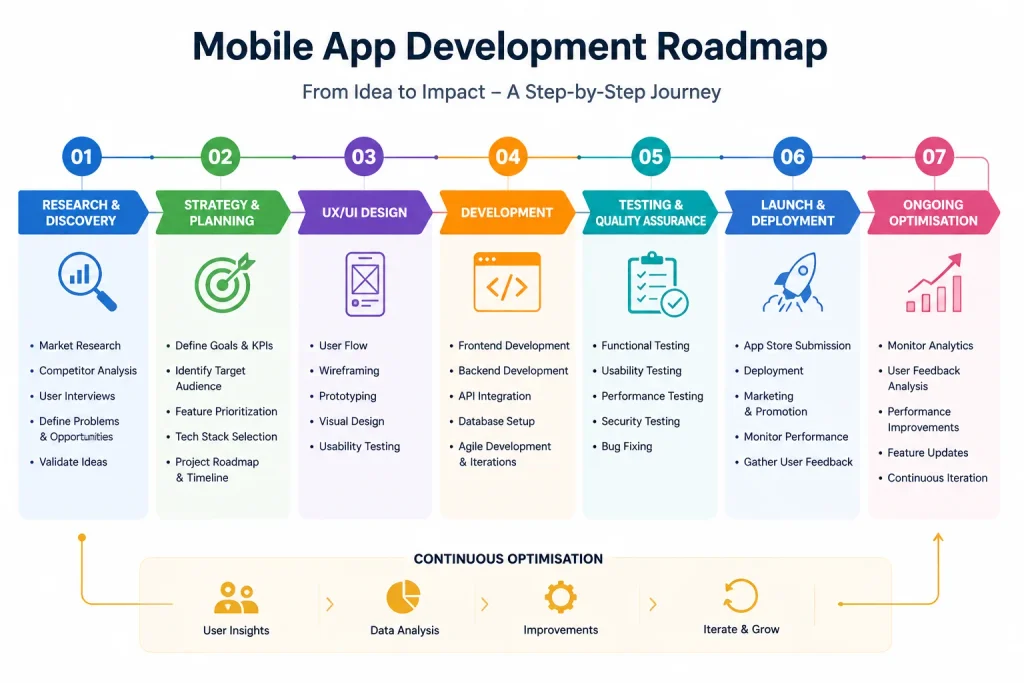
Understand the Mobile App Development Process
A structured mobile app development process helps businesses manage expectations, control scope, and identify problems before they become expensive to fix. Although individual projects differ, most follow a series of connected stages.
1. Discovery and planning
The discovery phase establishes what needs to be built and why.
The team reviews business objectives, target users, existing systems, competitors, technical dependencies, and project constraints. It should also identify risks such as complex integrations, sensitive data, or uncertainty about customer demand.
Typical deliverables include a requirements document, prioritised feature list, initial technical recommendations, project roadmap, and agreed success measures. This is also the time to clarify what falls outside the initial scope. A shared understanding of exclusions can prevent disagreements later.
2. UX and UI design
User experience (UX) design focuses on how people navigate and complete tasks. User interface (UI) design covers the visual elements, including layouts, typography, buttons, forms, and feedback messages.
Designers commonly develop user journeys, wireframes, and interactive prototypes before the full application is built. Testing these designs with representative users can reveal confusing navigation, unnecessary steps, or unclear instructions while changes are still relatively inexpensive.
Accessibility should be considered throughout this stage. Readable text, sufficient contrast, appropriately sized controls, clear error messages, and compatibility with assistive technologies all contribute to a more usable product.
3. App development and system integration
During development, engineers build the mobile interface, backend services, databases, and connections to other systems. Depending on the application, integrations might include payment gateways, customer relationship management (CRM) software, inventory platforms, booking systems, or existing business APIs.
These integrations can significantly affect the schedule and budget. An apparently simple feature may require additional work if the existing system has limited API support, inconsistent data, or complex access rules.
Ask the development team to explain these dependencies before agreeing to a fixed scope.
4. Testing and quality assurance
App testing should cover more than whether the main features work during a demonstration.
Quality assurance (QA) should examine functionality, performance, security, accessibility, and compatibility across the devices and operating system versions relevant to the target audience.
Testing should also cover less predictable situations, including:
- Interrupted payments and failed transactions.
- Poor connectivity or temporary loss of service.
- Expired sessions and unsuccessful sign-in attempts.
- Duplicate submissions and unexpected user input.
- Permission changes and interrupted workflows.
- High usage volumes and backend failures.
Security testing should be proportionate to the application’s risk, and sensitive applications may need specialist assessments.
Critical defects should be resolved before release. A clear acceptance process helps the business understand what has been tested and what issues, if any, remain outstanding.
5. App store submission and launch
Publishing an app involves preparing the appropriate store listing, screenshots, descriptions, support details, and privacy information.
Apple’s App Store and Google Play have their own review processes and submission requirements. Approval should not be assumed to happen instantly, so include time for review and possible changes in the launch schedule.
Before release, confirm that customer support staff know how to handle common issues and that the business has a process for reporting and resolving faults.
6. Maintenance and continuous improvement
Launch is the beginning of the product’s operational life, not the end of development.
Mobile operating systems change, dependencies need updates, security vulnerabilities emerge, and customers request improvements. The app may also need changes as the business introduces new services or its user base grows.
Plan for bug fixes, operating system compatibility, infrastructure monitoring, security patches, and periodic usability improvements. A defined maintenance agreement helps clarify who is responsible for these activities, how urgent issues are handled, and what ongoing support will cost.
Estimate Mobile App Development Costs in the UK
Mobile app development costs vary considerably. The final budget depends on the number and complexity of features, design requirements, platform choices, backend infrastructure, integrations, security needs, and the experience of the development team.
There is no single price that applies to every UK business app. Published agency rates and project estimates are useful for initial planning, but they should not be treated as quotations for a specific product.
Indicative app development budgets
The following ranges are broad planning estimates, not verified prices for a particular project.
| App type | Indicative budget | Typical scope |
|---|---|---|
| Basic MVP | £10,000 – £40,000 | Core screens, simple workflows, limited integrations |
| Mid-complexity app | £40,000 – £100,000+ | User accounts, APIs, payments, dashboards, multiple workflows |
| Complex business app | £100,000 – £200,000+ | Custom backend, advanced integrations, complex permissions, demanding security requirements |
These categories overlap because project scope matters more than the label attached to an app. A simple-looking product may still be expensive if it requires complex integrations or handles sensitive information.
For additional market context, Clutch’s UK mobile app development directory publishes agency profiles, client reviews, and pricing information. Its listed rates and project ranges vary by provider and project characteristics, so use the directory to compare suppliers rather than treating a published benchmark as a guaranteed cost.
What affects the final price?
Several factors can increase or reduce the investment required:
- Feature complexity: Authentication, real-time updates, messaging, payments, and complex workflows require different levels of effort.
- Platform coverage: Building and maintaining separate native iOS and Android applications may involve more work than sharing much of the code through a cross-platform framework.
- Backend development: Custom APIs, databases, admin dashboards, and business logic can form a substantial part of the project.
- Third-party integrations: Existing systems may require custom connectors, additional licences, or changes to their configuration.
- Security and compliance: Applications processing sensitive or high-risk information may require more extensive controls, documentation, and specialist testing.
- Design and accessibility: Research, usability testing, accessible interaction patterns, and bespoke interfaces all need time and expertise.
- Testing and ongoing support: Device coverage, performance testing, infrastructure monitoring, updates, and incident response contribute to the overall cost of ownership.
Budget for the full product lifecycle
The initial development quotation is only one part of the investment.
Your budget may also need to cover discovery workshops, branding, cloud hosting, third-party subscriptions, analytics, app store accounts, customer support, and future enhancements.
When comparing proposals, ask each supplier to separate initial development from recurring costs. Clarify whether the quotation includes testing, deployment, source code, technical documentation, post-launch fixes, and maintenance.
A slightly higher initial quotation may offer better value if it includes a clearer scope, stronger testing, and more reliable support. Conversely, a lower-cost approach may be entirely appropriate for a small, well-defined MVP.
The objective is to compare like with like and understand the total cost of ownership before committing.
Explore more: Cost of mobile app development in the UK
Plan Your App Launch and Marketing
Even a well-built app needs a reason for people to discover it, install it, and continue using it. Launch planning should therefore begin before development finishes.
1. Prepare for release
Create an app store listing that explains what the product does and who it helps. Use clear descriptions and relevant screenshots to demonstrate the main tasks customers can complete.
Prepare support documentation and decide how users will get help with account access, payments, technical problems, or changes to their information. Internally, make sure the people responsible for sales, customer service, and operations understand the app’s features and limitations.
2. Build a focused app marketing plan
Your marketing approach should reflect how your customers already interact with your business.
For existing customers, relevant channels may include email campaigns, website banners, account dashboards, receipts, or in-store promotion. For new audiences, options could include search engine optimisation (SEO), app store optimisation (ASO), paid campaigns, partnerships, and useful content.
Explain the practical benefit of installing the app rather than simply announcing its availability. Avoid promising features that are not yet available, and make sure any promotional claims can be substantiated.
3. Measure performance after launch
Use app analytics to understand how customers discover, activate, and use the product.
Depending on your goals, useful measures might include:
- Acquisition: How many relevant users install the app, and what does it cost to acquire them?
- Activation: How many new users complete a meaningful first action?
- Engagement: Which features do users return to, and how frequently?
- Conversion: How many users complete the intended booking, purchase, or workflow?
- Retention: How many users return over an appropriate period?
- Reliability: How often do crashes, errors, or failed transactions occur?
Interpret these metrics in context. A business app used by employees may be successful because it reduces task completion time, even if daily engagement is lower than that of a consumer app. Review customer feedback alongside quantitative data. Usage figures can show where people abandon a process, while interviews and support records may explain why.
The purpose of measurement is to identify improvements that support business objectives, not to collect as many metrics as possible.
How to Choose the Right UK App Development Partner
Choosing a mobile app development company is a business decision as much as a technical one. The right partner should understand the problem you want to solve, explain the available options, and be transparent about risks, costs, and ongoing responsibilities.
1. Evaluate relevant experience
Look for case studies involving comparable products, integrations, user groups, or technical challenges. A portfolio of attractive interfaces is useful, but it does not demonstrate how well an application performs after launch. Ask what the supplier delivered, what challenges arose, how those challenges were addressed, and what outcomes the client could verify.
Where possible, speak to previous clients or review independently published feedback.
2. Assess the development process
A credible supplier should be able to explain how it approaches discovery, requirements gathering, UX/UI design, development, QA, security, release management, and maintenance.
Ask who will work on the project and how progress will be communicated. Find out how the team records decisions, manages changing requirements, and escalates technical risks. A proposal should explain the scope, deliverables, milestones, assumptions, exclusions, and acceptance criteria.
3. Clarify ownership and contractual terms
Before signing, establish who will own the source code, design assets, documentation, and relevant accounts. Check how source code will be stored and handed over, whether third-party licences introduce restrictions, and whether the business can appoint another supplier if the relationship ends.
The contract should also explain payment milestones, change requests, delays, warranties, support arrangements, and responsibility for third-party services. These details are particularly important if the app will become central to your customer experience or day-to-day operations.
4. Compare value rather than price alone
The cheapest quotation may exclude important work, while the most expensive proposal may include functionality the business does not need.
Ask suppliers to explain the reasoning behind their estimates and identify the assumptions that could change the price. If two quotations differ substantially, compare their deliverables and exclusions before making a decision.
A strong development partner will challenge unnecessary complexity, explain trade-offs in plain English, and help you make informed decisions. They should not need to promise guaranteed commercial results to demonstrate the value of their work.
Explore more: Best mobile app development company in London
Mobile App Pre-Launch Checklist
Before releasing the application, review the product from both the user’s and the business’s perspective.
Product and usability
- The app addresses a clearly defined customer or operational problem.
- Essential features work as intended.
- Navigation, forms, and error messages are understandable.
- The experience has been tested with representative users where appropriate.
Technical quality and security
- Relevant devices and operating system versions have been tested.
- Performance, loading times, and error handling have been reviewed.
- Authentication, permissions, and access controls have been checked.
- Relevant security testing has been completed.
- Backup, monitoring, and incident response arrangements are defined where needed.
Privacy and accessibility
- Privacy notices and relevant consent flows have been reviewed.
- Personal information is collected and retained only as justified by the applicable requirements.
- Applicable data protection obligations have been assessed.
- Readability, colour contrast, control sizes, and assistive technology support have been considered.
- Third-party SDKs and integrations have been reviewed for their data handling implications.
Launch and ongoing operations
- App store listings, screenshots, and support details are ready.
- Analytics and baseline KPIs are in place.
- Customer support staff understand the product.
- Responsibility for bug fixes, updates, and maintenance is documented.
- Hosting, third-party subscriptions, and future development costs have been budgeted.
- The team has a plan for handling increased demand and future feature requests.
This checklist should be adapted to the product’s purpose, risk level, and technical architecture. An application handling payments or sensitive personal information will need different controls from a simple informational app.
Conclusion
Successful mobile app development for UK businesses begins with a clear business case, not a long list of features. Before investing, establish what customers need, validate that a dedicated app is the right solution, and define how you will measure success.
From there, choose an appropriate technology approach, plan for privacy and accessibility, and work with a development partner who can explain the technical and commercial trade-offs. A phased MVP can help control initial risk, while realistic budgeting ensures that maintenance and support are not overlooked.
The work does not end when the app reaches the App Store or Google Play. Ongoing testing, security updates, customer feedback, and performance measurement help the product remain useful as technology and business requirements change.
When these decisions are made carefully, a mobile app can become a practical investment in customer experience, operational efficiency, and long-term business growth.