


AI wearable technology is changing how people interact with data, devices, and digital services. From smartwatches to connected glasses, modern devices can now understand patterns and deliver useful responses. This shift is especially visible in AI wearable technology in different industries, where devices support healthcare, manufacturing, logistics, fitness, and workplace operations.
Unlike traditional trackers, newer devices can interpret information instead of simply collecting it. They combine sensors, connectivity, and intelligent software to turn everyday activity into useful recommendations or alerts.
The global wearable AI market was valued at $43.6 billion in 2025. It is projected to reach $310.6 billion by 2033, with a 27.8% CAGR.
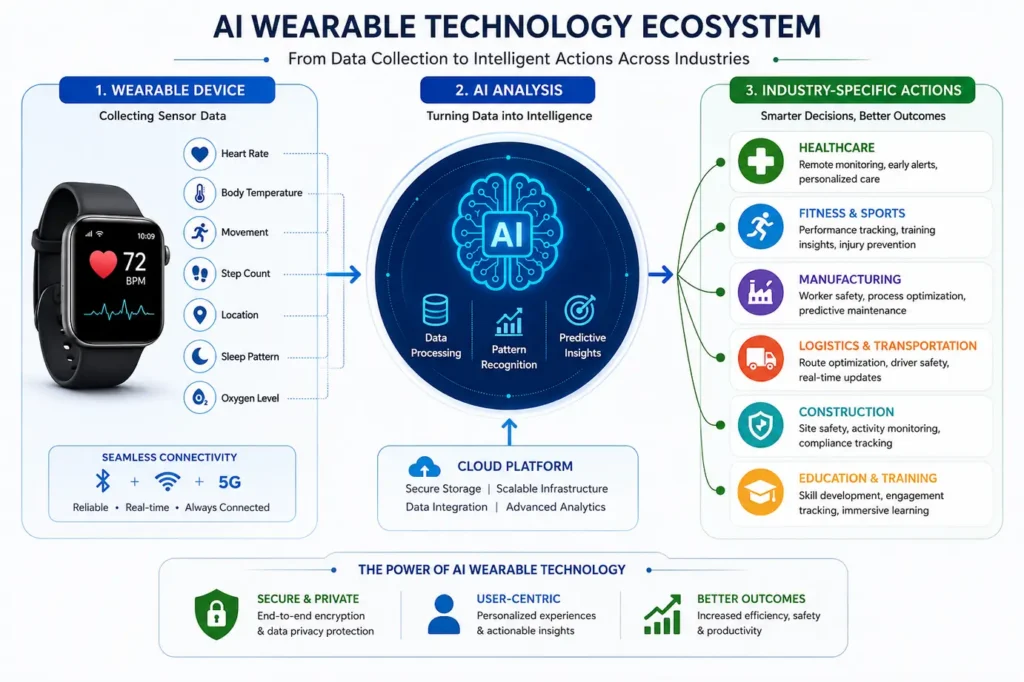
How AI is transforming different industries
The biggest change comes from the way devices process information. AI wearables can collect continuous signals and recognise patterns that may be difficult to spot manually.
Modern devices use smart sensors to capture movement, temperature, heart rate, location, posture, and other signals. AI models can then analyse this information and produce real-time data for users, managers, coaches, or healthcare teams.
This creates a shift from reactive systems to proactive systems. Instead of waiting for a problem, organisations can identify warning signs earlier and respond faster.
Key changes include:
- Continuous monitoring instead of occasional checks.
- Automated alerts instead of manual observation.
- Data-driven decisions instead of assumptions.
- Personalised recommendations instead of generic guidance.
- Faster communication between people, devices, and software.
- Better visibility across distributed operations.
Machine learning plays an important role in this process. It helps systems recognise patterns across large datasets and improve predictions as more information becomes available.
For businesses, this can create new wearable technology applications across operations, customer services, training, maintenance, and safety.
Explore more: Complete guide to wearable app development
Industry-specific examples of AI wearable technology
1. Healthcare
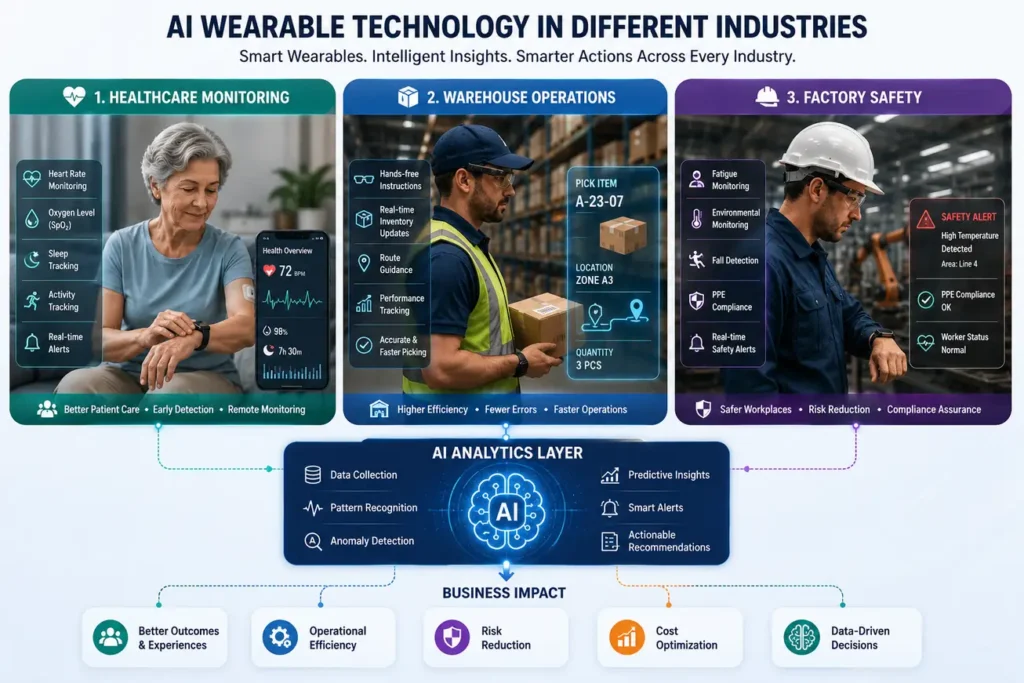
Healthcare is one of the strongest areas for intelligent wearables. Devices can monitor vital signs and support care outside traditional clinical environments. A patient may use a smartwatch, medical patch, or connected sensor to track health indicators throughout the day. AI can analyse these signals and identify unusual changes.
This approach supports remote patient monitoring, particularly for people managing long-term conditions. Healthcare teams can use biometric data to understand trends between appointments. AI can also prioritise alerts when readings suggest potential deterioration.
Common applications include:
- Heart and respiratory monitoring.
- Sleep analysis.
- Diabetes management.
- Rehabilitation tracking.
- Medication support.
- Aged care monitoring.
The value goes beyond collecting measurements. Intelligent systems can provide personalized insights that help users understand their health patterns.
2. Fitness and sports
Fitness has become a familiar entry point for wearable innovation. Smartwatches and fitness bands already measure steps, calories, sleep, heart rate, and exercise performance. AI takes fitness tracking further by interpreting those measurements. Instead of simply reporting activity, systems can identify patterns and suggest adjustments.
For example, a training platform could recognise declining recovery patterns and recommend a lighter workout. A sports team could analyse movement data to identify workload changes among athletes. This growth shows how consumers increasingly expect devices to act like personal digital coaches rather than simple counters.
3. Manufacturing
Factories can use AI wearable devices to improve worker productivity, training, maintenance, and safety. Smart glasses can display instructions while employees work. Workers can access technical information without repeatedly checking manuals or leaving their stations.
Wearable sensors can also identify unusual movement, fatigue indicators, or unsafe working conditions. This can support workplace safety when organisations combine wearable information with appropriate safety procedures. The International Labour Organization highlights smart wearables and environmental sensors as tools that can support real-time risk detection and safer workplaces.
Industrial wearable devices are already expanding across manufacturing, healthcare, transport, logistics, and other sectors.
4. Logistics and transportation
Logistics operations depend heavily on speed, accuracy, and worker coordination. Wearables can reduce unnecessary device handling and make information available during active tasks. Warehouse employees can use smart glasses to receive picking instructions. Drivers can access navigation or operational alerts through connected devices.
AI can analyse movement, location, workload, and operational patterns. This creates opportunities for better route planning, task allocation, and risk management. For example, a distribution centre could use wearable signals to identify bottlenecks. Managers could then adjust staffing or workflows before delays become widespread. Connected wearables can also work alongside IoT devices across warehouses, vehicles, and facilities. This creates a broader data network for operational decision-making.
5. Retail and customer service
Retail businesses can use wearables to improve employee productivity and customer experience. Store employees wearing smart glasses could receive product information while assisting customers. Staff could also check inventory without returning to a workstation.
AI can analyse customer interactions and operational patterns to identify service opportunities. Wearables may also help employees receive task reminders based on store activity. These capabilities can reduce friction during busy periods. They can also help employees spend more time helping customers rather than searching for information.
6. Field services
Technicians often work in environments where carrying laptops or repeatedly checking phones is inconvenient. Smart glasses can provide hands-free access to instructions, diagrams, and service information. AI can help technicians identify equipment issues using visual information and historical records. Experts can also support remote workers through live collaboration. This can shorten troubleshooting time and improve first-visit resolution rates. It also creates a more consistent process for complex maintenance work.
Benefits and challenges of AI wearable technology
The benefits of intelligent wearables extend beyond convenience. Businesses can use them to collect useful information, improve processes, and build services around continuous user interaction.
Major benefits:
- Continuous information: Devices can collect information throughout daily activities.
- Faster decisions: AI can analyse incoming signals and highlight important changes.
- Personalisation: Systems can adapt recommendations based on individual patterns.
- Higher productivity: Workers can access relevant information without switching devices.
- Improved safety: Wearables can detect selected risks and provide timely alerts.
- Better engagement: Intelligent feedback can encourage users to remain active.
- Operational visibility: Managers can understand workflows through aggregated data.
Businesses can also connect wearables with existing wearable technology solutions and mobile platforms. This creates a smoother experience between physical devices and digital services. However, adoption also brings challenges. Battery life remains important because continuous sensing and processing consume power.
Accuracy is another concern. Sensors can produce inconsistent readings because of movement, placement, environmental conditions, or device limitations.
Data privacy and security also require careful attention. Wearables may collect sensitive health, location, behavioural, or workplace information. Organisations should therefore establish clear consent policies, strong encryption, access controls, and appropriate data retention practices. Cost can create another barrier. Hardware, AI development, cloud infrastructure, mobile applications, testing, and ongoing maintenance can increase the overall investment.
Businesses planning a custom product should evaluate both technical requirements and long-term operating costs. Working with the best wearable app development company can help align device capabilities with practical business goals.
Explore more: How much wearable app development costs
Future implications of AI wearable technology
The next phase will focus on making devices more intelligent, smaller, and less dependent on constant smartphone interaction. One major direction is on-device processing. The wearable AI market already shows strong adoption of on-device AI, which accounted for 59.1% of market operations in 2025.
This approach can reduce latency and limit the amount of information sent to external servers. It may also improve privacy for applications that need rapid responses. Another important direction is multimodal interaction. Future wearables may combine voice, vision, motion, biometric signals, and environmental information.
Smart glasses could understand what users see. Earwear could provide contextual assistance. Rings and watches could continuously monitor selected health signals. These developments will influence wearable technology trends across consumer and enterprise markets.
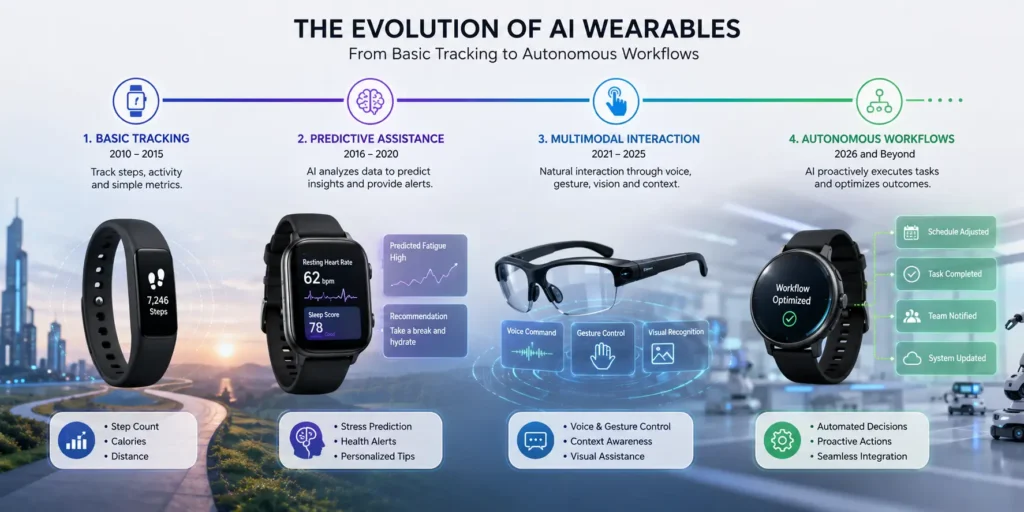
AI may also become more deeply integrated with augmented reality. A technician could see repair instructions over equipment while AI identifies the relevant component. Businesses will need strong software ecosystems to support these experiences.
Developers will need expertise across AI models, mobile platforms, cloud services, sensors, and device connectivity. Companies can hire dedicated developers when they need specialised skills for long-term wearable projects.
They may also work with a top mobile app development firm when the wearable experience depends heavily on mobile applications. The broader opportunity lies in combining AI in wearable technology with existing business systems. The wearable should not operate as an isolated gadget. It should become part of a connected digital workflow.
Conclusion
Wearables are moving beyond simple activity tracking. They can now combine sensors, connectivity, and intelligence to support meaningful decisions across multiple sectors. Healthcare can use them for continuous monitoring. Sports can use them for smarter training. Manufacturing can improve safety and efficiency. Logistics can streamline workflows, while retail can create more responsive services.
The next generation will bring stronger on-device intelligence, better sensors, richer software, and more natural interactions. For businesses exploring new digital products, AI wearable technology offers an opportunity to connect physical experiences with intelligent software. The organisations that focus on useful applications, responsible data practices, and strong user experiences will be best positioned to benefit from these developments.