


Businesses are investing in connected digital experiences as wearable technology continues to reshape everyday life. This wearable app development guide explains how wearable app development helps brands create smart, secure, and engaging applications for modern users. Whether you plan to build a healthcare solution, a fitness platform, or a business application, understanding the right approach saves time and budget. A successful wearable app development strategy focuses on user needs, device compatibility, security, and long-term scalability.
Wearable solutions now support healthcare, sports, retail, logistics, and enterprise operations. Users expect quick access to information without reaching for a smartphone. Developers must therefore create lightweight experiences that deliver value in seconds. Every design decision should improve convenience while maintaining excellent performance.
Understanding Wearable Devices
Wearables are compact electronic products designed to collect, display, or transmit information while users perform everyday activities. These devices work alongside smartphones, cloud platforms, and connected systems to deliver instant updates and personalized insights.
Today’s wearable devices include smartwatches, fitness bands, smart glasses, medical monitors, GPS trackers, smart rings, and industrial safety equipment. Each device serves a unique purpose, yet they all depend on reliable software for a smooth user experience.
The rapid growth of the wearable ecosystem has created new opportunities for businesses. Companies can improve customer engagement through personalized services, real-time notifications, and intelligent automation. Industries ranging from healthcare to manufacturing continue adopting wearable solutions to increase efficiency.
Modern applications rely on advanced wearable sensors that collect valuable information such as heart rate, movement, sleep quality, temperature, blood oxygen levels, and location. This information allows businesses to deliver smarter recommendations and more accurate insights. Many solutions also depend on IoT integration to connect wearables with cloud platforms, smartphones, medical systems, and enterprise software. Connected environments improve communication between devices while enabling automation and data synchronization.
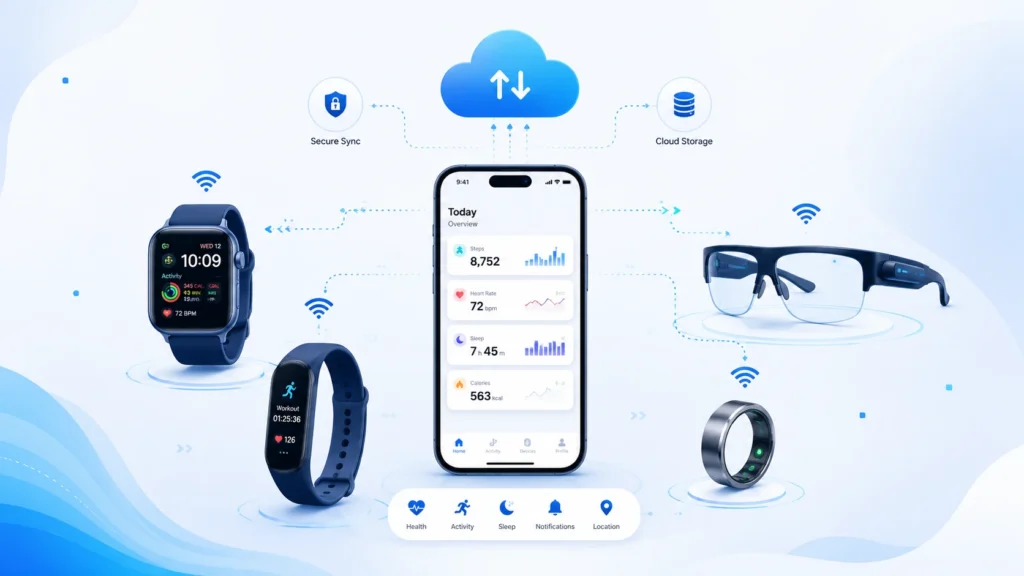
Healthcare remains one of the fastest-growing sectors. Many organizations invest in healthcare wearable app development to improve patient care, reduce hospital visits, and support preventive healthcare. Patients can securely share health records while doctors monitor important health indicators remotely.
One of the biggest advantages of wearable solutions is real-time health monitoring. Continuous monitoring allows healthcare professionals to detect unusual patterns quickly and respond before conditions become serious. Another important capability is biometric data tracking. Applications collect information such as heart rate variability, calories burned, activity levels, and sleep cycles. Businesses can transform this data into meaningful reports that encourage healthier lifestyles.
Reliable communication between smartphones and wearable hardware depends on Bluetooth Low Energy (BLE). This technology provides stable connections while reducing battery consumption. Efficient connectivity improves the overall user experience without sacrificing device performance.
Explore more: How AI makes wearable apps more predictive
Types of Wearable Apps
Different industries require different wearable experiences. Choosing the right application type depends on business objectives and user expectations.
1. Health and Medical Apps
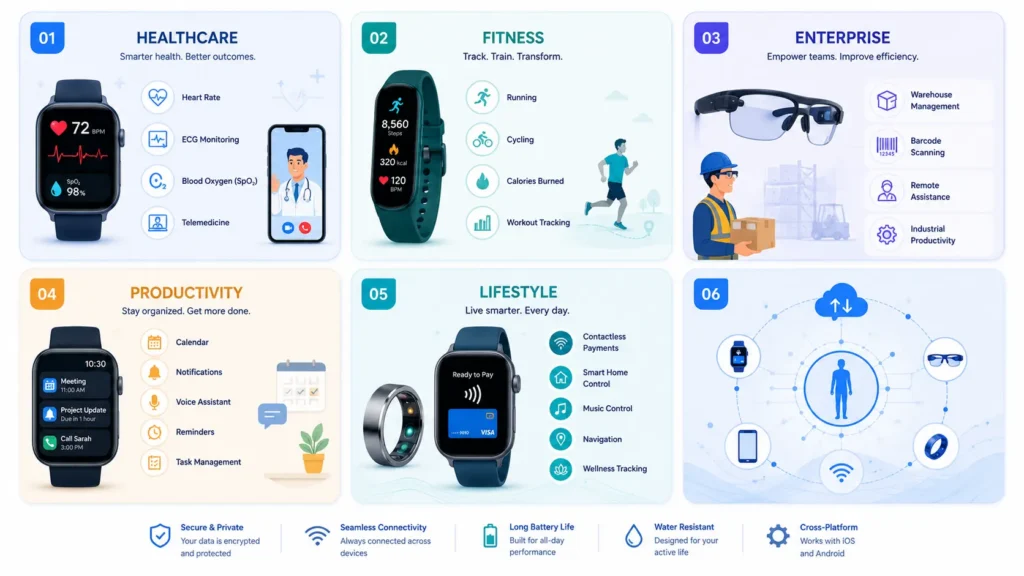
Medical applications help patients and healthcare providers monitor important health information. These health monitoring apps support chronic disease management, medication reminders, emergency alerts, and remote patient monitoring. Hospitals also use wearable platforms to improve communication between medical teams and patients. Secure data sharing enhances decision-making while reducing response times.
2. Fitness and Sports Apps
Fitness remains one of the largest wearable categories. Modern fitness tracking apps monitor workouts, daily activity, calories, distance, and recovery metrics. They also encourage users through personalized coaching and achievement tracking. Businesses investing in fitness app development for wearables often integrate AI-powered recommendations, personalized workout plans, and social challenges to improve long-term engagement.
3. Smartwatch Apps
Businesses increasingly build dedicated smartwatch applications because users prefer quick interactions on their wrists. These applications display notifications, reminders, navigation, messaging, payments, and productivity tools. Successful smartwatch app development focuses on simplicity. Small screens demand concise information, large touch targets, and intuitive navigation.
4. Enterprise Wearable Apps
Organizations use wearables to improve workplace safety, logistics, manufacturing, and field services. Employees receive hands-free instructions, equipment updates, and task notifications while remaining productive. These enterprise solutions often combine location tracking, inventory management, voice commands, and workflow automation to streamline daily operations.
5. Consumer Lifestyle Apps
Lifestyle applications include travel assistants, payment solutions, music controls, language translation, shopping companions, and smart home controllers. These applications simplify everyday activities while increasing user convenience. Businesses often choose wearable mobile app development when creating experiences that seamlessly connect smartphones and wearable devices. Consistent synchronization improves usability across multiple platforms.
Factors to Consider Before Developing a Wearable App
Creating a successful wearable application requires thoughtful planning before development begins. Technical decisions made early often determine long-term success.
1. Understand Your Target Audience
Every project starts with understanding user expectations. Identify who will use the application, where they will use it, and what problems it should solve. User research reduces unnecessary features while improving customer satisfaction. Businesses looking for a top wearable app development company should evaluate industry experience, technical expertise, communication practices, and post-launch support before selecting a development partner.
2. Choose the Right Platform
Platform selection influences development complexity, maintenance, and future scalability. Different wearable operating systems support different hardware capabilities and development frameworks. If your audience primarily uses Apple Watch, native development offers deep integration with Apple’s ecosystem. Businesses targeting Android users should consider Wear OS compatibility to reach a broader market.
Projects that require device-specific optimization often include Apple Watch app development and Android Wear app development during planning. Supporting both ecosystems increases accessibility for diverse user groups.
3. Prioritize User Experience
Excellent wearable user experience depends on speed, simplicity, and accessibility. Users interact with wearable screens for only a few seconds at a time. Every screen should present essential information without unnecessary distractions.
Good smartwatch UI design emphasizes readable typography, large buttons, minimal navigation, and clear visual hierarchy. Small improvements significantly enhance usability.
4. Plan for Security and Privacy
Security remains a critical priority because wearable applications process personal information and sensitive health records. Strong wearable app security protects users through encrypted communication, secure authentication, and safe cloud storage.
Organizations should also comply with applicable privacy regulations while implementing secure APIs and regular vulnerability assessments.
5. Think About Scalability
Technology evolves quickly. Businesses should plan future integrations, feature updates, and performance improvements from the beginning. Scalable architecture reduces redevelopment costs as user demand grows. Many organizations invest in custom wearable app development because tailored solutions adapt more easily to changing business requirements than generic applications.
Companies seeking expert mobile app development solutions often prioritize partners with experience in scalable architecture, cloud integration, AI capabilities, and long-term product evolution.
Before moving into production, every project should include comprehensive wearable app testing across different devices, operating systems, and usage scenarios. Testing ensures stable performance, reliable connectivity, and a consistent user experience.
Explore more: Wearable app development cost guide
Steps for Wearable App Development
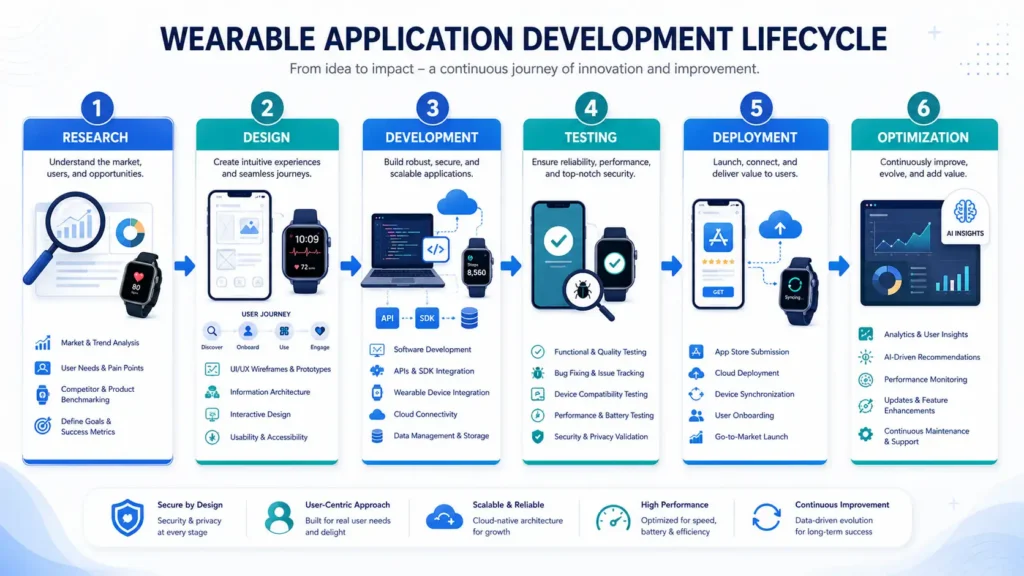
A structured wearable app development process helps teams reduce risks and deliver a reliable product. While project requirements vary, most successful wearable projects follow a similar path.
1. Research and Requirement Analysis
The first step involves defining business goals, target users, and technical requirements. Teams analyze competitors, identify market opportunities, and determine the features users need most. This phase also helps estimate timelines, resources, and potential challenges. Clear requirements prevent costly revisions later in the project.
2. UI/UX Design and Prototyping
After gathering requirements, designers create wireframes and interactive prototypes. Since wearable screens are small, simplicity becomes essential. Design teams focus on intuitive navigation, quick interactions, and readable content. Every action should require minimal effort from users. Testing prototypes early helps identify usability issues before development begins.
3. Architecture Planning and Integration
The development team designs the application’s architecture and selects suitable technologies. At this stage, developers determine how the app will communicate with devices, cloud services, and third-party platforms. Many projects involve wearable IoT app development solutions because wearable products often connect to larger digital ecosystems.
Proper planning ensures smooth communication between devices and backend systems. Businesses serving multiple device platforms frequently choose cross-platform wearable app development to reduce costs and accelerate deployment. A unified codebase simplifies maintenance while supporting broader market reach.
4. Development and Feature Implementation
Developers begin coding core functionalities after finalizing architecture and designs. Teams implement device communication, notifications, user authentication, data synchronization, and analytics.
The scope of wearable device app development often depends on the complexity of integrations and user requirements. Applications handling healthcare or enterprise data usually require additional security and compliance measures.
5. Testing and Quality Assurance
Quality assurance teams validate functionality, performance, usability, and security. Testing covers different devices, operating systems, and real-world conditions. Developers also monitor battery usage, synchronization speed, and connectivity reliability. Continuous testing reduces bugs and improves overall product quality before launch.
6. Deployment and Continuous Improvement
After successful testing, the application moves to app stores and distribution platforms. Launch is not the end of the journey. User feedback helps teams identify opportunities for enhancement. Regular updates keep the product competitive and aligned with changing customer expectations.
Explore more: How AI wearables are transforming industries
Distribution and Marketing of Wearable Apps
Building a great application is only part of the challenge. Businesses must also create a strong distribution and marketing strategy to reach their audience.
1. Launch Through Relevant App Stores
Most wearable applications are distributed through ecosystem-specific marketplaces. Developers must follow platform guidelines, performance requirements, and security standards. App store optimization improves discoverability. Clear descriptions, relevant keywords, quality screenshots, and positive reviews help attract downloads.
2. Build a Strong Marketing Strategy
Marketing should begin before launch. Businesses can generate awareness through content marketing, social media campaigns, email marketing, influencer partnerships, and product demonstrations. Highlighting practical benefits often produces better results than focusing only on technical features. Users want to understand how the app improves their daily lives.
3. Partner With Experienced Development Teams
Many businesses work with specialized agencies to accelerate development and marketing efforts. Organizations looking for custom wearable app development services often seek partners with experience across healthcare, fitness, and enterprise projects. An experienced team can help define product strategy, optimize user experience, and support long-term growth.
4. Invest in Ongoing Support
Successful wearable products evolve continuously. User expectations change, operating systems receive updates, and new devices enter the market. Regular wearable app maintenance ensures compatibility, security, and performance. Businesses that invest in ongoing improvements typically achieve stronger retention rates and better customer satisfaction.
5. Monetization Strategies
Choosing the right revenue model is important for long-term success. Effective wearable app monetization may include subscriptions, premium features, in-app purchases, licensing, or enterprise contracts. The ideal approach depends on target users, industry requirements, and business objectives. Subscription models often work well for fitness and healthcare applications because they provide recurring revenue.
6. Future Opportunities
The market continues to evolve rapidly. Emerging technologies such as AI, predictive analytics, and advanced sensors are expanding what wearable applications can accomplish. Many businesses monitor wearable app development trends to identify new opportunities and maintain a competitive advantage. Organizations that adapt quickly can deliver more personalized and valuable user experiences.
Companies planning long-term digital products often hire experienced dedicated developers to support innovation, scalability, and continuous improvement throughout the product lifecycle.
Conclusion
Wearables have transformed how people interact with technology, monitor health, and access information. Businesses across industries now recognize the value of connected digital experiences. This wearable app development guide highlights the key stages involved in building successful wearable solutions. From research and design to deployment and maintenance, every step plays a vital role in product success.
A thoughtful approach to wearable app development helps organizations create secure, scalable, and user-friendly applications. As wearable adoption continues to grow, businesses that invest in innovation today will be better positioned for future opportunities.