


A blockchain application can be technically ready for launch and still expose a business to costly security risks if critical weaknesses have not been identified. This risk is becoming harder to ignore. In the first half of 2026, Web3 incidents resulted in more than $1.31 billion in losses across 344 security incidents tracked by CertiK. The largest share of thefts involved compromised wallets, vulnerabilities or stolen access credentials, highlighting why blockchain application security needs to cover smart contracts and the wider systems surrounding modern blockchain applications.
For a business preparing to launch, this matters because security gaps are much harder to deal with once users and transactions depend on the application. Weak blockchain security can turn a launch-ready product into a last-minute remediation project. This guide explains what businesses should validate before going live and how to identify security gaps before they become costly problems.
Why security validation needs to happen before launch
Security issues are easier to identify and fix before a blockchain application goes live. Once users, business processes and valuable transactions depend on it, even a minor weakness can lead to service disruption, data exposure or financial loss.
That is why security should be incorporated into blockchain application development from the start. Security validation should continue throughout development, including architecture and smart contract reviews, access control checks and blockchain penetration testing to uncover weaknesses that could be exploited in real-world scenarios.
What does blockchain application security cover?
Blockchain application security covers the complete technology environment supporting a blockchain product, not just the underlying network.
A practical view includes:
Application code, smart contracts, wallets, keys, APIs, infrastructure, integrations and monitoring
This broader scope creates multiple potential attack vectors. Attackers may target an insecure API, a privileged wallet, an application permission or a third-party service integration. Businesses should therefore consider access controls, encryption and data handling, key management and blockchain network security as connected aspects of an overall security strategy.
Five principles for a secure blockchain application
A practical security strategy should follow five principles.
- Secure by design: Identify threats during architecture and design rather than relying on testing to uncover them later.
- Apply least privilege: Give users, services and administrators only the access they need.
- Assume components can fail: Design for compromised accounts, wallets, APIs and third-party services.
- Validate before deployment: Combine automated and manual checks, including peer review, before deployment.
- Monitor continuously: Security controls must be maintained beyond initial deployment.
These principles help management teams ask a more useful question than “Has the application been tested?” The better question is: “What have we tested, what did we find and what evidence shows that the critical risks have been addressed?”
What should businesses validate before launching a blockchain application?
Before launch, businesses should validate the security of their blockchain applications, covering everything from application architecture and smart contracts to wallets, APIs and real-world attack scenarios.
1. Application architecture
Review how the application communicates with both on-chain and off-chain components (APIs, databases, wallets and third-party services). Threat modelling can help identify trust boundaries and potential attack vectors, allowing businesses to make architectural changes while they are still cost-effective.
2. Smart contract logic
Check permissions, transaction logic, external calls and upgrade mechanisms before deploying contracts. Reviewing smart contract code can help identify issues such as improper access controls and reentrancy vulnerabilities before they affect users or transactions.
3. Wallets and private keys
Review how wallets, private keys and signing credentials are stored, accessed and protected. Key management should cover access controls, secure storage, rotation where appropriate and recovery procedures. This is especially important for wallets used to authorise transactions or control high-value assets.
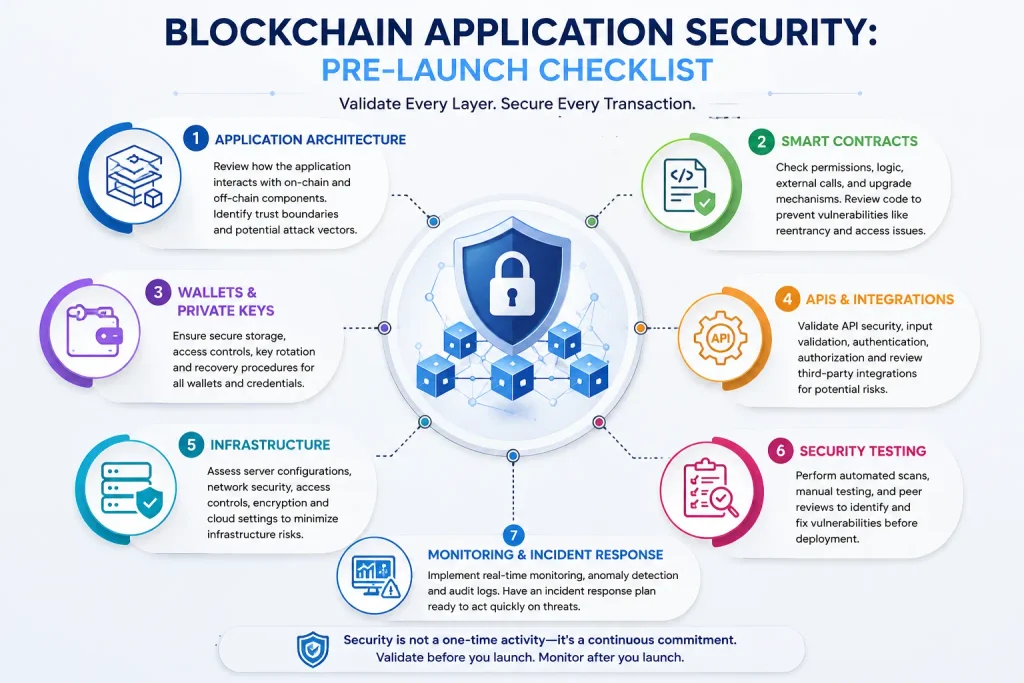
4. APIs and integrations
Review the systems that connect the blockchain application with users, internal services and external platforms. This includes API security, input validation, permissions, authentication and authorisation. Third-party integrations should also be reviewed, as a weakness outside the smart contract can still expose the wider application.
5. Real-world attack scenarios
Automated security tools can help identify potential vulnerabilities, but they may not reveal how those weaknesses could be exploited in real-world attacks. Vulnerability assessments and penetration testing can simulate attack scenarios involving privilege abuse, API misuse, contract interactions and unauthorised access.
Explore more: Right blockchain technology for app development
What should a blockchain security assessment checklist cover?
A useful analysis should go beyond confirming that an application has passed a test. It should provide clear evidence of identified risks, prioritised findings and practical remediation actions, giving businesses a clear understanding of what needs to be fixed before launch.
| Checkpoint | What to check before sign-off |
| Architecture | Confirm trust boundaries, dependencies and exposed attack surfaces have been reviewed. |
| Smart contracts | Check business logic, permissions, external calls and upgrade mechanisms for unsafe behaviour. |
| Application code | Review code for implementation flaws, insecure functions and unexpected input handling. |
| APIs | Verify authentication, authorisation, input validation and rate-limiting controls. |
| Wallets & keys | Confirm private keys are securely stored, access is restricted and transaction signing is protected. |
| Infrastructure | Check cloud configurations, servers, deployment pipelines and exposed services for security misconfigurations. |
| Third-party integrations | Verify oracles, external APIs and other connected services do not introduce new attack paths. |
| Security testing | Confirm identified weaknesses have been tested, prioritised and retested after fixes. |
| Monitoring & response | Ensure logging, security alerts and incident response procedures are in place before going live. |
| Final sign-off | Make sure critical findings are resolved, residual risks are documented and ownership is assigned. |
When Should Blockchain Application Security Testing Happen?
Security should follow the product lifecycle rather than be rushed into the final week before launch.
- Before development: Define security requirements and model likely threats.
- During development: Apply secure coding practices, automated tests and code-level checks.
- Before deployment: Review critical components and conduct deeper security testing.
- Before launch: Remediate critical findings, retest fixes and verify deployment controls.
- After launch: Continue monitoring, reassess changes and review emerging risks.
This lifecycle approach to blockchain application security testing makes security part of the development process rather than treating it as an approval gate at the end.
Common Blockchain Security Myths and Facts
Some security assumptions can leave gaps even when individual tests have passed. These are the common myths businesses should challenge before launch:
| Myth | Fact |
| “Our smart contract audit passed, so everything is secure.” | A contract audit does not cover every part of the application. |
| “We can fix security after launch.” | Fixing critical issues later can disrupt users and transactions. |
| “Automated tools found nothing.” | Tools can miss business-logic flaws and complex attack paths. |
| “The blockchain is secure, so our application is secure.” | Application-level risks can still exist in wallets, APIs, permissions and infrastructure. |
Explore more: Complete guide to blockchain app development
Application security best practices that continue after launch
Launching a secure application is not the end of an organisation’s work to protect it. Blockchain security best practices should continue as the application evolves, with new features, integrations and infrastructure changes being assessed for security risks. Businesses should therefore continue to:
- Monitor application activity: Use logs, alerts and security monitoring to identify unexpected transactions, failed authentication attempts or abnormal system behaviour.
- Review and update smart contracts: Monitor deployed contracts for new risks and review any proposed changes before they are deployed into production. New functionality should be assessed against the same security standards as the original code.
- Test after major changes: Perform targeted security testing and vulnerability assessments after significant changes, additions or infrastructure upgrades.
- Strengthen access controls: Regularly review user permissions, administrator accounts and service access. Ensure that privileges are removed when they are no longer needed and that credentials are rotated where appropriate.
- Protect keys and wallets: Continuously review wallet access, signing processes and cryptographic key management, particularly for privileged or high-value accounts.
- Maintain an incident response plan: Define the process for responding to a vulnerability or suspicious activity, including who will lead the investigation, who has the authority to pause specific functions and how the system can be restored.
- Track emerging threats: Maintain defences against new application-specific vulnerabilities, attack vectors and wider ecosystem developments.
Build and validate your blockchain application with IIH Global
Building a blockchain application is a big investment, so security issues should not become an expensive surprise after launch. With IIH Global as your experienced blockchain app development agency, you can identify risks early, reduce rework and avoid costly post-launch fixes. From smart contracts and architecture to testing and deployment, you get practical support to move from development to launch with confidence.
Ending Note
Blockchain security is not a one-time testing exercise. From smart contracts and wallets to APIs and infrastructure, the entire application environment should be reviewed before deployment and continuously monitored after launch. Identifying and addressing potential issues early can reduce remediation costs, minimise disruption and give teams greater confidence in what they are deploying.
If you are preparing to launch a blockchain application, contact our experts to discuss your security requirements and identify what needs to be validated before going live.