


Building a real estate marketplace app for the UK property market requires more than a searchable property catalogue. The platform must connect buyers, sellers, landlords, tenants, agents, and service providers through a reliable digital experience. A successful real estate marketplace app should combine accurate property data, location tools, communication features, secure transactions, and practical insights.
The UK market also has specific requirements around property information, energy performance, data protection, and user trust. Therefore, businesses planning a real estate marketplace app for the UK property market should define their audience, business model, technical architecture, and compliance requirements before development begins.
Understanding Real Estate Marketplace Apps
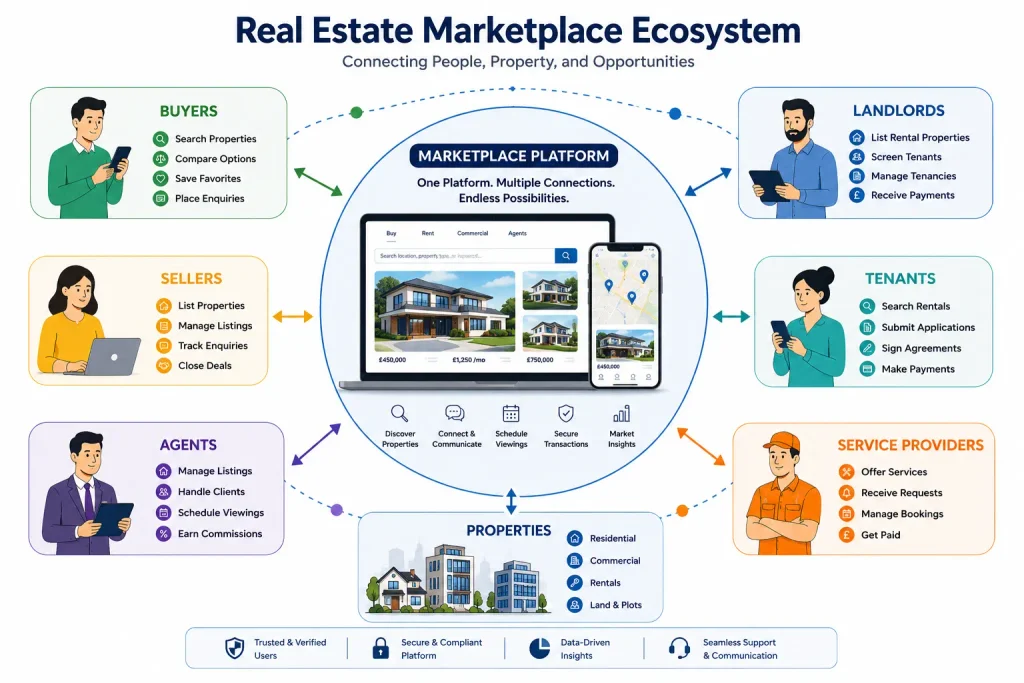
A real estate marketplace connects multiple participants through one digital platform. Users can browse properties, compare options, contact stakeholders, arrange viewings, and manage enquiries from their phones.
Unlike a basic property website, a marketplace can support multiple listing providers and user groups. It may generate revenue through listing fees, subscriptions, commissions, premium placements, advertising, or additional property services.
A typical platform supports residential sales, rentals, commercial properties, or multiple categories. The business model determines which workflows and features deserve priority during development.
For example, property buyers may need detailed listings, location information, affordability tools, and viewing requests. Meanwhile, property sellers may need listing management, enquiry tracking, analytics, and communication tools.
A strong marketplace also needs reliable data management. Property information should remain structured, searchable, and easy to update across different user accounts.
How the UK Market Shapes the Product
The UK property market covers different regional conditions, property types, pricing patterns, and regulatory considerations. London, Manchester, Birmingham, Edinburgh, and other cities can have very different user expectations.
A platform should therefore support location-aware searches and flexible listing categories. It can also provide relevant information such as house prices, property type, tenure, energy information, and local amenities.
For a business targeting this market, real estate app development in UK projects should consider local user behaviour from the planning stage. This helps the product feel relevant rather than simply adapting a generic property platform.
Explore more: Key benefits of real estate app development
Key Features of a Real Estate Marketplace App
The feature set should support the complete property journey, from discovery to enquiry and transaction. A practical MVP can begin with essential features before adding advanced capabilities.
1. Property Listings and Search
The foundation of a marketplace is its listing experience. Users should see clear property listings with photographs, pricing, location, descriptions, availability, and essential property information.
A property listing app in the UK should provide structured listing categories for sales and rentals. Users should also have access to flexible property filters covering price, location, bedrooms, bathrooms, property type, tenure, and other relevant attributes.
A dedicated property search app in the UK can improve discovery by combining keyword search with location-based functionality. Users should be able to switch between list and map views without losing their search criteria.
2. Maps and Location Intelligence
A map-based property search helps users understand where properties sit within their preferred areas. Map integration can display listings alongside roads, neighbourhoods, transport links, schools, and other useful points of interest.
Location services can also support radius searches and distance calculations. These functions become particularly useful when users search around workplaces, stations, schools, or specific postcodes.
3. Detailed Property Information
Each listing should provide comprehensive property details without overwhelming the user. High-quality images, videos, descriptions, specifications, and floor plans can help users evaluate properties remotely.
Energy information is also important in the UK. Where available, listings can display EPC ratings and relevant energy details.
A good listing page should make important information easy to scan. Users should quickly understand the property’s price, size, location, availability, key features, and contact options.
4. Accounts and User Verification
Marketplace platforms need different account types for buyers, sellers, landlords, tenants, and agents. Role-based permissions can control what each user can create, edit, view, or manage.
User verification can reduce fraudulent listings and improve trust. Depending on the platform model, verification may involve email confirmation, phone verification, identity checks, or business validation.
5. Saved Searches and Alerts
Users often return to properties that match their requirements. Features for saved properties allow them to create personal shortlists.
Property alerts can notify users when new listings match their saved criteria. Combined with push notifications, alerts can help users respond quickly when attractive properties enter the marketplace.
6. Enquiries and Property Viewing
Communication should remain simple throughout the property journey. Users can contact agents or sellers through enquiry forms, in-app messaging, calls, or other approved channels.
The platform should also support property viewing requests. Calendar integration can help users select available slots while allowing agents or sellers to manage appointments.
7. Financial Tools
Financial features can increase the practical value of a property platform. A mortgage calculator can provide estimated monthly repayments based on price, deposit, interest rate, and loan duration.
The platform can also integrate property valuation services where suitable data sources are available. These tools should clearly distinguish estimates from professional valuations.
8. Payments and Monetisation
If the marketplace charges listing fees, subscriptions, deposits, or other applicable charges, payment infrastructure becomes essential.
Businesses should use established payment providers and implement secure payments with appropriate authentication and transaction controls. Payment records should remain traceable for users and administrators.
Explore more: How to choose a real estate app development partner
Steps to Build a Real Estate Marketplace App
1. Define the Business Model
Start by identifying who will use the platform and how it will make money. Decide whether the marketplace focuses on sales, property rental, commercial property, or multiple segments. Then define revenue channels such as subscriptions, promoted listings, commissions, advertising, or lead generation.
2. Research Users and Competitors
Study how buyers, sellers, landlords, tenants, and agents currently search for properties. Identify common frustrations and gaps in existing platforms. The research should influence the product rather than simply replicate competitor features. Build user journeys for listing creation, property discovery, enquiries, saved searches, and viewing requests.
3. Plan the MVP
An MVP should solve the core problem without introducing unnecessary complexity. Essential modules may include registration, listings, search, filters, maps, messaging, favourites, notifications, and administration. Advanced functions such as AI recommendations, automated valuation, predictive analytics, and personalised experiences can follow after validating demand.
4. Design the User Experience
Create wireframes for the main workflows before development starts. Keep navigation simple and make property discovery the central experience. Responsive interfaces are important because users may move between smartphones, tablets, and desktop devices. Accessibility should also influence typography, contrast, navigation, forms, and interactive elements.
5. Select the Technology Stack
The technology stack depends on expected traffic, features, integrations, budget, and development strategy. A typical architecture can include a mobile frontend, backend APIs, database, cloud infrastructure, search engine, maps, analytics, and third-party services.
A property marketplace app development in UK project may use native iOS and Android app development or cross-platform technologies. The right approach depends on the product’s performance requirements and available resources.
6. Develop the Backend and APIs
The backend should manage users, properties, searches, enquiries, payments, notifications, permissions, and administrative workflows. API-first development can make it easier to connect mobile applications with web dashboards and external services. Search infrastructure should also support fast filtering across large property datasets.
7. Integrate Property and Location Services
Depending on the platform, developers may integrate mapping, geolocation, address lookup, property data, valuation, mortgage, analytics, and communication APIs. Data licensing deserves particular attention. A business should confirm that its chosen provider permits the intended commercial use, storage, redistribution, and display of property data.
8. Add Security and Compliance Controls
Security should cover authentication, authorisation, encryption, secure API communication, data storage, logging, backups, and access controls. For a UK-focused platform, privacy and data protection requirements should influence the architecture from the beginning. Developers should also establish clear data retention and deletion processes.
9. Test the Platform
Testing should cover functional workflows, search accuracy, performance, security, usability, compatibility, and failure scenarios. Testers should verify listing creation, search filters, map interactions, notifications, messaging, payments, account permissions, and administrative actions.
10. Launch, Measure, and Improve
After launch, monitor search behaviour, listing engagement, enquiry rates, conversion funnels, crashes, and performance. Regular product updates should respond to real user behaviour. This approach helps the marketplace evolve without adding features simply because competitors offer them.
Explore more: Real estate app development cost guide
Real Estate Marketplace App Development Cost
The cost of building a marketplace varies significantly because each platform has different requirements. A basic MVP with listings, accounts, search, maps, favourites, and an admin panel requires less development than a large multi-sided marketplace.
For a UK project, a practical planning range for a lean MVP is around £40,000 – £80,000. A mid-level platform with advanced integrations and stronger marketplace workflows may reach £80,000 – £150,000.
A complex platform with AI, sophisticated property data integrations, advanced analytics, automated valuation, multiple user roles, and extensive administration can exceed £150,000.
These figures represent planning ranges rather than fixed quotations. The final price depends on platform scope, UX complexity, integrations, development location, security requirements, testing, maintenance, and post-launch support.
Businesses can control initial costs by launching an MVP and prioritising features based on business value. A modular architecture then allows additional functionality to be introduced as usage grows.
For larger projects, businesses may hire dedicated developers in UK or work with an external development team. The choice depends on hiring costs, project duration, internal technical expertise, and required delivery capacity.
Challenges and Future Opportunities
Real estate marketplaces face several technical and business challenges. Maintaining accurate listings is one of the most important because outdated information can quickly reduce user trust.
Scalability also matters. Search performance can decline when the platform handles large listing volumes, heavy traffic, images, maps, and complex filtering.
Fraud prevention requires continuous attention. Businesses should combine verification, moderation, reporting mechanisms, secure authentication, and monitoring to identify suspicious activity.
Another challenge involves third-party data. Property information may come from multiple providers with different formats, licensing terms, update schedules, and API limits.
Explore more: Cost to build a real estate app like Rightmove
AI and Personalised Property Discovery
AI can improve search and recommendations when sufficient quality data exists. A platform could analyse preferences such as budget, location, property type, amenities, and previous interactions. AI can then help rank relevant listings or power conversational search. For example, users could describe their requirements naturally instead of manually selecting every filter.
Automated document analysis, lead prioritisation, listing quality checks, price insights, and customer support are other potential applications. However, AI outputs should remain transparent and appropriately controlled. Businesses should avoid presenting estimates or recommendations as guaranteed facts.
Future Marketplace Opportunities
A modern real estate mobile app development in UK strategy can expand beyond basic property discovery. Future products may integrate digital identity, virtual tours, smart contracts, valuation services, mortgage journeys, insurance, moving services, and home management.
A strong ecosystem can create value beyond listing properties. The marketplace can become a central platform for several stages of the property lifecycle.
Businesses working with an experienced app development company in the UK can also introduce features incrementally. This approach reduces initial complexity while creating a foundation for future expansion.
Conclusion
Building a successful marketplace requires careful planning across product strategy, user experience, technology, security, data, and monetisation. The strongest platforms focus on making property discovery and communication straightforward.
A real estate marketplace app for the UK property market should reflect local requirements while remaining flexible enough to support changing user expectations. Businesses can start with a focused MVP, validate demand, and expand through measurable product improvements.
With the right architecture and development approach, the platform can support property discovery, enquiries, viewings, and related services within one connected experience.