


Every organisation planning to launch a mobile app must decide how the solution should be developed. One of the most important decisions is choosing between build vs buy mobile app development. With the total revenue in the global app market estimated to reach US$739.61bn in 2026, organisations are looking for a clear roadmap. Navigating this landscape can be challenging, especially when businesses need an app to engage customers, support daily operations, and achieve specific business goals.
Some of the most common questions here include: Should we create our solution from scratch or invest in buying an off-the-shelf product? Which option will help our business grow and deliver the greatest value? Factors such as budget, timeline, app requirements, and long-term business goals all play a role in making the right decision.
This decision is rarely a purely technical one; it is primarily a business decision. Modern mobile app solutions range from completely tailored products to subscription-based platforms that can be customised within days. Each approach can serve different business needs, but they involve trade-offs in cost, control, flexibility, and customisation. The decision can also affect the user experience that customers ultimately encounter.
This guide explains the differences between the two approaches, when each may be suitable, and the factors to consider before making a decision. We also cover the cost, return on investment, and how to pick a partner. Keep reading!
What Does Build vs. Buy Mean for Mobile Apps?
Building means investing in custom mobile app development to create a solution that is tailored around business-specific requirements. An individual or development team designs, codes, tests, and launches the product. The development team works with the business to translate its requirements into a solution tailored to its workflows and objectives.
Buying, meanwhile, means adopting a ready-made mobile app solution that has already been built by a vendor. The buyer typically pays a licence fee or subscription charge, configures the available settings, and deploys the solution. The vendor retains overall control of the roadmap and the underlying infrastructure.
Some businesses also choose to customise an off-the-shelf mobile app. Vendors may offer customisation options that can be suitable when the available functionality meets the business requirements. It is therefore advisable to define what success means for your business before contacting and comparing vendors.
Build vs Buy Mobile Application: Key Differences
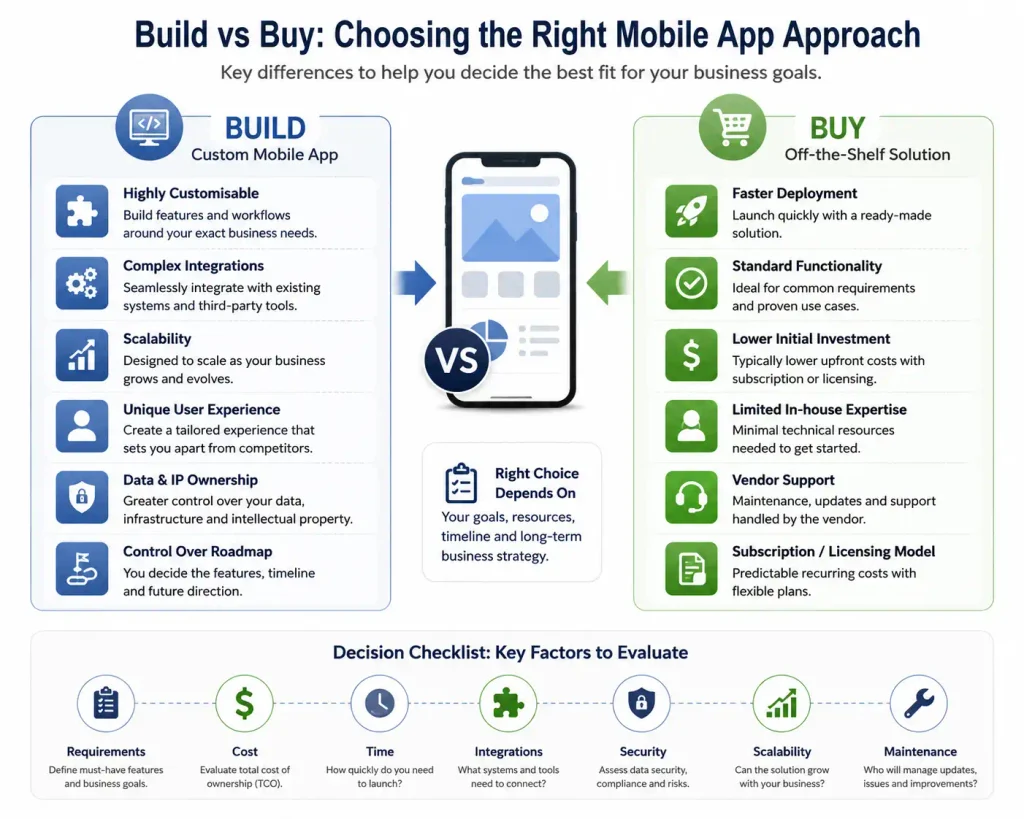
Although both approaches aim to deliver a solution that meets business objectives, they differ in several important ways. The key differences include:
1. App Customisation
Because the solution is developed around the business’s requirements, custom development can provide a high degree of control over workflows, functionality, and user experience. Buying a ready-made product will often result in paying for what you don’t need. It may also require businesses to adjust their workflows and processes to fit the product rather than the other way around.
2. App Development Time
Custom mobile app development involves the discovery, design, coding, and testing phases. The timeline therefore often stretches over several months or up to a year, depending on the complexity. An off-the-shelf product can often be deployed faster because much of the underlying functionality has already been developed.
3. Cost Structure
A custom application typically requires a larger up-front investment. A purchased solution, meanwhile, typically involves ongoing costs in the form of subscriptions or licence renewals. Neither is necessarily more expensive than the other in the long run. The benefits, however, differ a great deal, with the former providing greater control over how the application is designed for future growth.
4. Technical Support
With a custom app, the support and updates fall to the development partner or the in-house team depending on the engagement model. Meanwhile, the reliability and maintenance of a purchased solution depend largely on the vendor’s technical support and update policies.
5. Data Ownership
With a custom app, the business can generally have greater control over its data, infrastructure, and application architecture, depending on the hosting model and contractual arrangements. A purchased solution, meanwhile, may have limitations on how the data can be accessed or exported.
6. Control Over Roadmap
With a built app, the business has greater control over the product roadmap, whereas the roadmap of a purchased app is primarily determined by the vendor. These differences show that the build-vs-buy decision is not simply about which approach is better, but which one best fits the business’s needs.
Explore more: Why your business needs custom mobile app development
When Should Businesses Build a Custom Mobile App?
Custom app development may be more suitable when the app plays a central role in the company’s competitive strategy. Building may be particularly suitable when the business requires extensive customisation to support unique processes. Consider investing in a custom mobile app in the following situations:
1. Unique Processes
If the way the business does things cannot fit into existing digital processes, then buying may actually slow the business down. Teams may be required to work around it at every step, wasting time that could be used elsewhere.
2. Complex Integrations
Businesses working with different tools require complex integrations to keep the operations running smoothly. These may include CRM and ERP systems, logistics platforms, payment gateways, and other business systems. Strong API integration facilitates the two-way flow of data between the app and the systems. Integration with a purchased solution is generally limited to the APIs, connectors, and integration options supported by the vendor.
3. Substantial Growth Requirement
If a business has plans to scale in the future, mobile app scalability is important. It allows the application to accommodate increases in users, transaction volumes, and feature requirements. A custom application can be designed to accommodate anticipated increases in users, transaction volumes, and feature requirements. This requires scalability to be considered during design and development.
4. User Experience Is a Key Differentiator
Apart from scalability and performance, building is beneficial when a polished UI/UX and unique features are integral to the product’s appeal. Businesses can exercise greater control over the app’s design, interactions, and user experience.
5. Ownership Priorities
A custom app can generate lasting value as an intellectual property asset. Depending on the development agreement, the business may retain ownership of the source code, intellectual property, and business data.
If more than one of these points applies, working with a partner that offers custom mobile app development services is well worth considering. A suitable development partner should typically begin with discovery and roadmap workshops, followed by a lean MVP launch to test the solution before iterating and expanding.
When Should Businesses Invest in Buying an Existing Mobile App?
Buying may be more suitable when speed and simplicity are more important than differentiation. In the context of the build vs buy application dilemma, these are the situations where purchasing an existing mobile app is more compelling:
- Requirements are relatively standard
- Budget or timeline is limited
- In-house expertise is limited
- Complex integrations are not required
An existing mobile app is a good way to test an idea before committing to something larger. Here, businesses might need to also factor in high app maintenance costs. Vendor lock-in can also be an issue if the requirements change or the costs begin to exceed the budget. Ask the vendor about the exit options, such as data export, before signing the contract.
Explore more: Why UK businesses are adopting AI-powered mobile apps
Top 8 Factors to Evaluate in Build vs Buy Mobile App
The decision to build or buy an app should be made after careful consideration of the following factors:
1. Business Requirements
Create a list of must-have features, desirable features, and the user segments that will adopt the product. Make sure to consult with the stakeholders from operations, sales, and support to avoid surprises later. If the majority of the required functionality does not exist in ready-made mobile app solutions, opt for building a new one.
2. Development Cost
If the organisation has clearly defined budgetary constraints, mobile app development cost is a major factor. Ask about a detailed cost estimate of development from the vendors, compare them, and then make the right decision.
3. Total Cost of Ownership
For a custom app, TCO can include development, hosting, maintenance, support, security, and future enhancement costs. For a purchased solution, it may include subscription or licensing fees, implementation, integrations, support, and additional user or usage charges. Compare these costs over a defined period, such as three to five years, rather than focusing only on the initial investment.
4. Time to Market
In situations where a mobile presence is required within a short window, buying a mobile app solution may offer an advantage. For example, this may be relevant around the launch of a seasonal product or in response to a competitor’s move. Meanwhile, a larger-scale custom solution may take longer to launch but could provide greater long-term value when extensive customisation is required. Consider a phased launch in either case.
5. Integration Requirements
Prepare a list of the tools and systems the new mobile app will need to integrate with. These may include payment gateways, ERP and CRM systems, inventory platforms, and sales systems. Ask the vendor to conduct a detailed demo showcasing the functioning of all these integrations. Base your decision on whether this works for your requirements. A custom app may be more suitable in complex situations where the integration requirements are unique or are not adequately supported by existing solutions.
6. Security and Data Control
Many companies overlook mobile app security until it is too late. Ask the potential vendor about the encryption, authentication, and penetration testing procedures. Ensure they align with the industry standards for the type of data being stored. Define the acceptable risk in case of a security breach and the liabilities in case of a regulatory violation. Regulated industries often benefit from a custom build, but this depends on the specific requirements.
7. Scalability and Future Growth
The business objectives for growth are important considerations too. If the business has a static number of users, it might think of buying the app. Organisations expecting substantial increases in users, transactions, or data volumes may benefit from building a custom solution. Scaling a ready-made solution may become more challenging if higher usage requires a significant increase in subscription or licensing fees.
8. Maintenance and Vendor Dependency
Lastly, consider the long-term maintenance and support, including security updates, operating system compatibility, and issue resolution. With a bought solution, these fall to the vendor, but they will prioritise their own products and customers. With a custom app, the company has full control and has to bear the responsibility and the cost.
Explore more: How to choose the best mobile app development company
Conclusion
There is no universally right answer to the build-vs-buy decision. The most suitable approach depends on your business requirements, budget, timeline, integration needs, security obligations, scalability expectations, and desired level of control.
Before partnering with a vendor, clearly define your objectives. Evaluate the total cost of ownership, implementation timeline, maintenance requirements, and long-term flexibility of each option. The goal is to choose the approach that aligns most closely with your organisational needs and business objectives.
IIH Global is a custom mobile app development company helping organisations across industries build reliable mobile solutions from the ground up. Contact us to learn how we can help you turn your app requirements into a scalable digital solution.