


Choosing an eCommerce website technology stack involves more than selecting the right tools and technologies. It affects page load times, the ease of adding new features, and the security of customer data. Your platform’s long-term maintainability also depends on this decision.
With global eCommerce sales projected to reach $6.4 trillion in 2026, choosing the right technology stack is an important step towards building a scalable and successful online store. Effective eCommerce website development begins with matching technology to business goals.
This guide explains the key considerations and practical steps involved in choosing the right stack for your eCommerce website.
What Does an eCommerce Website Technology Stack Include?
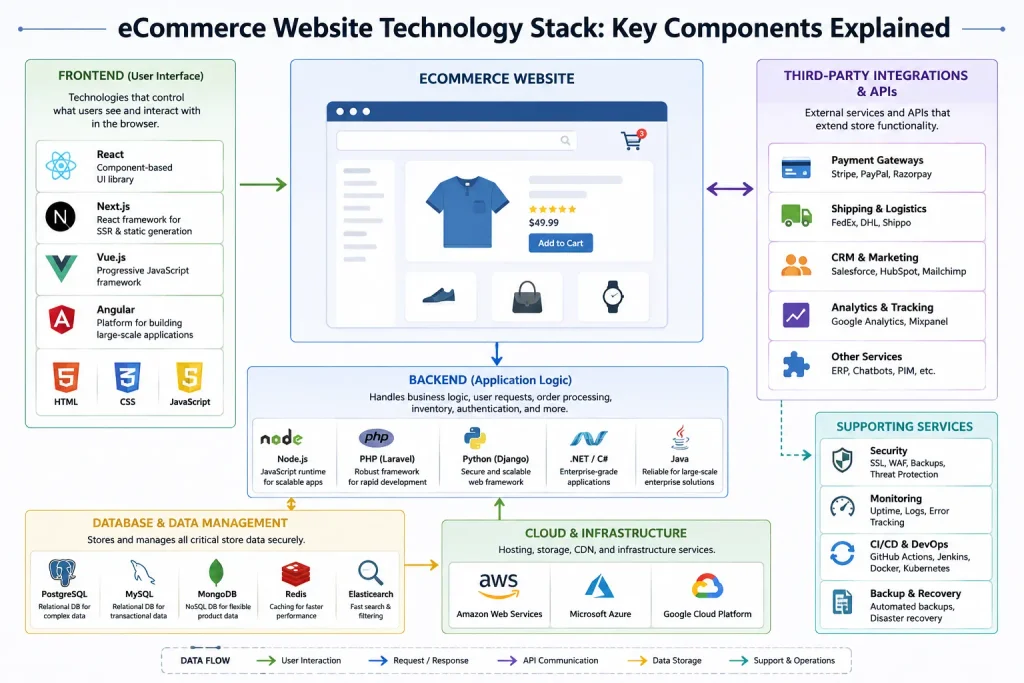
An eCommerce tech stack is the combination of programming languages, frameworks, tools, infrastructure, and services that power your store. It supports the different layers of your store, including the presentation layer, application logic, data storage, and third-party integrations. These technologies must work together seamlessly; otherwise, integration issues can lead to poor performance, higher costs, and additional development work.
Key Factors to Consider When Choosing an eCommerce Tech Stack
Selecting an eCommerce website technology stack is not an isolated step. It requires careful consideration of several factors, including scalability, budget, time to market, and your team’s technical expertise. The main factors to consider include:
1. Website Security
Online stores deal with payment processing and handle personal data. Security cannot be an afterthought. Choose technologies that receive regular security updates and support appropriate protections against threats such as SQL injection and cross-site scripting (XSS). Ensure that your payment processing arrangements comply with the applicable PCI DSS requirements.
2. Integrations
Check how easily the stack integrates with your ERP, CRM, marketing tools, and other systems. These integrations determine how efficiently your teams can access and exchange the data they need.
3. Maintenance and Scalability
A stack with limited community support or infrequent updates may require more maintenance effort. Choose the technology with regular releases, strong community support, and a healthy talent pool. It should also scale with your business requirements.
Explore more: Complete guide to custom eCommerce website development
Frontend Technologies for eCommerce Websites
The frontend technology stack determines how your eCommerce website looks and performs in users’ browsers. HTML, CSS, and JavaScript form the foundation of the frontend. Frameworks and libraries build on these technologies.
React supports component-based user interfaces, while Next.js builds on React with features such as server-side rendering and static generation that can improve initial loading performance and search engine visibility when implemented appropriately. Vue.js and Nuxt offer a gentler learning curve, while Angular suits large, structured applications.
Your frontend should support responsive design and consistent performance across screen sizes, devices, and browsers.
Backend Technologies for eCommerce Websites
Backend technologies power functions such as inventory checks, order processing, and user account management. The right choice depends on your business requirements and your team’s expertise.
Node.js is well suited to real-time features and handles many concurrent requests efficiently. PHP with Laravel is a practical option for rapid, cost-effective development. Python with Django provides a structured framework and built-in security features. Java and .NET are commonly used for more complex workflows, such as in enterprise-scale stores.
The eCommerce development technologies you select must pair well with a database that matches your data patterns. Modern stores connect to payment providers, shipping carriers, CRMs, and marketing tools through well-designed APIs.
Database Technologies and Data Management
The database stores critical information within your eCommerce technology stack. Relational databases such as PostgreSQL and MySQL are commonly used for transactional data, including orders, payments, and customer accounts because they support transactions and data integrity. NoSQL databases such as MongoDB can be useful for product catalogues with flexible or varied data structures, depending on query patterns and consistency requirements.
You can also use Redis for caching, which can speed up access to frequently requested data. Consider Elasticsearch or Algolia for fast product search and filtering. Plan for regular backups, encryption of sensitive records, and a clear data retention policy. Good data management keeps reporting accurate and pages responsive even when your catalogue and customer base are growing.
Explore more: Choosing an eCommerce expert for your business
eCommerce Architecture and Platform Selection
Next, consider your eCommerce architecture and platform options. Let’s examine the main considerations in detail.
eCommerce architecture
eCommerce website architecture describes how the frontend, backend, database, and external services interact. A clear architecture keeps code organised, simplifies testing, and makes it easier to add features. Consider a modular monolith or a microservices architecture based on your business and operational needs. Microservices allow individual services to scale independently but introduce additional deployment, monitoring, and maintenance complexity.
Traditional vs headless approach
Traditional setups tie the frontend and backend together. In contrast, headless eCommerce separates the frontend from the backend and connects them through APIs. This gives designers freedom to build fast, custom experiences across web, mobile, and other channels. Many stores use a hybrid approach as well.
Platform considerations
Using the right eCommerce platform can shorten your launch time. Popular options include Shopify, Adobe Commerce (formerly Magento), WooCommerce, and BigCommerce. Pick the one that is best suited for your content management system needs. Easy editing of pages, blogs, and product content saves your marketing team time.
Customisation
No two businesses operate in the same way. A custom eCommerce website will give you full control over features, workflows, and user experience. Although custom development may take longer, it can deliver a strong return on investment when it addresses specific business needs.
eCommerce Integrations, APIs, and Essential Features
A store is only as capable as the systems it connects to. Start by choosing a reliable payment gateway such as Stripe, PayPal, Razorpay, or Adyen. Make sure it supports the payment methods your customers actually use.
eCommerce APIs allow your online store to exchange data with shipping providers, tax tools, ERPs, and CRMs. Well-documented APIs reduce development time and prevent data silos. You can also use third-party integrations to add functionality like reviews, live chat, email marketing, and analytics.
Core features should include a smooth shopping cart with saved items and guest checkout. All these systems should also sync automatically to let your team spend less time on manual work. This helps customers receive accurate information about product availability, orders, payments, and deliveries.
Explore more: eCommerce website development cost guide
eCommerce Hosting, Security, Performance, and Scalability
Hosting, security, performance, and scalability are also essential considerations.
Cloud infrastructure
Cloud hosting through AWS, Google Cloud, or Azure lets you add or reduce resources on demand, with costs depending on the services and pricing model you choose. Cloud platforms provide access to managed services and geographically distributed infrastructure. However, redundancy, autoscaling, and disaster recovery depend on the services you select and how you configure your architecture.
Security
Strengthen security by using HTTPS everywhere. Also keep dependencies updated and apply role-based access controls. Add a web application firewall, enable two-factor authentication for admins and run regular security audits and penetration tests.
Performance and scalability
All your store features should perform under heavy load and scale as required. These include inventory management and order management. Monitor the performance of all your functions continuously. There are tools that help fix issues before they disrupt your processes.
How to Choose the Right eCommerce Technology Stack
There is no universal formula that works for all when selecting the best technology stack for eCommerce. Since every project is different, the technology it will require will be different too. Some platforms need to focus on high speed, while others need to cater to a larger number of customer requests simultaneously. Here are some steps that you can follow to select the best fit as per your business objectives.
Step 1: Define business requirements
Start by defining your target audience, product types, and market. A B2B online store with custom pricing will need different tools than a fast-moving consumer fashion brand. Write down must-have outcomes before looking at any technology.
Step 2: Estimate traffic and growth
Based on your business model, estimate the expected number of visitors, order volume, catalogue size, etc. for the next two to three years. Choose the infrastructure that can help your business scale smoothly with the growing requirements. Technology that has difficulty scaling will be disadvantageous in the future.
Step 3: Determine functionality
The next step in helping you select the best eCommerce website technology stack is to decide what features your platform will offer. These might include subscriptions, multi-currency support, personalisation, or marketplace capabilities. Ensure the tech stack you select will support such functionalities without heavy workarounds.
Step 4: Assess development resources
Also, select the stack after evaluating your in-house teams and deciding the budget you can spend on eCommerce store development. It gives you a clear idea of how much training your team requires. Choose the tools that can be adopted easily within the required timeline.
Step 5: Evaluate long-term ownership
Finally, also look at the cost and effort required for owning the system long-term. These include licensing, hosting, updates, security patches, etc. Prioritise a stack that balances maintenance costs, operational benefits, and long-term business needs.
Conclusion
Selecting the eCommerce tech stack is a pivotal decision and requires careful consideration. You need to choose a stack that performs the best while keeping your team’s proficiency and budgetary constraints in mind.
If you are stuck, IIH Global can help your business with high-performing eCommerce website development solutions. We can be a part of your journey right from deciding the best tech stack to launch and maintenance.