


Modern online retail is more competitive than ever. Businesses need digital stores that reflect their brand, support growth, and deliver smooth shopping experiences. Custom eCommerce website development helps companies build unique platforms instead of relying on generic templates. Investing in custom eCommerce development allows businesses to create tailored features, improve performance, and meet changing customer expectations.
Unlike ready-made solutions, a custom-built store gives complete control over design, functionality, and integrations. Whether you serve consumers or businesses, the right platform can increase conversions and strengthen customer loyalty. This guide explains the development process, essential features, future trends, and practical considerations before starting your project.
Why Businesses Need Custom eCommerce Development
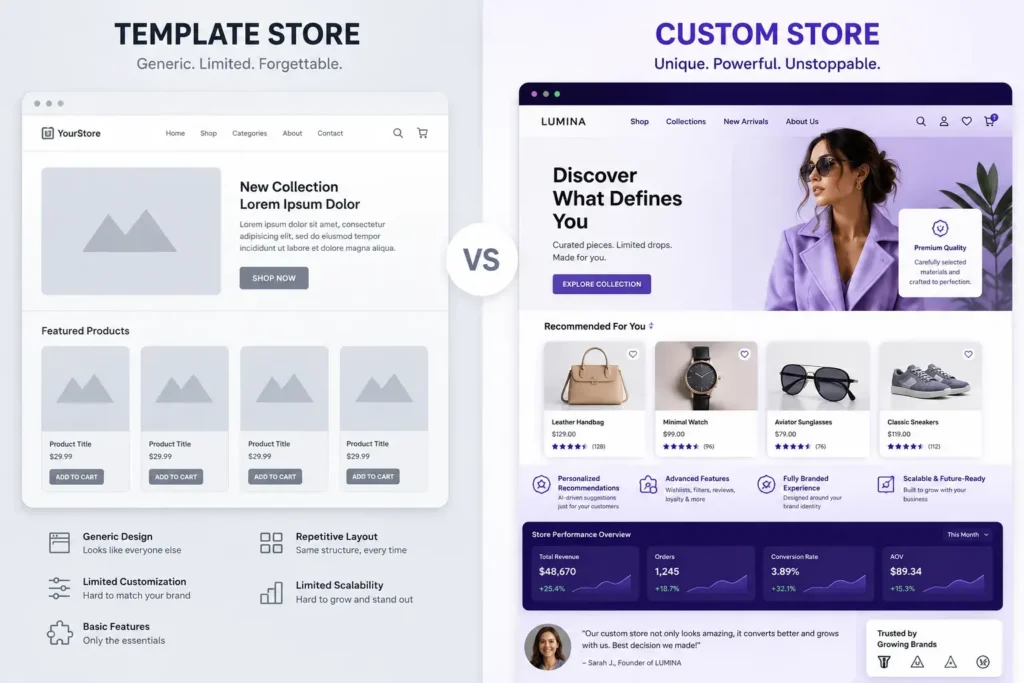
Every business has different goals, products, and customers. A standard platform often creates limitations as operations grow. A custom eCommerce website gives complete flexibility to build exactly what your business needs.
1. Greater flexibility and scalability
A tailored platform supports future growth without forcing businesses to rebuild everything later. Whether you plan to expand internationally or add new product lines, a scalable eCommerce website adapts to changing requirements. According to industry reports, online retail sales continue to grow worldwide every year. Businesses with scalable digital platforms respond faster to market changes and customer demand.
2. Better customer experience
Customers expect fast-loading pages, simple navigation, and secure checkout. A customized platform improves the customer experience in eCommerce by removing unnecessary friction during shopping. For example, brands like Nike and Apple invest heavily in personalized shopping journeys because better experiences increase repeat purchases and customer satisfaction.
3. Competitive advantage
The benefits of custom eCommerce website solutions extend beyond appearance. Businesses gain unique workflows, personalized recommendations, advanced search capabilities, and business-specific automation. Instead of adapting business operations to software limitations, the software supports the business.
4. Template versus custom platforms
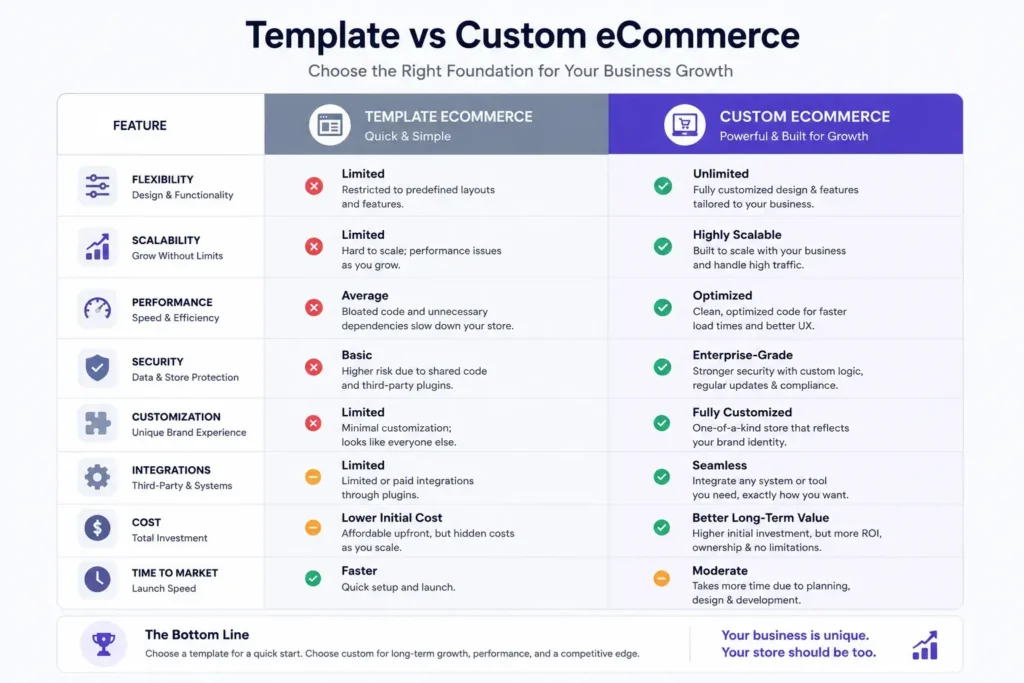
Choosing between a custom vs template eCommerce website depends on business goals. Templates work for startups with simple requirements. Growing companies usually require greater flexibility, stronger security, and custom integrations that templates cannot provide efficiently.
Understanding Custom eCommerce Website Development
Custom eCommerce website development involves designing and building an online store from the ground up according to unique business requirements. Every function serves a specific purpose instead of relying on generic modules. The process begins by understanding customer behavior, operational workflows, and long-term business objectives.
Developers then select the right custom eCommerce technology stack based on expected traffic, required integrations, and future scalability. A successful project includes more than coding. It combines business strategy, UX design, security planning, testing, and optimization. Modern businesses also require advanced custom eCommerce solutions that integrate CRM systems, ERP software, logistics providers, accounting tools, and marketing platforms.
Many organizations choose professional eCommerce development because experienced specialists reduce technical risks and deliver reliable long-term solutions. For companies planning international expansion, working with providers offering bespoke eCommerce web development services can simplify compliance with local regulations and customer expectations when targeting British markets.
Successful projects also prioritize online store customization. Personalized product recommendations, loyalty programs, and custom dashboards help businesses stand out in crowded marketplaces.
Explore more: eCommerce website development cost guide
The Process of Developing a Custom eCommerce Website
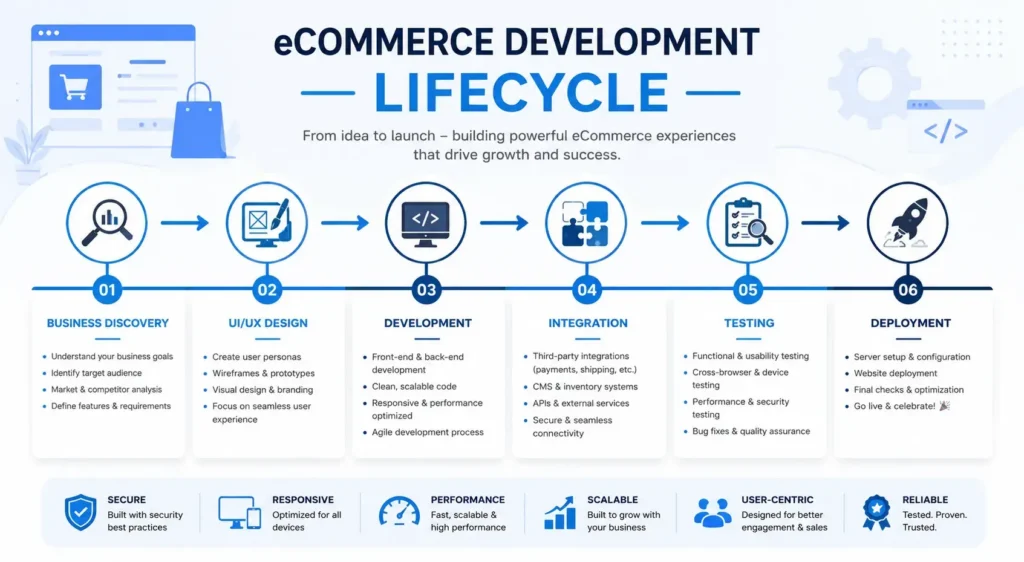
Every successful eCommerce website development process follows structured phases that reduce risk and improve project quality.
1. Business discovery
The first stage identifies business goals, customer needs, competitors, and technical requirements. Developers define user journeys, required integrations, payment methods, shipping workflows, and reporting needs before writing code.
2. UI/UX design
Designers create wireframes and interactive prototypes. Their goal is to deliver a user-friendly online shopping experience across desktops, tablets, and smartphones. Navigation should remain simple while highlighting products effectively.
3. Development
During development, engineers build frontend and backend components while implementing custom eCommerce platform development practices. They also perform shopping cart development, customer account management, order processing, and backend administration. Businesses often choose modern frameworks because they simplify maintenance and improve scalability.
4. Integration
Most stores depend on external software. Effective API integration for eCommerce connects payment providers, shipping companies, ERP systems, accounting software, CRM platforms, and marketing automation tools. Developers also configure an inventory management system that updates stock automatically across sales channels.
5. Testing and deployment
Quality assurance verifies speed, security, usability, and compatibility across browsers. Testing includes checkout validation, mobile responsiveness, payment processing, and product search. After successful testing, developers deploy the platform using secure hosting infrastructure.
Many growing organizations also hire best dedicated developers for continuous improvements after launch. Regular updates keep the platform secure and competitive.
Explore more: Find the best eCommerce expert for your business
Must-Have Features for a Successful Custom eCommerce Website
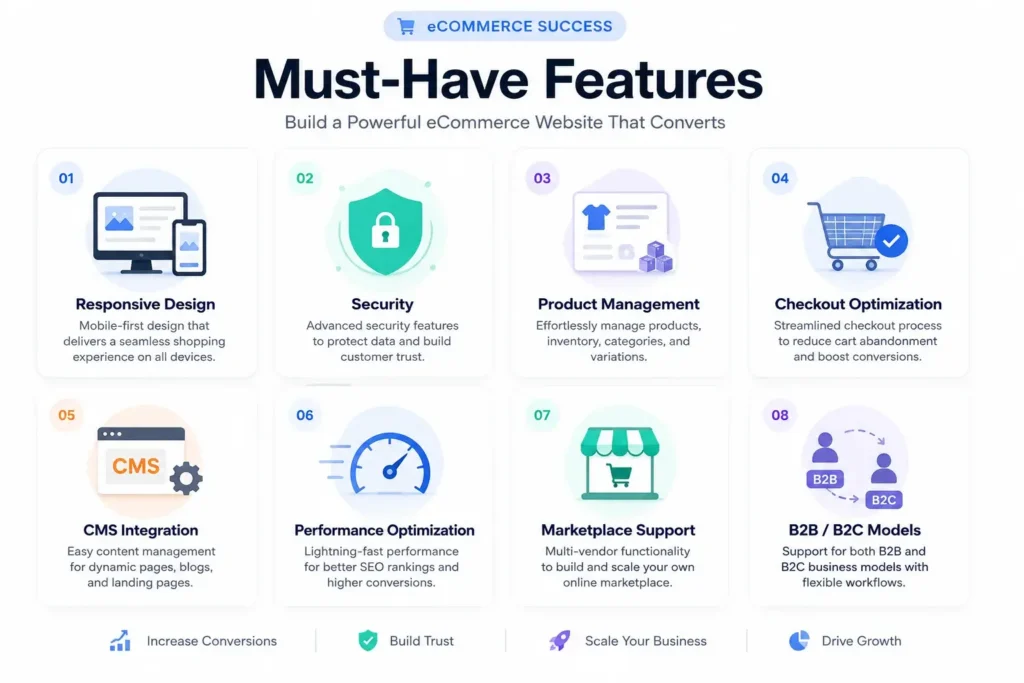
A successful platform combines usability with powerful business functionality.
1. Responsive design
Every modern store needs a mobile-friendly eCommerce website because mobile shopping continues to increase globally. Customers expect a fully responsive online store regardless of screen size.
2. Security
Strong eCommerce website security protects customer information and payment data. Developers implement SSL encryption, multi-factor authentication, fraud detection, secure hosting, and regular vulnerability testing. Dedicated secure payment gateway integration also builds customer trust while reducing transaction failures.
3. Product management
Large online stores require efficient product catalog management for categories, variants, pricing, discounts, and product attributes. Automation saves time and reduces inventory errors.
4. Customized checkout
A streamlined custom checkout process reduces cart abandonment. Businesses remove unnecessary steps, enable guest checkout, and support multiple payment methods.
5. Content management
Selecting the right eCommerce CMS allows teams to update products, promotions, blogs, and landing pages without technical knowledge. Marketing teams can publish content quickly while maintaining brand consistency.
6. Performance optimization
Fast websites improve both SEO and customer satisfaction. Proper eCommerce website performance optimization includes image compression, caching, CDN implementation, optimized databases, and efficient code.
7. Marketplace support
Some businesses expand into marketplace models using a multi-vendor eCommerce website where multiple sellers manage products independently. This approach creates new revenue opportunities while increasing product variety.
8. Business-specific platforms
Development requirements vary between a B2B eCommerce website and a B2C eCommerce website. B2B platforms often include quotation systems, bulk pricing, and account-based purchasing. Consumer-focused stores emphasize faster checkout, personalized recommendations, and promotional campaigns.
Many businesses also invest in complete eCommerce website design and development to maintain consistent branding across every customer touchpoint. Companies looking for long-term digital growth frequently partner with a top web development company that provides strategy, development, maintenance, and continuous optimization throughout the platform lifecycle.
The Future of Custom eCommerce Website Development
The future of custom eCommerce website development focuses on flexibility, personalization, and intelligent automation. One major trend is headless eCommerce, which separates the frontend from the backend systems. Businesses gain greater design freedom while delivering faster digital experiences across websites, mobile apps, and smart devices.
Artificial intelligence also personalizes recommendations, predicts inventory demand, and automates customer support. Voice commerce and conversational shopping continue gaining popularity as consumers adopt smart assistants.
Cloud-native infrastructure allows businesses to scale during seasonal demand without affecting website performance. Businesses expanding into North America often work with an experienced eCommerce development company to meet regional compliance requirements and support local customer expectations.
Companies planning long-term growth increasingly choose to build custom eCommerce website strategies instead of relying on restrictive template platforms. Demand also continues rising for custom shopping website development because businesses seek unique customer experiences that strengthen brand identity. Similarly, custom eCommerce store development supports advanced loyalty programs, subscription services, and personalized buying journeys that improve long-term customer retention.
Explore more: Choose the right Shopify expert
Conclusion
Building an online store involves far more than an attractive design. Success depends on understanding customers, selecting suitable technologies, ensuring security, and creating seamless shopping experiences. A thoughtfully planned platform supports future expansion while improving operational efficiency and customer satisfaction.
Businesses that invest in custom eCommerce development gain flexibility that generic platforms rarely provide. Whether you launch a new venture or modernize an existing store, a strategic approach to development creates lasting business value and prepares your brand for continued digital growth.