


A few years ago, learning largely stopped when the school bell rang. Today, it continues on the train, at the kitchen table and in the spare ten minutes before bed. Education now fits in a pocket.
If you lead a school group, a training business, a university or a corporate academy, you might have seen this shift first-hand. Your learners also expect the seamless digital experiences they enjoy in banking and streaming apps. That is why eLearning apps in the UK have evolved from a value-added offering into a core part of education strategy.
In this guide, we discuss what is driving the change, why quality matters, and how to approach your own build with confidence.
Why Education Is Moving to Smartphones
The UK is one of the most connected markets in the world. Most pupils, students and working adults carry a smartphone, and reach for it first when they want to learn something new. Online education has grown dramatically, and this behaviour is fuelling rapid growth in UK education technology. Boards, investors and school leaders are all paying close attention.
From Remote Learning to Everyday Learning
The pandemic pushed schools into remote learning almost overnight, accelerating the adoption of digital learning tools, including mobile apps. Developed under considerable time pressure, many early tools offered a less polished user experience. And yet they proved the vital point that people can learn well outside a classroom.
Expectations have matured since then. Learners no longer accept a video call and a PDF. They want online learning apps that respect their time and fit around work, family and study. This demand has made digital learning in the UK a boardroom priority rather than an ambitious IT project.
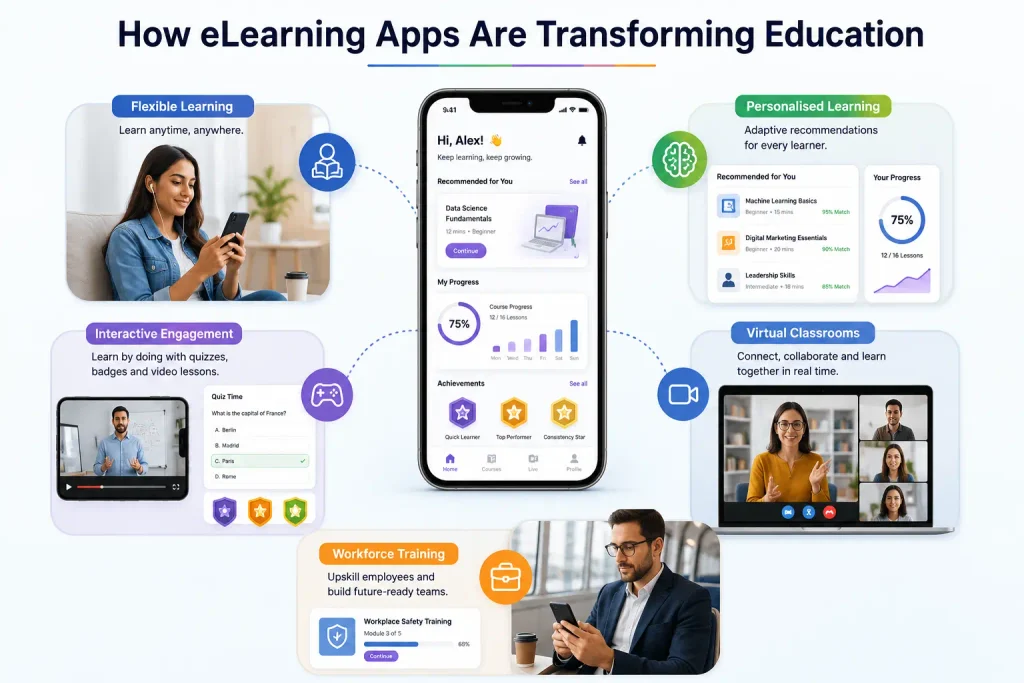
How eLearning Apps in the UK Are Changing Education
The UK e-learning market is forecast to grow by USD 14.63 billion between 2025 and 2030, at a compound annual growth rate (CAGR) of 17.1%. The adoption of AI and adaptive learning is among the factors expected to contribute to this growth.
Some of the most evident changes include:
1. Flexibility and Accessibility in Learning
Flexible learning is the first big win for end users. For example, a nurse on night shifts can finish a module at 6 am. A parent can revise course material during a suitable break in the day. With flexible schedules, learners control the pace, and providers reach people who could never attend a fixed timetable.
Accessible learning matters just as much. Captions, text-to-speech, adjustable fonts and colour contrast settings help learners with dyslexia, hearing loss or visual impairments participate fully. Built well, mobile education widens your audience and supports your equality duties at the same time.
2. Personalised Learning at Scale
Personalised teaching once required a private tutor. Now adaptive apps adjust difficulty, suggest the next lesson and flag struggling learners early. AI in education drives much of this. Smart recommendations, instant feedback and automated marking allow teachers to focus on the human side of teaching.
3. Stronger Student Engagement
Interactive learning helps keep people involved. Features like quizzes, short videos, simulations and live polls turn passive study into active practice. Gamification in education, through badges, streaks and leaderboards, also adds healthy motivation.
These features can support student engagement and course completion when implemented effectively. Every CFO will recognise that as an enhanced return on investment.
4. Learning Beyond Four Walls
Learners can now access educational resources well beyond traditional classrooms. Virtual classrooms let tutors teach live groups across the country. Digital classrooms keep notes, homework and discussion in one place. Educational technology does not replace the teacher. It extends the teacher’s reach.
Explore more: How much it costs to develop an eLearning app
Types of Education Apps Gaining Ground
Education applications now cover a wide range of needs. Three categories of eLearning apps are particularly relevant in the UK:
1. Learning Apps for Students
Students from schools and colleges need help with their curricula. These apps therefore include features such as homework help, exam revision, language practice, and coding lessons. They work best when lessons are short, progress is visible, and parents or teachers can follow along.
2. Mobile Learning Apps for Workforce Training
Workforce training helps develop employee skills and supports long-term business growth. Compliance training, onboarding and upskilling modules can all be delivered through mobile apps. These apps help employers train distributed teams without pulling people off the floor for a full day.
3. Educational Mobile Apps for Tutors and Institutions
In addition to in-person course enrolments, online learning is also on the rise. Tutors, colleges, and training academies use these apps to sell their courses, run assessments, and build paid communities directly with their learners.
What Makes a Learning App Succeed
Strong products share a few common traits. Before you take your vision to any developer, check that your plan covers these:
- Learning management system integration, so content, users and reports stay in sync
- Offline access for learners with unreliable internet connections
- Secure login and UK GDPR-compliant data handling
- Analytics dashboards that show progress, drop-off and results
- Push notifications that nudge without nagging
- Smooth performance across iOS, Android and web
Digital education only works when the technology fades into the background and the learning takes centre stage. Skip the basics, and you will lose learners in the first week. Get them right, and the app becomes a habit.
Explore more: A comprehensive guide to eLearning app development
How the Right Technology Partner Helps You Build the Right Product
The right technology partner will carefully assess your idea, requirements and business goals. They will not be just a vendor selling an off-the-shelf product with features you might never use. Contact the partner with a clear goal, such as higher completion rates or a new revenue stream, and they will shape the product around that goal. eLearning apps designed around the learner first and then around the business case are more likely to succeed.
The Best Approach for eLearning App Development
A practical approach to developing an education app starts with your learners’ needs and business requirements. Here are the key steps involved in building a high-performance app:
1. Discovery and strategy
The first step is to understand your learners, goals and competitors before writing any code. The right partner will create a strategy based on the findings of this stage.
2. UX and UI design
The next step is to create clear and accessible journeys that learners can use without instructions. User-friendly design is one of the key factors influencing an application’s success.
3. Development
During this stage, developers build the application and integrate it with existing systems. Your native or cross-platform apps are built and connected to the existing systems. Following good coding practices and documentation helps make the codebase easier to maintain and adapt to future requirements.
4. Testing and compliance
Here, the entire app is checked for performance, accessibility, and data security against UK standards. It is tested under realistic traffic loads and across critical user journeys, and any bugs are fixed.
5. Launch and support
Launch marks the beginning of ongoing monitoring, maintenance and improvement. A good development partner will help you optimise the app as market conditions and user needs evolve. A good development partner will help you optimise the product as market conditions and user needs evolve.
Apart from this, your chosen development partner should communicate in plain language, share clear timelines and report progress openly.
Explore more: How much it costs to build a language learning app
The Next Step
The shift from the classroom to the smartphone is already well underway. Learners have made their choice, and the organisations that respond quickly will win their loyalty. Smart eLearning app development starts with a clear goal and a partner who understands both education and technology.
If you are ready to explore your options, speak with IIH Global today. Our eLearning app development services cover strategy, design, build and long-term support under one roof. Book a free consultation, share your vision, and we will map out a practical path from idea to launch.