


The real estate app development cost depends on scope, platforms, data, design, integrations, and the depth of marketplace features. A simple local product needs less investment than a national housing platform. The cost to build a real estate app like Zillow can range from $60,000 for a focused MVP to $250,000+ for an advanced platform. These figures reflect practical 2026 planning ranges, not fixed quotations.
Zillow’s scale explains the investment behind such products. Its apps and sites recorded an average of 221 million unique monthly users in Q4 2025.
Overview of Zillow
Zillow operates as a broad housing marketplace covering buying, renting, mortgages, home values, and professional services. Its product connects consumers with property information and real estate professionals.
In 2025, Zillow Rentals averaged 2.4 million monthly active rental listings. Its Zestimate reported median errors of 1.8% for listed homes and 7.2% for off-market homes. A Zillow-like real estate app therefore needs more than listings. Users expect accurate data, fast search, maps, saved homes, alerts, communication, and useful financial tools.
A successful product should also support agents and administrators. That means listing workflows, lead management, moderation, analytics, and secure data controls.
Factors to Consider before Building a Real Estate App
1. Business model and target users
Define your audience before choosing features. Buyers, renters, agents, landlords, and developers have different needs. Revenue can come from subscriptions, promoted listings, advertising, lead fees, referral commissions, or premium services. A focused market can reduce the cost to develop a real estate app.
2. Platform and product scope
Decide whether you need iOS, Android, web, or a combination. Cross-platform development can reduce duplicated work when both mobile platforms need similar experiences. Define the MVP before development. Launching core search and enquiry journeys first can validate demand without funding every advanced feature.
3. Data, compliance, and integrations
Property data often creates major technical and legal requirements. You may need MLS or IDX access, maps, geocoding, mortgage data, analytics, identity services, and payment tools. Licensing rules can affect how data is displayed, refreshed, stored, and shared. Review provider terms before finalising the architecture.
4. User experience and search
Property discovery should feel fast and simple. Useful property search features include price, location, bedrooms, property type, amenities, status, and listing-date filters. A property listing platform should also offer map-based discovery and detailed property pages. GPS property search can help users find homes near their current location.
5. Technology and team
A typical team includes product managers, UI/UX designers, mobile developers, backend developers, QA engineers, DevOps specialists, and data engineers. The right partner matters when integrations and scalability become complex. A best real estate app development company USA can support strategy, architecture, development, and maintenance.
Real Estate App Development Cost: What to Budget
Current market cost range
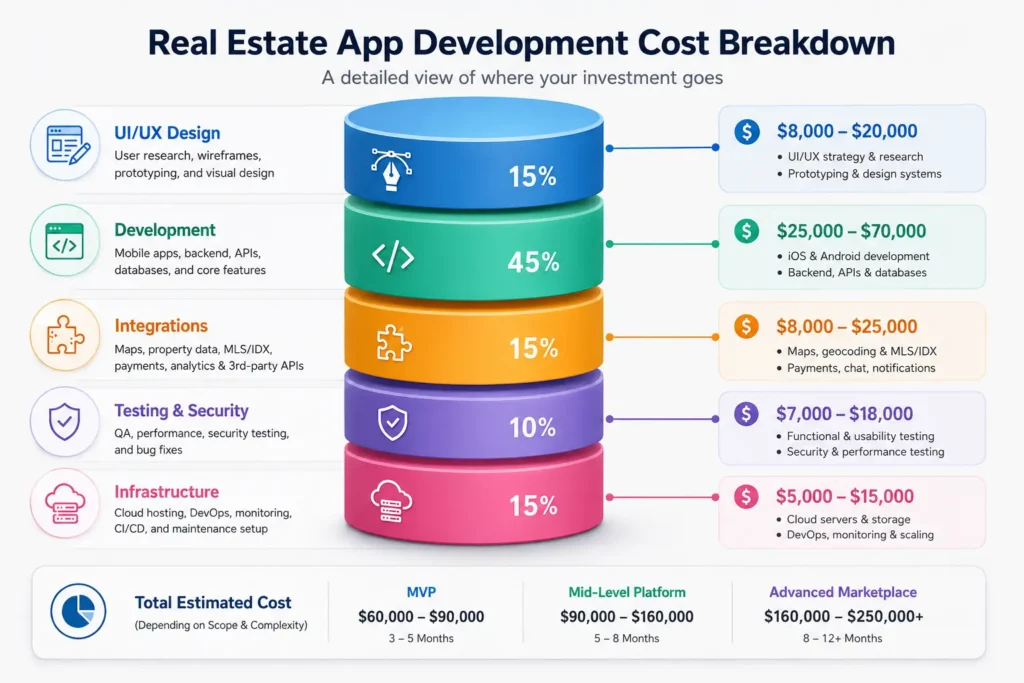
The cost to build a real estate app like Zillow varies with functionality and technical complexity. A practical 2026 planning range looks like this:
| App scope | Estimated cost | Timeline |
|---|---|---|
| Focused MVP | $60,000–$90,000 | 3–5 months |
| Mid-level platform | $90,000–$160,000 | 5–8 months |
| Advanced marketplace | $160,000–$250,000+ | 8–12+ months |
These ranges are planning benchmarks. Clutch’s July 2026 pricing guide reports many app development companies at $25–$49 per hour, while US specialists can charge more.
Costs rise with AI, complex search, real-time messaging, multiple dashboards, advanced analytics, and high-volume property data.
Feature-wise cost breakdown
| Component | Estimated cost |
|---|---|
| UI/UX design | $8,000–$20,000 |
| Mobile development | $25,000–$70,000 |
| Backend and APIs | $20,000–$50,000 |
| Admin and agent portals | $10,000–$30,000 |
| Data and map integrations | $8,000–$25,000 |
| QA and security | $7,000–$18,000 |
| Cloud and DevOps | $5,000–$15,000 |
Property app development costs also continue after launch. Hosting, monitoring, security, third-party services, support, and new features create recurring expenses. To control spending, start with registration, listings, search, maps, saved properties, enquiries, and administration. Add advanced capabilities after user behaviour validates them.
Explore more: Real estate app development cost
Features and Functionality of a Real Estate App
Buyer and renter features
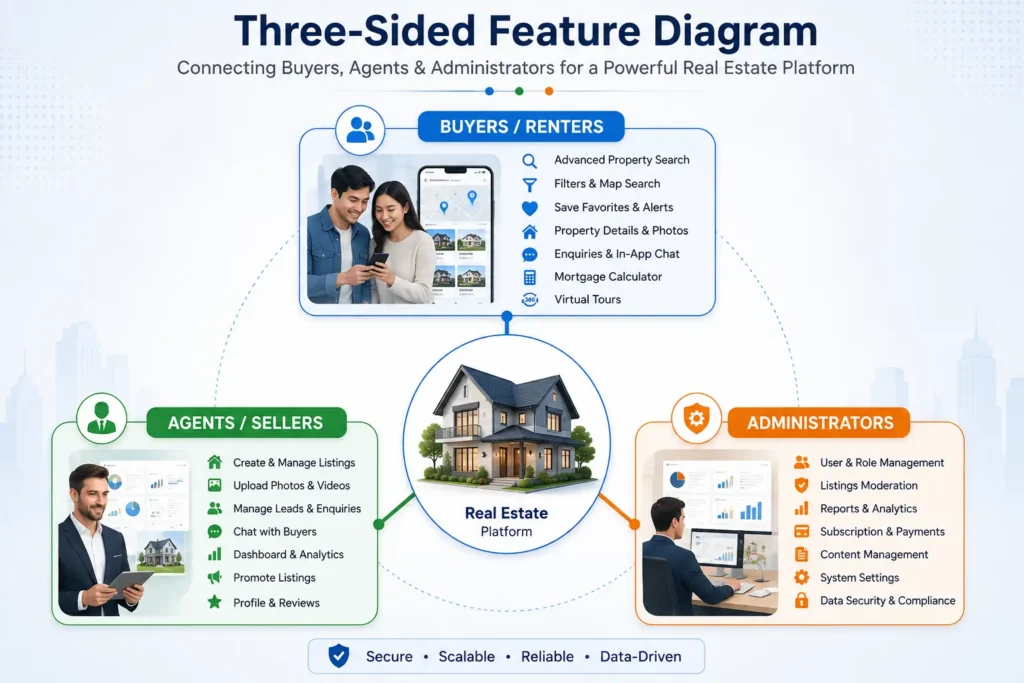
A property listing app should support accounts, profiles, property discovery, filters, favourites, saved searches, and enquiries. A property search app should provide photos, floor plans, prices, amenities, availability, neighbourhood details, and map browsing. A mortgage calculator can help users understand affordability. Property valuation can add useful context when users compare homes.
Virtual property tours can improve remote discovery. Push notifications can alert users about new listings, price changes, and saved-search matches. In-app chat can connect buyers with agents directly. Verified profiles and reviews can further improve trust.
Agent and seller features
Property listing management should let agents create listings, upload media, update prices, manage leads, and respond to enquiries. Agent dashboards can show views, saves, enquiries, response rates, and lead sources. Promoted listings can provide another monetisation option.
Admin and platform features
A property marketplace needs strong administration for users, listings, agents, reports, subscriptions, payments, content, and permissions. A property database should support fast queries, duplicate detection, validation, media storage, and regular listing updates. Search indexing becomes increasingly important as inventory grows.
AI-powered property search can understand natural language requests, such as homes under $500,000 near good schools. Mapping supports location browsing, boundaries, commute views, and nearby amenities. Third-party API integration can connect maps, payments, analytics, notifications, and property data.
These real estate app features can transform a basic listing product into a scalable real estate marketplace app. Businesses with changing workloads can also hire best dedicated developers in USA for flexible engineering capacity.
Explore more: Cost to build a real estate app like Rightmove
Steps to Building Your Real Estate App
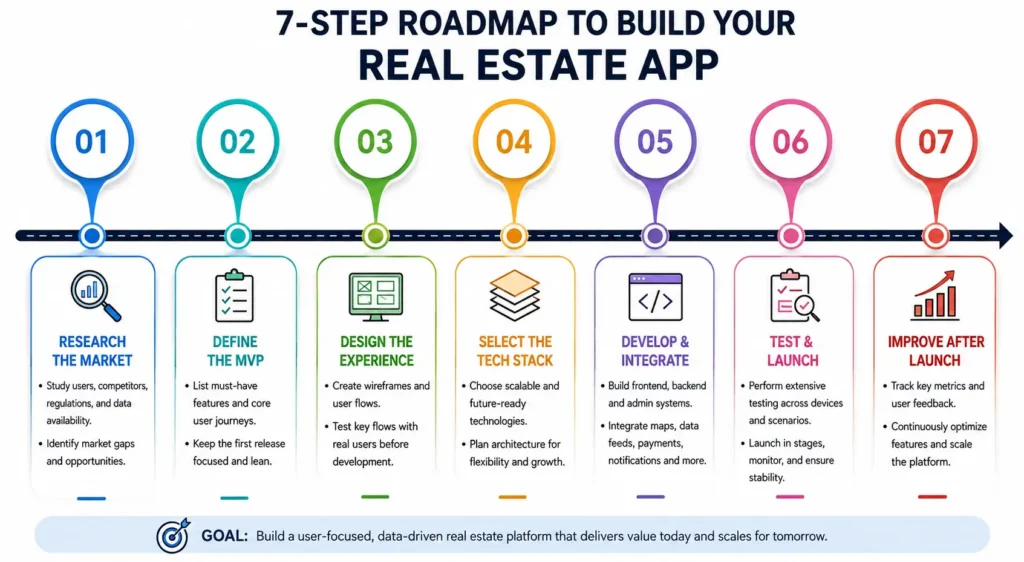
1. Research the market
Study users, competitors, local inventory, pricing models, regulations, and data availability. Identify a clear market gap before investing heavily.
2. Define the MVP
Separate must-have workflows from future features. This keeps the first release focused and makes budget decisions easier.
3. Design the experience
Create wireframes for search, property details, maps, accounts, messaging, and dashboards. Test key flows with potential users before development.
4. Select the technology stack
A practical stack can use Flutter or React Native for mobile, React for web, and Node.js or Laravel for backend services. PostgreSQL can manage structured data. Cloud infrastructure such as AWS can support storage, deployment, monitoring, and scaling. The architecture should allow new modules without major rewrites.
5. Develop and integrate
The real estate application development process should cover frontend work, backend APIs, authentication, search, maps, property feeds, notifications, payments, and administration. Teams offering custom real estate app development services USA can also align the product with local data sources and business requirements.
6. Test and launch
Run functional, usability, security, performance, device, and integration testing. Search speed and property accuracy deserve special attention. A staged launch reduces risk. Start in one market, measure usage, fix friction, and expand after the platform proves stable.
7. Improve after launch
Track searches, listing views, saves, enquiries, conversions, and retention. Use those results to prioritise future releases. A real estate mobile app development team can support mobile-specific performance, analytics, and feature updates.
Explore more: How to choose a real estate app development company
Conclusion
Building a property platform requires planning across product strategy, data, design, technology, and operations. The cost to build a real estate app like Zillow can start around $60,000 for a focused MVP and exceed $250,000 for an advanced marketplace.
The right budget depends on your market, feature set, integrations, platforms, and team. Instead of copying every Zillow capability, launch the features that solve your users’ biggest problems.
A phased approach limits early risk and creates room to learn from real users. Reliable property data, scalable architecture, strong UX, and disciplined testing can support long-term growth. A best mobile app development agency USA can help maintain these priorities as the product expands.