


Businesses today need mobile apps that deliver speed, quality, and consistent performance across different devices. This Flutter app development guide explains how modern teams build scalable applications using Flutter app development while reducing development effort. Whether you are launching a startup product or upgrading an enterprise solution, Flutter offers a practical way to build high-quality apps without maintaining separate codebases.
Developed by Google, Flutter has become one of the most trusted technologies for building Android, iOS, web, and desktop applications. It combines fast development, attractive interfaces, and reliable performance in a single solution. This guide explores its features, advantages, best practices, and development approach to help businesses make informed decisions.
What is Flutter?
Flutter is Google’s open-source app development framework designed for creating applications from a single codebase. Developers write code once and deploy it across multiple platforms with minimal changes. This approach saves development time while maintaining consistency.
Unlike many traditional solutions, Flutter does not rely heavily on native UI components. Instead, it uses its own rendering engine to create responsive and visually appealing interfaces. This makes it easier to deliver the same design across Android, iOS, web, desktop, and embedded devices.
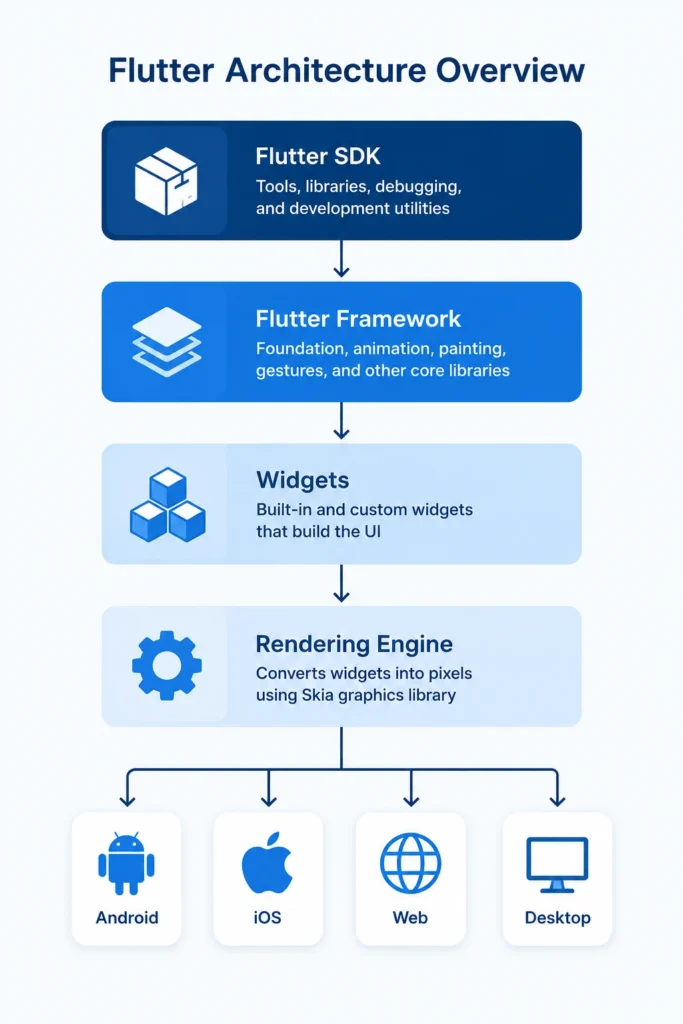
At its core, Flutter uses the Dart programming language, which supports object-oriented programming and fast compilation. Dart helps developers write clean, maintainable code while enabling rapid development and testing. The platform also includes the Flutter SDK, which provides essential libraries, debugging tools, testing support, and deployment utilities. Developers can build, test, and optimize applications from one integrated environment.
Understanding the Flutter Framework
The Flutter framework follows a layered architecture that separates rendering, widgets, and platform integration. This design keeps applications organized and easier to maintain as they grow. Flutter also follows a widget-based architecture. Everything displayed on the screen is built using widgets, from simple buttons to complete layouts. Developers can combine widgets to create flexible and reusable interface components.
Another strength is its rich UI toolkit, which includes ready-made Material Design and Cupertino widgets. Businesses can create applications that match Android and iOS design standards while maintaining brand consistency.
Why Flutter Stands Out
Many organizations choose Flutter because it supports multi-platform development without sacrificing quality. Teams can launch products faster while keeping maintenance costs under control. For businesses planning long-term digital products, Flutter provides an efficient balance between development speed and user satisfaction.
Explore more: Best cross-platform app development framework
Benefits of Flutter for App Development
1. Faster Development with a Single Codebase
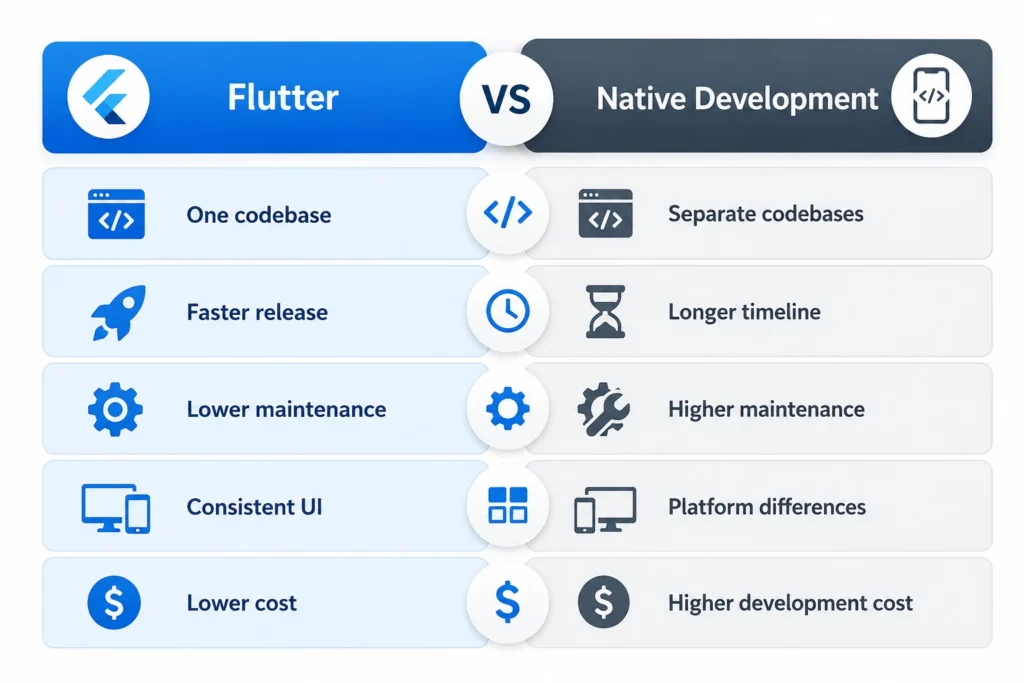
One of the biggest reasons businesses choose Flutter is development efficiency. Developers maintain one project instead of separate Android and iOS applications. This significantly reduces coding effort, bug fixing, testing, and future updates. Companies can launch products sooner while lowering overall development expenses.
2. Consistent User Experience
Modern applications must deliver a smooth user experience across every platform. Flutter renders its own interface instead of relying entirely on native controls. This creates a consistent appearance regardless of device or operating system. Developers also gain better control over animations, layouts, typography, and interactive elements.
3. Native-Like Performance
Performance directly affects customer satisfaction. Flutter compiles applications into native machine code, delivering native-like performance for most business applications. Users experience smooth scrolling, responsive animations, and faster interactions. For ecommerce, healthcare, education, and finance applications, this performance advantage creates a more reliable digital experience.
4. Rich and Flexible UI Development
Modern businesses compete through design as much as functionality. Flutter simplifies Flutter UI development by offering thousands of customizable widgets. Designers and developers can build attractive interfaces without creating everything from scratch. This flexibility also supports better mobile app design, helping brands maintain a unique visual identity.
5. Lower Long-Term Maintenance
Maintaining separate native applications often doubles future development effort. Flutter reduces maintenance because updates happen inside one shared project. Bug fixes reach every supported platform with fewer development hours. This approach makes ongoing mobile app maintenance simpler for growing businesses.
6. Ideal for Businesses of Every Size
Flutter works well for startups, SMEs, and large enterprises. Many companies choose Flutter during startup app development because it enables faster product launches with controlled budgets. Larger organizations also use Flutter for internal business applications, customer portals, ecommerce platforms, healthcare solutions, and logistics systems.
This flexibility makes Flutter an excellent choice for Flutter for business initiatives that require scalability and long-term support.
Explore more: Benefits of Flutter app development
Advanced Features of Flutter
Flutter continues to evolve with features that support modern application development across industries.
1. Hot Reload for Faster Development
One of Flutter’s most appreciated capabilities is Hot Reload. Developers instantly see code changes without restarting the application. This speeds up development, debugging, and interface improvements. Faster feedback also encourages experimentation and continuous improvement during development.
2. Extensive Plugin Ecosystem
Flutter supports thousands of community and official plugins. Developers integrate payment gateways, maps, authentication, cloud storage, notifications, analytics, cameras, Bluetooth, and location services with minimal effort. This reduces custom coding while accelerating project delivery.
3. Strong Support for Cross-Platform Projects
Businesses looking for cross platform app development often select Flutter because one team manages multiple platforms efficiently. Applications maintain similar functionality across Android, iOS, web, desktop, and embedded devices while simplifying future feature updates.
4. Scalable Architecture
Flutter works well for both small applications and enterprise platforms. Proper architecture enables modular code, easier collaboration, and simplified maintenance as projects expand. Development teams often separate business logic, presentation, networking, and storage into independent modules.
5. Testing and Deployment Support
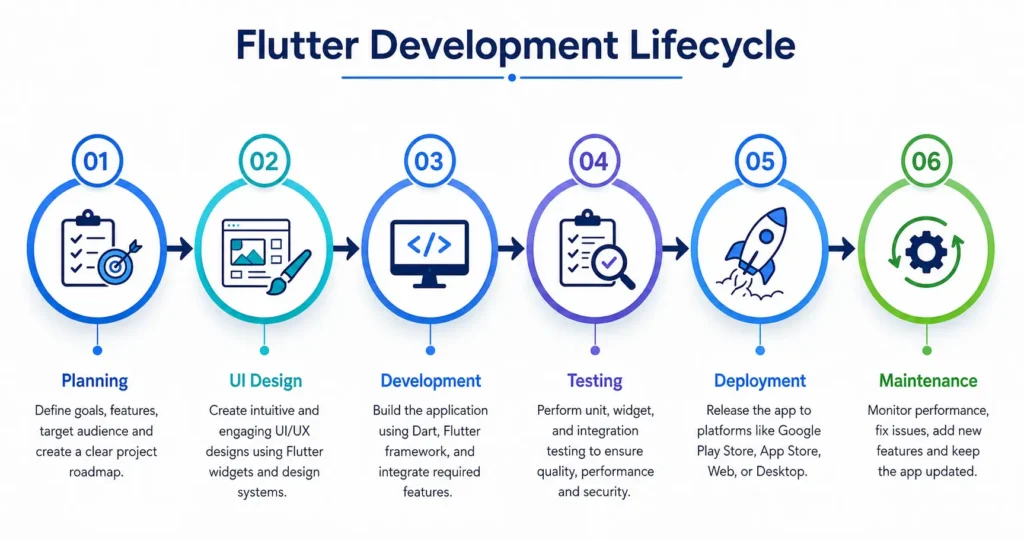
Reliable software requires continuous quality assurance. Flutter includes built-in tools for app testing, including unit, widget, and integration testing. Developers identify issues early before production deployment. Once testing finishes, the framework also simplifies app deployment across Google Play, Apple App Store, web hosting platforms, and desktop environments.
Explore more: Flutter app development services in the UK
Best Practices for Flutter App Development Guide
Successful Flutter projects depend on more than choosing the right technology. Following proven development practices improves application quality, scalability, and long-term performance.
1. Plan the Project Before Writing Code
Every successful application begins with clear business goals. Define target users, essential features, technical requirements, and future expansion plans before development starts. A structured Flutter app development process reduces unnecessary revisions later.
2. Design Reusable Components
Reusable widgets simplify maintenance and improve development efficiency. Instead of repeating interface code, developers should create modular components that work throughout the application. This approach also improves consistency across screens.
3. Optimize Performance Regularly
Performance optimization should continue throughout development. Developers should reduce unnecessary widget rebuilding, compress images, optimize API requests, and monitor application memory usage. Small improvements often produce noticeable performance gains.
4. Choose Experienced Development Partners
Selecting skilled Flutter app developers significantly improves project success. Experienced professionals understand architecture, performance optimization, testing strategies, security, and deployment requirements. Many businesses also evaluate a expert Flutter app development company when searching for experienced technology partners capable of handling complex enterprise projects.
Beyond technical expertise, experienced teams also provide consultation on architecture, scalability, security, and post-launch improvements. They help businesses avoid expensive mistakes during planning and implementation. Working with specialists often shortens development cycles while improving long-term software quality.
5. Focus on Quality Throughout Development
Quality should remain a priority from planning through production. Regular code reviews, automated testing, documentation, and continuous integration improve software reliability. Businesses investing in Flutter mobile app development achieve better long-term results when quality assurance becomes part of the entire development lifecycle instead of a final activity.
Developers should also monitor application analytics after launch to identify improvement opportunities and respond quickly to user feedback. Continuous refinement keeps applications competitive in changing markets.
Explore more: Flutter development cost guide
Common Challenges and How to Overcome Them
Although Flutter is a mature technology, every development project presents unique challenges. Careful planning and experienced implementation help teams reduce risks and deliver successful applications.
1. Managing Platform-Specific Features
Some device features still require native Android or iOS code. Examples include advanced Bluetooth functions, background services, and platform-specific hardware integrations. Developers can overcome this challenge by using platform channels or reliable plugins maintained by the Flutter community. Planning these requirements early prevents delays during development.
2. Maintaining Application Performance
Applications with large datasets or complex animations can experience performance issues if developers ignore optimization. Teams should profile the application regularly, optimize image assets, reduce unnecessary widget rebuilds, and improve network requests. Monitoring memory usage also helps maintain smooth performance as the application grows.
3. Choosing the Right Architecture
Poor project structure often creates maintenance problems. A scalable architecture separates presentation, business logic, networking, and data storage into independent layers. This makes future updates easier and improves collaboration among development teams. Following clean coding standards also reduces technical debt.
4. Estimating Development Budget
Many businesses ask about Flutter development cost before starting a project. Current market pricing depends on application complexity, features, integrations, design requirements, developer location, and maintenance needs.
A simple MVP typically costs between USD 15,000 and USD 35,000.
A medium-sized business application generally ranges from USD 35,000 to USD 80,000.
Enterprise platforms with advanced integrations, custom features, and high scalability often exceed USD 80,000.
The best approach is to define project requirements clearly before requesting estimates. Accurate planning reduces unexpected expenses later.
5. Selecting the Right Development Partner
Technology alone does not guarantee success. Businesses should evaluate technical expertise, portfolio quality, communication practices, security standards, and long-term support before selecting a development partner.
Organizations looking for custom mobile app development services should also review previous projects, client feedback, and post-launch support capabilities. An experienced partner can recommend the most suitable architecture while aligning development with business goals. A reliable company also offers transparent planning, realistic timelines, and continuous collaboration throughout the project lifecycle.
Conclusion
Flutter has transformed modern application development by helping businesses build high-quality products with greater speed and efficiency. Its flexible architecture, rich widget library, and excellent performance make it suitable for startups, growing businesses, and enterprises alike. This Flutter app development guide demonstrates why Flutter continues to gain popularity across industries. From faster development and consistent interfaces to easier maintenance and scalable architecture, the framework supports both current business needs and future growth.
Organizations planning Flutter application development should focus on clear requirements, experienced developers, quality assurance, and continuous improvement. Businesses that also need custom Flutter app development services can benefit from working with trusted technology partners that understand complex project requirements and scalable solutions.
As projects grow, companies may also choose to hire full time dedicated developers to accelerate delivery, strengthen technical expertise, and provide long-term product support. With the right strategy and team, Flutter app development remains one of the most practical choices for building reliable, future-ready mobile applications.