


Developing a mobile application is not just a technical task – it is also a strategic business decision. Whether you’re building a minimum viable product (MVP) for your startup or digitising business processes in your company, selecting the best cross-platform app development framework directly affects development costs, scalability, user experience, and long-term success.
In the modern world, businesses are seeking faster ways to launch their applications and reduce maintenance costs. This is why cross-platform mobile app development has become the preferred solution for businesses seeking professional, cost-effective, and faster app development.
Choosing the framework is not simply about comparing features. The right decision depends on business requirements, maintenance costs, scalability, ecosystem maturity, developer skills, and future technology adoption. Partnering with the leading mobile application development firm will help make this choice easier.
This guide explains how to evaluate today’s leading frameworks, compares their strengths, and highlights the key factors every decision-maker should consider before beginning application development.
Why Cross-Platform Development Is Growing
The widespread use of cross-platform technologies indicates a shift in approach that businesses are taking in developing software.
According to industry research, the worldwide market for mobile applications is anticipated to reach USD 777.4 billion in 2032, owing to the growing digitisation in various industries. In addition, companies are now focusing on the development of frameworks that reduce development time and support multiple platforms.
The following are some of the main forces behind this demand:
- Businesses require rapid time-to-market to stay competitive.
- Funding for development is increasingly concentrated on reusable technologies.
- Consumers demand the same experience on all devices.
- Current frameworks can provide near-native performance for most enterprise applications.
What Is a Cross-Platform App Development Framework?
A cross-platform app framework is a development solution that allows developers to build applications for multiple platforms using a single codebase. Choosing the best cross-platform app development framework helps businesses accelerate development, simplify maintenance, and deliver a consistent user experience across devices.
Several cross-platform frameworks are currently available.
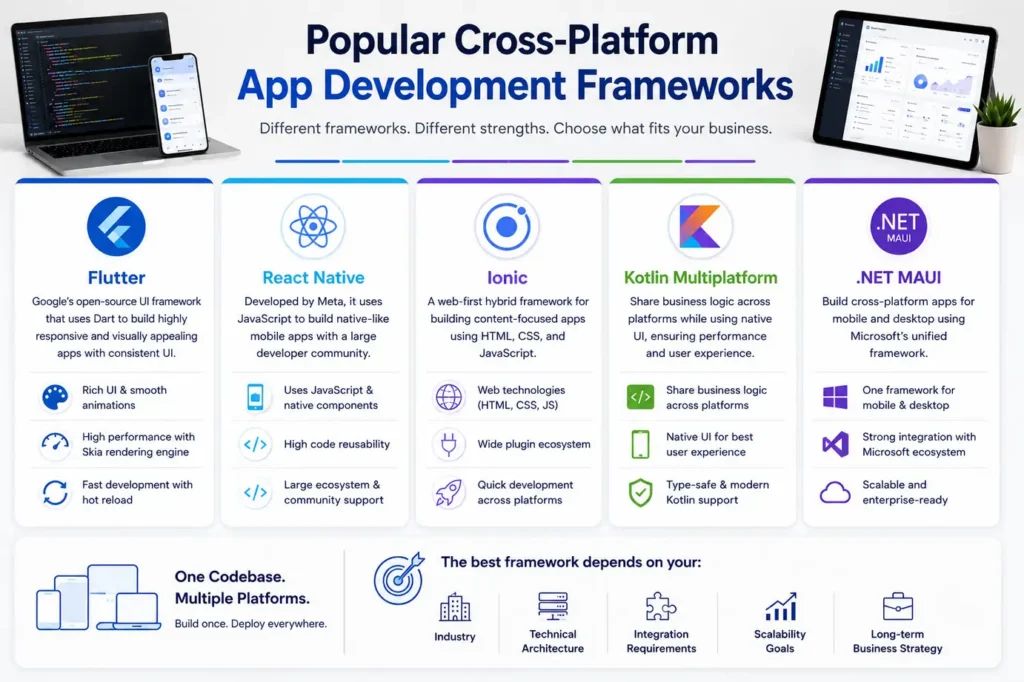
1. Flutter
Flutter is an open-source UI framework developed by Google that uses the Dart programming language to build highly responsive and visually appealing applications. The rendering engine in Flutter ensures designs remain consistent across different devices. In the ongoing Flutter vs React Native debate, Flutter is often preferred by businesses that prioritise rich user interfaces, smooth animations, and consistent visual experiences across platforms.
2. React Native
React Native, developed by Meta, enables developers to use JavaScript to build mobile applications. The framework combines native components with JavaScript logic, making it ideal for businesses with existing JavaScript expertise. Today, it remains one of the preferred technologies used by any expert React Native app development company.
3. Ionic
Ionic continues to be a widely used hybrid app development framework by enterprises developing content-focused apps using web technologies. It allows quick development across multiple platforms in a web-first manner.
4. Kotlin Multiplatform
With Kotlin Multiplatform, businesses are able to share business logic across platforms and use native user interfaces at the same time. An increasing number of companies are adopting Kotlin Multiplatform to share business logic while maintaining native user experiences.
5. .NET MAUI
With .NET MAUI, developers can create apps that run on both mobile and desktop platforms using a single framework, making it an ideal choice for organisations invested in the Microsoft ecosystem. Each framework offers unique strengths. The ideal choice depends on your industry, technical architecture, integration requirements, scalability goals, and long-term business strategy rather than popularity alone.
Explore more: How much does React native app development cost
Factors to Consider Before Choosing a Cross-Platform Framework
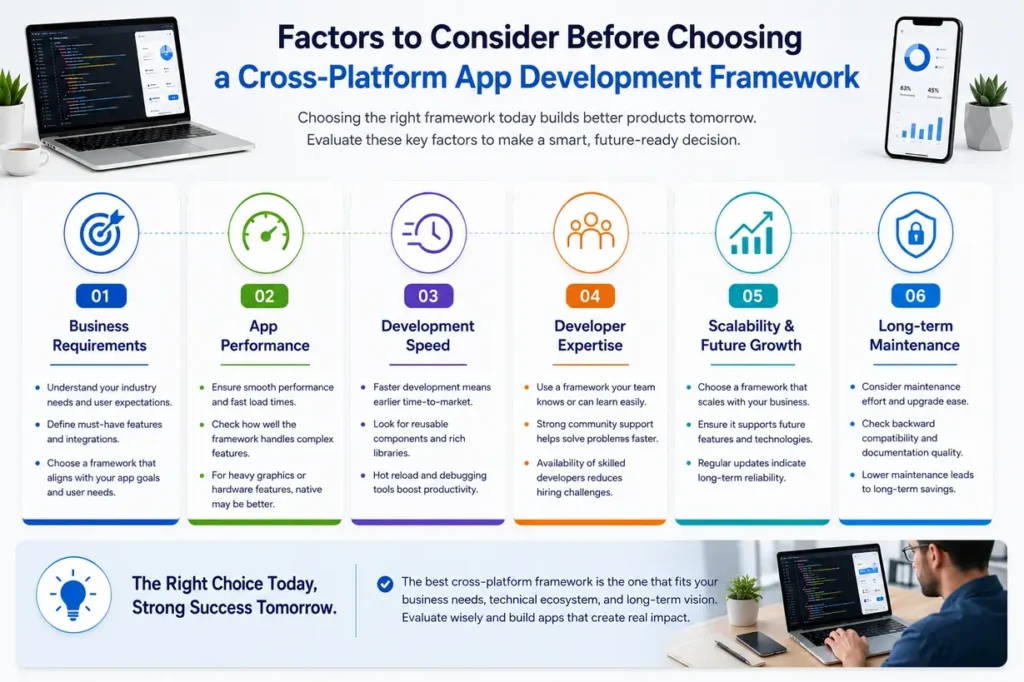
Choosing the right framework should not be based solely on technology trends. Businesses should evaluate factors such as code reusability, scalability, long-term maintenance, developer expertise, and future growth to ensure the framework supports both current project goals and evolving business requirements.
1. Business Requirements
Every software project has unique business requirements.
While a finance product that serves customers needs strong security features, an internal business application may prioritise faster delivery.
2. App Performance
Expectations of users keep rising. Users expect applications to load instantly, respond smoothly, and offer intuitive navigation. While current frameworks provide exceptional application performance, applications that need to run graphics-intensive operations, games, or hardware-specific features could still use native application development.
3. Development Speed
Faster development is one of the main strengths of cross-platform development. The common architecture enables development teams to release features simultaneously across platforms.
4. Cost Efficiency
Businesses increasingly choose cross-platform technologies because they support cost-effective app development. In contrast to maintaining separate development teams, the engineering process can be streamlined while retaining product quality.
5. User Interface Quality
Frameworks that maintain a consistent user interface on different screen sizes, OS, and devices allow companies to provide a professional digital experience, which helps to build customer trust. Flutter’s widget-based UI approach gives developers greater control over application design.
6. Scalability
Applications rarely remain unchanged after launch. New updates, more users, alternative business models, and adding new features demand robust scalability. Selecting an appropriate framework to support future scalability can reduce migration costs.
7. Integrations
Rarely do modern applications operate in isolation. Third-party integration is needed for payment gateways, CRM, analytics tools, cloud services, authentication systems, and APIs. Framework compatibility must be considered before developing an application.
8. Community Support
Technology moves at lightning speed. A vibrant developer community helps develop plugins, write documentation, make security changes, and innovate. Frameworks with active developer communities usually get updated quicker and are more stable.
9. Maintenance Strategy
Launching an application is only the beginning. Updates, security fixes, OS compatibility, and new features will all help reduce maintenance expenses in the long term. Companies need to consider how well a particular framework can support upgrades over many years.
10. Time to Market
Being ahead of the competition by a couple of months can result in faster customer acquisition, increased revenue, and a stronger competitive advantage. Cross-platform frameworks enable companies to shorten development time without compromising the quality of the product.
Which Cross-Platform Framework Is Right for Your Business?
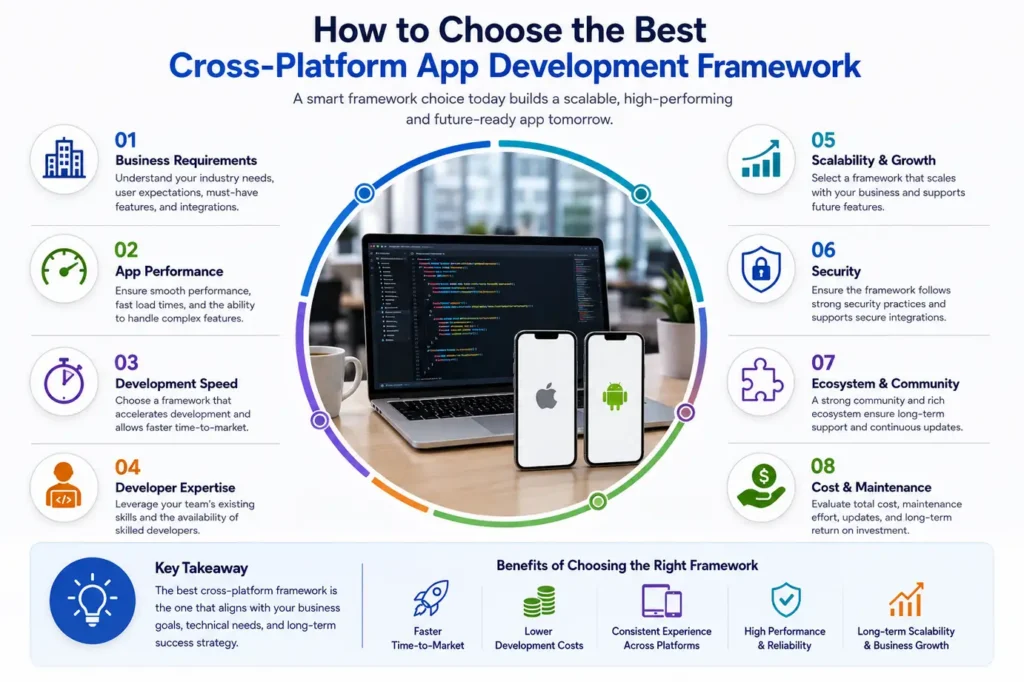
Every business has different technical requirements, budgets, and long-term objectives, so there is no single framework that fits every project. The right choice depends on factors such as application complexity, expected performance, scalability, developer expertise, integration requirements, and long-term maintenance.
Once you’ve compared the leading frameworks, the next step is finding the right implementation partner. For example, organisations that choose Flutter often partner with a Flutter app development company for projects requiring highly customised user interfaces. While businesses adopting React Native may prefer to hire certified dedicated developers with proven experience in enterprise application development.
The comparison chart below highlights the strengths, language use, and ideal use cases of today’s leading frameworks, helping you identify the option that best supports your business goals before making your technology investment.
Cross-Platform Framework Comparison
Before selecting a mobile app development framework, businesses should understand the differences between native vs cross-platform apps. Evaluating performance, scalability, ecosystem maturity, and long-term maintenance helps identify the framework that best supports business objectives.
| Framework | Language | Best For | Advantages | Limitations |
| Flutter | Dart | High-performance business apps | Open-source SDK with an excellent UI toolkit, hot reload, Google support | Smaller talent pool than JavaScript |
| React Native | JavaScript | Enterprise and startup apps | Built on a JavaScript framework, large ecosystem, reusable components, mature libraries | Advanced functionalities can require native modules |
| Ionic | HTML, CSS, JavaScript | Internal business apps | Rapid development and web familiarity | Performance may not suit graphics-intensive apps |
| Kotlin Multiplatform | Kotlin | Enterprise applications | Native experience with shared business logic | Smaller ecosystem compared to Flutter and React Native |
| .NET MAUI | C# | Microsoft-based businesses | Strong integration with Microsoft technologies | Best suited for organisations already using .NET |
Explore more: Flutter vs React native: Which framework is best
Common Mistakes Businesses Make and How to Avoid Them
Most firms prefer a trend-based framework over one that offers greater long-term business value. This often results in higher costs, delayed development, and future rework for iOS and Android app development projects. Below are some common mistakes and how to avoid them:
Mistake: Choosing a framework based solely on popularity.
Solution: Analyse the framework against your business needs, technical requirements, and your overall product strategy instead of following industry trends.
Mistake: Defining the technology first, but not defining the business objective.
Solution: Identify your target audience, core functions of your product, and your project aims before choosing a framework.
Mistake: Concentrating only on the initial costs of development.
Solution: Estimate the cost of ownership of the framework you choose, its maintenance, possible upgrading, infrastructure requirements, etc.
Mistake: Not considering the future app scalability.
Solution: Pick a framework that will allow you to easily cope with growing numbers of users, more functionalities, and business growth.
Mistake: Not taking into account future maintenance of the product.
Solution: Analyse the update cycles, community support, documentation, and long-term prospects of the framework you chose.
Mistake: Picking the framework without analysing the developer skills.
Solution: Use professionals or a specialised development company with appropriate expertise in the framework you have chosen.
Mistake: Not paying attention to third-party integration.
Solution: Make sure the framework is compatible with all necessary APIs, payment systems, analytics, cloud services, etc. before development.
Mistake: Prioritising speed over quality.
Solution: Find the proper balance between speed and the quality of development.
Explore more: Flutter app development guide
Ending Note
Selecting the right mobile application development platform will always be primarily a business decision rather than a purely technical one. Selecting the right framework should be based on your product vision, budget, scalability needs, and future roadmap to ensure that it will provide you with faster delivery and maintenance. Flutter, React Native, Ionic, Kotlin Multiplatform, and .NET MAUI each offer distinct advantages.
The right selection is based on the complexity of your application, skill set, and long-term business needs. As a reputable cross-platform app development company, IIH Global helps you choose the right technology and develop applications aligned with your business objectives. If you are planning a Flutter app development or React Native app development project, our team is here to help.
Need dedicated specialists? Contact our experts to discuss your project requirements and identify the framework that best aligns with your business goals.