


Customers increasingly expect speed, convenience, immediacy, and personalised experiences. This is why on-demand app development is becoming an important part of digital growth strategies across industries, from retail and logistics to healthcare and professional services.
The opportunity, however, goes beyond simply launching an app. Businesses need to understand which on-demand app development trends are shaping customer expectations and how emerging technologies can turn convenience into measurable business value.
This guide explores the key trends businesses should watch and how they can turn them into practical growth opportunities.
Why On-Demand App Development Is Becoming a Business Priority
Modern customers expect businesses to deliver services quickly, efficiently, and with minimal friction. These expectations are influencing industries such as retail, healthcare, logistics, finance, food delivery, hospitality, and professional services.
The broader mobile application market is also growing. According to Grand View Research, the global mobile application market was estimated at $285.7 billion in 2025 and is projected to reach $885.3 billion by 2033.
For businesses, this creates an opportunity to use technology to:
- Reduce manual processes
- Improve customer access to services
- Automate routine operations
- Increase customer engagement
- Support new revenue models
- Make services available 24/7
On-Demand App Development Trends to Watch
The latest on-demand app trends are changing how businesses deliver services and how customers expect to access them. The focus is now shifting from simply delivering services on-demand to creating intelligent, connected, and highly personalised experiences. Here are the key trends businesses should watch.
1. AI-Driven Personalisation
AI in on-demand apps helps businesses create personalised experiences by analysing customer behaviour, preferences and past interactions. AI-powered on-demand apps can recommend relevant products, suggest suitable services, personalise notifications and simplify repeat purchases.
For example, a food delivery app can recommend dishes based on previous orders, while a healthcare app can suggest suitable doctors based on user preferences. These capabilities make interactions more relevant and convenient, improving the user experience while helping businesses increase customer satisfaction, engagement, and repeat usage.
2. Real-Time Tracking and Visibility
Customers increasingly want to know what is happening after they place an order, book a service, or request a delivery. Real-time tracking features provide this visibility by showing service status, location, estimated arrival times, and important updates.
This is especially important in logistics, food delivery, transportation, and home services. Instead of asking support about the status of an order, the user gets this information within the app. This can reduce support requests, build customer trust, and simplify service operations.
3. Cloud-Based and Scalable Applications
Customer demand can change rapidly. For instance, a business may have hundreds of users during normal periods and thousands during promotional periods or special events. Cloud-based on-demand apps allow businesses to respond to these changes more flexibly.
Cloud infrastructure provides flexible computing resources and storage that businesses can scale as usage grows. It can also help businesses connect their applications with payment services, analytics platforms, CRMs, and other tools.
This makes future growth and scalability important considerations from the start. Planning for increasing demand helps prevent performance issues as user numbers, transactions, and data volumes grow.
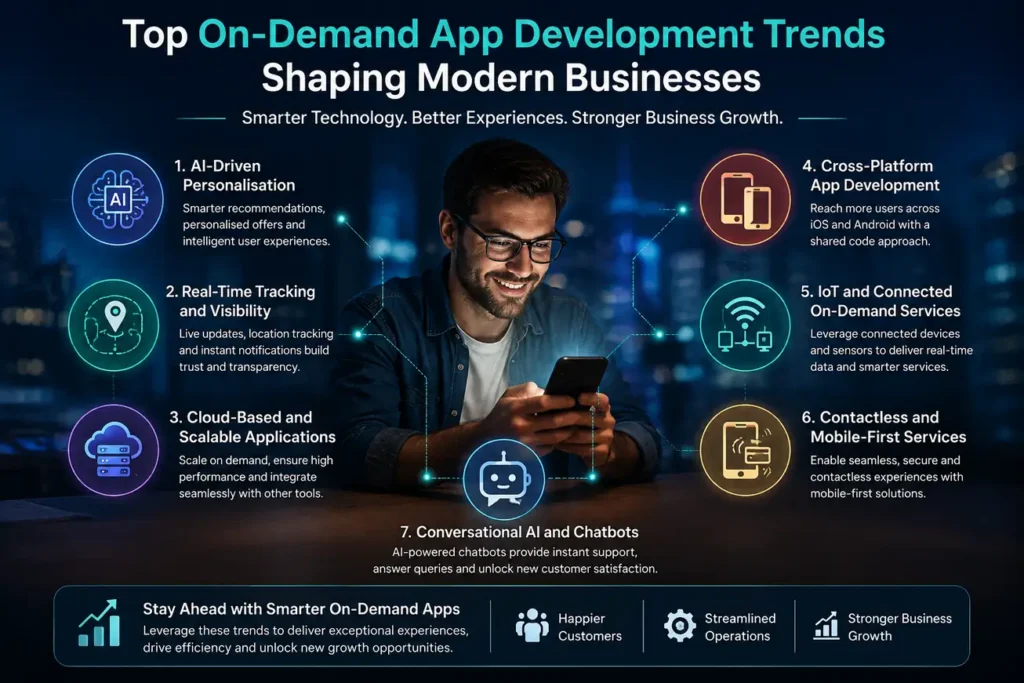
4. Cross-Platform App Development
Businesses want to reach customers across iOS and Android without building separate applications. Cross-platform app development supports this through a shared development approach. For on-demand mobile app development, it can reduce development duplication and speed up feature releases. However, businesses should consider performance, security, device capabilities and product complexity before choosing this approach.
5. IoT and Connected On-Demand Services
IoT integration is broadening what on-demand applications can achieve. Rather than being dependent solely on the input provided by users, applications can now access real-time data from connected cars, equipment, sensors and other devices.
For example, a logistics company can use connected vehicles to provide real-time delivery updates. Meanwhile, an industrial company can monitor its machinery remotely, while a smart home business can allow customers to control connected devices through its app.
6. Contactless and Mobile-First Services
As part of the latest mobile app development trends, businesses are also responding to changing mobile commerce trends, with customers expecting services without unnecessary calls, paperwork, or waiting. Digital payments, QR codes, mobile ordering, digital check-ins, and remote service requests make this possible. These contactless services improve convenience, reduce queues, and simplify routine transactions for both customers and businesses.
7. Business Automation Through On-Demand Apps
Modern on-demand app solutions are not limited to consumer-facing applications; they have also evolved into management systems for internal business processes.
Companies can use workflow automation to manage bookings, payments, notifications, scheduling, approvals, invoices and reporting. Instead of employees manually moving information between systems, workflows can happen automatically within the application. This can reduce repetitive work, minimise human error, and give management clearer visibility into daily operations.
8. Predictive Analytics and Smarter Decision-Making
On-demand applications generate large amounts of data through customer activity, transactions, bookings and service requests. Businesses can use this data to identify patterns, forecast demand and make faster decisions. These capabilities are especially valuable for larger organisations, where data from multiple departments can support better planning, resource allocation and operational efficiency. For example, delivery businesses can forecast busy periods, while retailers can anticipate product demand and manage stock more effectively.
9. Stronger Security and Privacy
As on-demand applications handle payments, personal information, location data and business records, security is becoming a core part of product development rather than a final-stage requirement. Businesses need to consider app security best practices such as secure authentication, encryption, access controls, regular testing and appropriate data protection measures.
For businesses operating in regulated industries, security is also critical to maintaining customer trust and meeting compliance requirements. Building security into the application from the beginning is generally more effective than adding it later.
10. Conversational AI and AI Agents
On-demand business apps are increasingly using conversational AI and AI agents to help customers and employees complete tasks without navigating multiple screens or waiting for support. Users can ask questions, make bookings, track orders, reschedule services or receive updates through natural language.
Unlike traditional chatbots, AI agents can potentially execute multi-step workflows rather than simply respond to questions. Businesses should focus on AI capabilities that solve specific customer or operational problems rather than adopting AI simply because it is a current technology trend.
Explore more: How much does on-demand app development cost?
Essential Features of Modern On-Demand Applications
The right on-demand app features should improve both customer experience and business operations. Modern on-demand applications typically include:
- Real-time tracking: Allows users to monitor orders, deliveries, or the location of service providers.
- Secure payments: Provides convenient and secure in-app payment options.
- Notifications: Keeps users informed about bookings, payments, and service updates.
- Booking automation: Simplifies scheduling and reduces manual effort.
- Personalised recommendations: Uses customer behaviour and preferences to suggest relevant products or services.
- Ratings and reviews: Builds trust and helps businesses evaluate service quality.
- Analytics and reporting: Provides insights into demand, customer behaviour, and operational performance.
How Businesses Can Choose the Right On-Demand App Trends
Businesses need to select trends based on their objectives, customer needs, and specific requirements. Understanding the future of on-demand apps can also help businesses identify which technologies are likely to deliver lasting value. This is particularly important when evaluating on-demand app development services, where businesses need to balance emerging trends with long-term scalability. Before making an investment decision, consider:
- Business value: Pick technologies that fix a clear business problem or add measurable value.
- Customer needs: Focus on features that make services faster, easier, or more convenient.
- Scalability: Make sure the technology can handle more users, transactions, and data.
- Integration: See if the trend can work well with your current systems and tools.
- Security: Look at data protection, authentication, and compliance needs.
- Long-term relevance: Pick solutions that can change as your business and customers’ needs grow.
What Is the ROI of On-Demand App Development?
The ROI of an on-demand application should be measured by the business results it delivers, not simply by the number of downloads. By adopting emerging app technologies as part of their digital transformation strategy, businesses can improve customer experiences, automate processes, reduce operating costs, and create new revenue opportunities.
Key areas where businesses can see measurable returns include:
- More revenue opportunities: On-demand applications can support new revenue models through subscriptions, booking fees, direct sales, and repeat purchases.
- Lower operational expenses: Automation can reduce the manual effort involved in bookings, payments, scheduling, customer support, and order fulfilment.
- Improved customer loyalty: Faster service, personalised experiences, and convenient digital interactions can encourage repeat usage.
- Greater staff efficiency: Automation allows teams to spend less time on repetitive administrative tasks and more time on higher-value activities.
- Faster service delivery: Automated workflows and real-time information can reduce delays and improve service response times.
- Better decision-making: Data from customer interactions and operations can help businesses identify trends and make more informed decisions.
- Scalability: A well-designed app can support expansion into new services, customer segments, and geographic markets.
Explore more: On-demand taxi app development: complete guide
The Future of On-Demand App Development
On-demand applications are becoming valuable tools for automation, revenue growth, and better customer experiences. On-demand business apps can help companies streamline workflows, respond to changing customer needs, and deliver services more efficiently. Businesses should focus on technologies that solve specific challenges while considering scalability, security, and long-term customer expectations.
The future of on-demand applications will bring smarter, more personalised, and responsive experiences through AI, cloud infrastructure, real-time monitoring, and connected technologies. Choosing the right technology and development approach can help businesses build platforms that deliver measurable value as they grow.
Businesses looking for an experienced on-demand app development company can work with IIH Global for support across discovery, UI/UX design, development, integration, testing, and ongoing support. If you are planning an on-demand application, talk with our experts to explore the right technology approach for your business goals.