


The salon app development cost depends on several business and technical factors. Every salon has different goals, customer expectations, and service models. As a result, salon app development requires careful planning before estimating the budget. Whether you own a single salon or a growing chain, a mobile app can improve customer convenience and daily operations. Understanding the pricing structure helps you avoid unnecessary expenses and invest in features that deliver real value.
Modern customers expect quick booking, secure payments, and personalized experiences. A mobile app makes these services available around the clock. It also helps salons reduce manual work and improve customer satisfaction. Before starting your project, it is important to understand the development process, pricing factors, and long-term investment. This guide explains everything you should know before building a salon application.
Salon App Development: Key Features and Benefits
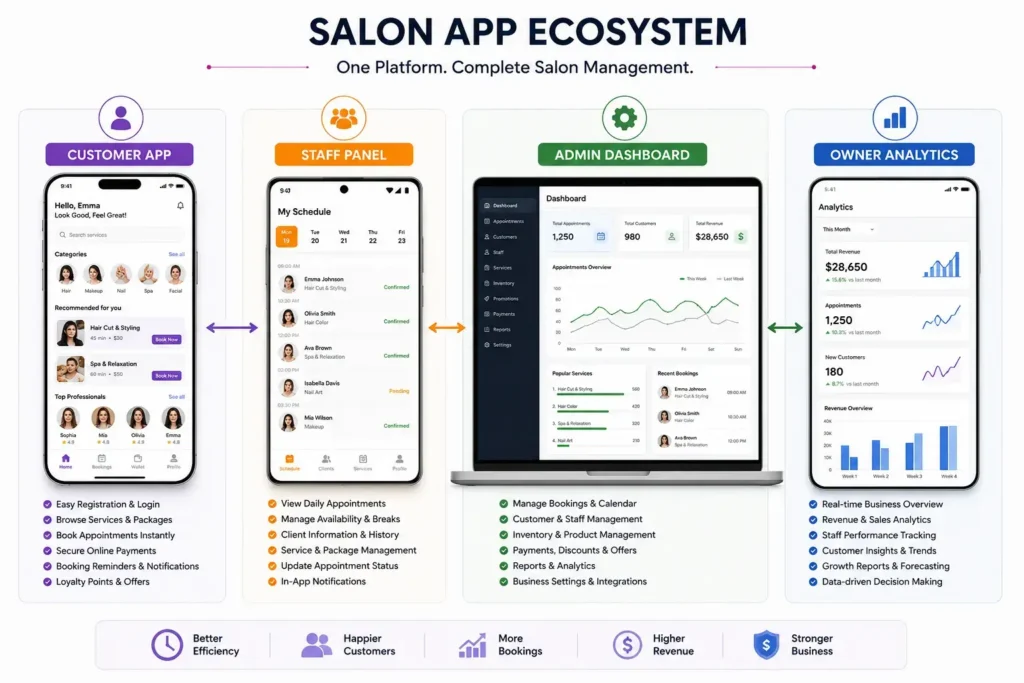
A successful salon application should solve real customer problems while simplifying daily business tasks. The right combination of features creates a smooth experience for customers, salon staff, and administrators.
1. Customer Booking Experience
The core of every salon appointment booking app is simple appointment scheduling. Customers should browse available services, choose professionals, select time slots, and confirm bookings within minutes. An intuitive online salon booking app reduces phone calls and manual scheduling. Customers receive reminders before appointments, reducing missed bookings and improving customer retention.
2. User-Friendly Design
An attractive salon app UI/UX encourages customers to return. Clean navigation, fast loading screens, and easy checkout improve user satisfaction. Simple interfaces also reduce customer support requests. Users should find every important function within a few taps.
3. Secure Payment Options
Reliable salon payment integration allows customers to pay through cards, digital wallets, or online banking. Secure payment systems increase customer confidence while reducing payment-related issues for salon owners.
4. Customer Relationship Management
Effective salon customer management tools help businesses track appointments, purchase history, loyalty rewards, and customer preferences. These insights help salons create personalized promotions and improve repeat business without additional marketing costs.
5. Business Management Dashboard
A complete salon business app should include an admin panel that manages bookings, staff schedules, inventory, reports, discounts, and customer feedback. Business owners gain better visibility into daily operations and make faster decisions using real-time analytics.
6. Cross-Platform Accessibility
Many businesses choose a cross-platform salon app because it supports multiple operating systems using a shared codebase. This approach reduces development time while maintaining consistent performance across devices.
7. Android and iOS Compatibility
Most customers use either an Android salon app or an iOS salon app depending on their preferred device. Supporting both platforms expands your customer reach and improves booking accessibility without limiting your audience.
8. Benefits for Salon Owners
A well-designed application offers several business advantages.
- Faster appointment management
- Higher customer retention
- Reduced administrative work
- Better revenue tracking
- Improved customer engagement
- Stronger brand visibility
Businesses investing in beauty salon app development often see higher booking efficiency because customers can schedule appointments anytime.
Factors That Influence the Salon App Development Cost
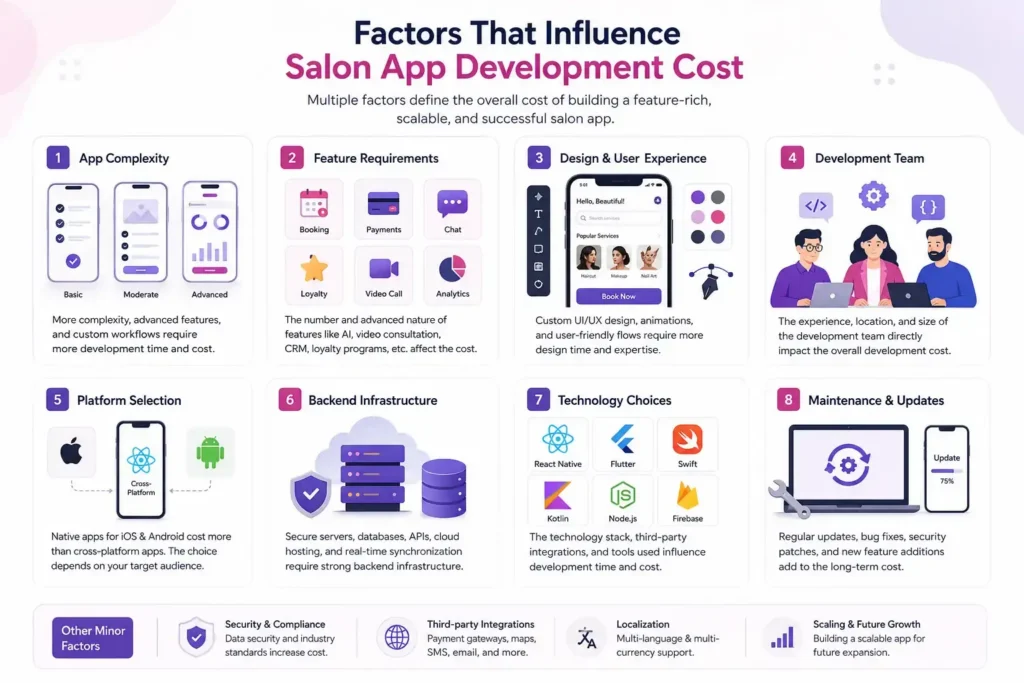
Every project has unique requirements. Therefore, the salon app development cost varies based on design complexity, features, technology, and business goals.
1. App Complexity
A simple salon booking application costs much less than a fully customized platform with advanced automation.
Basic applications usually include:
- Registration
- Service listing
- Appointment booking
- Notifications
- Payment gateway
Advanced solutions may include AI recommendations, loyalty programs, CRM integration, analytics dashboards, and marketing tools.
2. Feature Requirements
The number and complexity of features significantly affect the cost to build a salon app. Features like video consultation, live chat, membership subscriptions, multilingual support, and automated marketing require additional development hours. Adding unnecessary features at launch often increases the budget without delivering immediate business value.
3. Design and User Experience
Custom interface design costs more than standard templates. High-quality design improves usability and strengthens your brand identity. Investing in thoughtful design often produces better long-term customer engagement.
4. Development Team
Choosing an experienced mobile app development agency improves project quality, communication, and delivery timelines. Experienced developers usually identify technical risks early, preventing expensive revisions during later development stages. Businesses planning long-term digital growth should evaluate technical expertise rather than selecting vendors based only on price.
5. Platform Selection
Developing separate native applications increases overall costs. Many startups begin with a shared codebase before expanding platform-specific functionality. A balanced strategy depends on your business objectives, customer base, and available budget.
Explore more: Salon Website Development Cost Guide
6. Backend Infrastructure
Every application requires secure servers, databases, APIs, authentication systems, and cloud hosting. Scalable backend architecture supports future business growth without requiring complete redevelopment.
7. Technology Choices
The selected salon app technology stack influences development speed, scalability, security, and maintenance. Popular technologies include Flutter, React Native, Node.js, Laravel, Firebase, PostgreSQL, and AWS cloud services. Choosing proven technologies reduces future compatibility issues and improves application stability.
8. Third-Party Integrations
Many salons connect their applications with payment gateways, SMS services, maps, analytics platforms, and CRM software. Every external integration adds development effort and testing requirements.
9. Development Model
Many startups begin with an MVP salon app instead of building every feature immediately. Launching an MVP helps validate business ideas before making larger investments. Businesses collect customer feedback and expand features based on actual usage. Around this stage, many companies also evaluate a top salon app development company when exploring experienced technology partners for scalable projects and long-term product support.
10. Custom Development Requirements
Some businesses require highly specialized workflows, advanced reporting, franchise management, or loyalty ecosystems. In such cases, custom salon app development provides greater flexibility than template-based applications. Organizations seeking enterprise-grade scalability often explore custom salon app development services to build tailored solutions for complex operational needs and future expansion.
11. Dedicated Development Resources
Growing businesses often prefer to hire best dedicated developers instead of assembling multiple freelancers. A dedicated team improves communication, maintains consistent coding standards, and accelerates project delivery throughout the development lifecycle.
12. Future Business Expansion
Businesses planning on-demand salon app development should consider future scalability during the initial planning stage. Applications built on flexible architecture adapt more easily as customer demand increases. Many modern businesses also adopt broader on-demand app solutions to support additional beauty services, home appointments, and multi-location operations from a single platform.
Average Cost Breakdown of Salon App Development
The final salon app development cost depends on project scope, development approach, and feature complexity. The estimates below reflect the current global market in 2026. Actual pricing varies by development team, technology stack, and customization needs.
| Development Stage | Estimated Cost (USD) |
|---|---|
| Business Analysis & Planning | $2,000 – $5,000 |
| UI/UX Design | $3,000 – $8,000 |
| Frontend Development | $8,000 – $20,000 |
| Backend Development | $10,000 – $25,000 |
| API & Third-Party Integrations | $2,000 – $8,000 |
| Testing & Quality Assurance | $3,000 – $8,000 |
| Deployment & Launch | $1,000 – $3,000 |
A basic salon application usually costs between $20,000 and $35,000. It includes customer registration, service listings, appointment booking, notifications, and online payments. A medium-sized solution generally ranges from $35,000 to $70,000. It often includes loyalty programs, advanced analytics, customer profiles, marketing tools, and multi-staff scheduling.
A feature-rich enterprise platform can cost $70,000 to $150,000. These applications support multiple branches, franchise management, AI recommendations, CRM integrations, and advanced reporting. The salon booking app development cost also depends on the number of supported platforms. Building separate native apps usually costs more than using a cross-platform framework.
Similarly, the beauty app development cost increases when businesses require premium designs, custom workflows, advanced security, or complex third-party integrations. Businesses planning hair salon app development often start with essential booking features before expanding into customer loyalty, subscriptions, and personalized marketing. Companies investing in salon management app development usually prioritize staff scheduling, inventory tracking, sales reports, and business analytics alongside customer-facing features.

Additional Costs to Consider
Development is only one part of the total investment. Every mobile application also includes ongoing operational expenses after launch.
1. Cloud Hosting
Reliable cloud hosting ensures stable application performance and supports future user growth. Monthly hosting expenses increase as traffic and data storage requirements grow.
2. Third-Party Services
Payment gateways, SMS providers, email platforms, push notification services, maps, and analytics tools often charge monthly or transaction-based fees.
3. Security and Compliance
Security updates, encryption, backups, vulnerability testing, and compliance requirements help protect customer information and business data.
4. App Store Fees
Publishing applications on Android and iOS marketplaces involves developer account fees and periodic policy updates.
5. Marketing and User Acquisition
Launching an application does not guarantee downloads. Businesses should allocate a marketing budget for SEO, paid advertising, social media campaigns, referral programs, and customer engagement.
6. Feature Enhancements
Customer expectations change quickly. Regular feature updates keep the application competitive while improving customer satisfaction.
Tips for Reducing Salon App Development Costs
Reducing costs should never compromise quality. Smart planning helps businesses maximize their investment without sacrificing performance.
1. Build an MVP First
Launching with essential features allows businesses to validate customer demand before expanding functionality. Customer feedback guides future investments and reduces unnecessary development.
2. Prioritize Business Goals
Focus on features that solve immediate business challenges. Avoid adding advanced functionality unless customers truly need it.
3. Choose Cross-Platform Development
Cross-platform frameworks reduce development time and simplify future maintenance while reaching both Android and iOS users.
4. Reuse Trusted Components
Experienced development teams often reuse tested libraries and reliable APIs. This approach shortens development time while improving software stability.
5. Plan for Scalability
A scalable architecture prevents expensive redevelopment as the business grows. Investing in flexible infrastructure early often saves money later.
6. Work with Experienced Developers
An experienced development partner delivers cleaner code, stronger security, and fewer post-launch issues. Quality development reduces long-term operating costs even if the initial investment is slightly higher.
Conclusion
Understanding the salon app development process helps businesses create realistic budgets and make informed technology decisions. Project pricing depends on features, design complexity, development approach, integrations, and long-term business goals.
Instead of selecting the lowest price, focus on long-term value, application quality, scalability, and user experience. A well-planned salon application improves customer satisfaction, streamlines operations, and supports future growth. Careful planning today leads to better returns throughout the product lifecycle.