


A wearable can tell you how many steps you took today. But what can it tell you about tomorrow? That is where the next frontier of wearable technology lies. Devices are already capturing continuous data on movement, sleep, heart rate and other physiological measurements. The real differentiator will be their ability to identify patterns, make predictions and deliver timely interventions. For businesses building digital health, fitness or wellness products, AI in wearable apps is shifting the proposition from simply tracking users to helping them understand what their data means.
The Wearable AI Market Is Moving Beyond Fitness: What’s Driving the Shift
The global wearable AI market is projected to reach USD 55.7 billion in 2026 and USD 310.6 billion by 2033, representing a CAGR of 27.8%. Healthcare is projected to be one of the fastest-growing application segments.
In the UK alone, the wearable technology market is set to expand at a 26.83% CAGR, driven by demand for advanced health monitoring features. This shift is creating new opportunities for wearable app solutions, particularly as businesses look to turn continuous device data into more meaningful and predictive experiences.
From Reactive to Predictive: How AI in Wearable Apps Actually Works
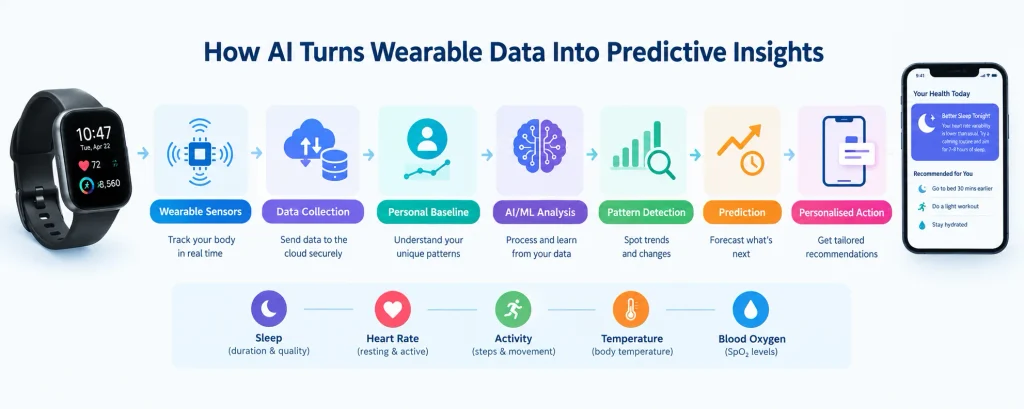
The shift from tracking to prediction begins with a more intelligent use of wearable data. A wearable app development company plays a key role in turning wearable device data into actionable insights, rather than simply connecting the device to an application. The real value lies in identifying meaningful patterns in continuous signals and turning them into relevant, timely predictions that improve the user experience.
1. Start With a Prediction Worth Making
Each predictive feature should begin with a clearly defined outcome. The goal might be to support recovery, detect unusual activity, or help users achieve a specific health or fitness objective. Defining this outcome helps keep the AI feature focused on a specific product need rather than adding AI simply because it is technically interesting.
2. Connect the Relevant Data Sources
Bring together the signals needed to support that outcome, whether they come from wearable sensors, a mobile device or approved external platforms. Data quality and relevance matter more than simply collecting large quantities of data. Getting the right data sources in place is an important part of AI wearable app development, as collecting every available metric does not necessarily lead to better predictions.
3. Establish the User’s Baseline
Prediction becomes more useful when the product understands what is normal for each individual. Historical activity, sleep and physiological measurements can help establish a personal baseline, making meaningful changes easier to recognise. This approach also helps smart wearable apps move beyond generic thresholds and provide experiences that reflect individual behaviour.
4. Identify Signals That Matter
AI and ML can analyse relationships across multiple measurements to identify trends or deviations that may be difficult to detect through simple dashboards or rule-based systems. Instead of presenting another set of numbers, the product surfaces the change that deserves attention. The goal is to turn continuous sensor and health data into insights that users can understand and act on.
5. Turn the Insight Into Action
A correct prediction is of little use if it arrives too late or fails to account for different contexts. When real-time data is available, the result can be turned into a notification, recommendation, summary or next-step suggestion depending on the situation. It is this kind of integration that takes predictive intelligence from the background into the day-to-day user experience.
6. Learn From Real-World Results
Post-launch monitoring completes the cycle, as teams can evaluate prediction accuracy, false alerts, user reactions and evolving patterns to improve the models and product logic.
For AI wearable app development, this continuous feedback is essential, particularly for wearable health apps where prediction quality and user response directly influence the overall experience. The objective is not a one-time AI implementation, but a product that becomes more useful as teams learn from real-world performance.
Before you invest in a wearable app, understand what actually drives the cost. Read more in our guide, How Much Does Wearable App Development Cost? Complete Guide.
What Technology Makes Predictive Wearable Apps Possible?
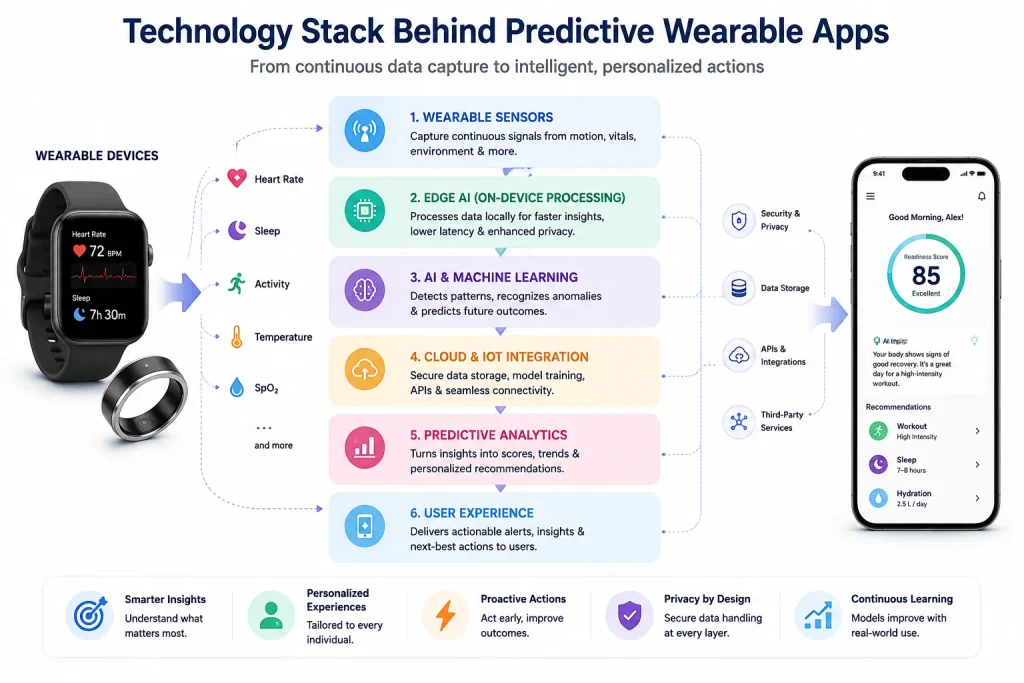
Predictive wearables rely on more than just AI. They involve sensors that continuously capture signals, AI algorithms that make sense of these signals, and a cloud or edge system that can process all that information fast enough to generate insights. Together, these technologies support wearable app features that go beyond basic tracking and help deliver more personalised, predictive experiences.
Advanced Wearable Sensors
Accelerometers, gyroscopes and optical sensors, including photoplethysmography (PPG) sensors, capture signals related to movement, heart rate and other physiological data. More sophisticated devices may also capture information on temperature, blood oxygen and biochemicals.
The quality and consistency of captured signals directly affect how effectively software can identify patterns and make predictions.
Artificial Intelligence and Machine Learning
AI and ML analyse time-series data to identify relationships and patterns that are difficult to detect through basic rules. Depending on the use case, models can recognise changes in activity, sleep or physiological signals and support health-related predictions.
Models need appropriate training data, validation and continuous monitoring to produce reliable results.
Edge AI and On-Device Processing
Not all computations need to be performed in the cloud. Edge AI makes it possible to perform some of these computations directly on wearable or connected devices.
This can reduce latency and minimise the amount of sensitive data that needs to be transmitted to external servers. The right balance between on-device and cloud processing depends on the product’s requirements.
Cloud Computing and IoT Integration
Cloud infrastructure provides the storage and computing capacity required to process large volumes of wearable data, train models and manage application services. IoT connectivity also allows wearable devices to exchange information with mobile apps, APIs and approved external data sources.
For example, combining wearable measurements with relevant environmental or contextual data can provide a broader picture of the factors affecting a user’s behaviour or wellbeing.
Predictive Analytics and Personalisation
Once data has been collected and processed, AI-driven analysis can identify trends, anomalies and changes over time. Predictive analytics in wearable apps helps transform those patterns into useful outputs rather than simply displaying another set of measurements.
The result can be personalised health insights based on an individual’s historical patterns, current signals and relevant context. This is what allows a wearable experience to move from reporting what happened to helping users understand what may happen next.
Explore more: AI wearable technology across industries
How AI Is Making Wearable Apps More Predictive
One of the biggest changes AI brings to wearable apps is not simply more accurate tracking, but better interpretation of the data. Instead of treating each heart rate, sleep or activity reading as an isolated data point, AI analyses patterns, allowing wearable products to move from reporting what happened to identifying what may need attention next.
Recognising Patterns Across Multiple Signals
Human behaviour rarely follows a single measurable signal. A change in sleep, activity and heart rate together may mean something different from a change in any one of them alone.
AI can analyse these relationships across large volumes of time-series data, supporting anomaly detection and identifying patterns that basic rule-based systems may overlook. For example, a fitness app could detect a combination of reduced activity, poorer sleep and slower recovery, then highlight that the user’s recovery pattern has changed.
Understanding What Is Normal for Each User
A prediction is more effective when it takes into account an individual’s normal patterns. The AI may consider past data to create a personal baseline instead of just using general thresholds. For example, a resting heart rate that represents a significant change for one user may be normal for another. Personalised models can help differentiate between individual variations and meaningful deviations.
Turning Predictions Into Useful Actions
Generating a prediction is only half the job. The product also needs to present it in a way that helps the user decide what to do next.
For instance, if an AI model identifies a pattern associated with poor recovery, the app could recommend a lighter training session, additional rest or closer monitoring. In a wellness context, these personalised recommendations can make the insight more practical than simply displaying another metric.
Making Wearable Experiences More Proactive
This shift redefines the wearable from a passive tracking tool into a more proactive digital experience. Instead of requiring users to check the device themselves, the app can proactively bring relevant information to their attention.
That doesn’t mean everything the product anticipates should become an alert. A well-designed product can anticipate potential changes but should only alert users when the information is relevant, timely and appropriate.
Learning From Real-World Behaviour
Predictive functionality also improves through continued use. Teams can monitor model performance, false alerts, user responses and engagement to understand whether predictions are genuinely useful.
This creates a continuous improvement cycle in which the AI models and product experience evolve together. For businesses, that makes predictive capability more than a one-time feature; it becomes part of the product’s long-term value proposition.
Explore more: Wearable app development guide
Where Predictive Wearable Apps Create Business Value
The commercial value of wearable devices extends well beyond personal fitness. Smartwatches, smart rings, activity bands and medical wearables can generate continuous streams of data that businesses can use to create more personalised and compelling digital experiences.
Creating that value requires more than pairing a wearable to an app. A mobile application development company can combine device data, APIs, AI models and user-facing features to create an engaging experience around those signals.
Fitness and Performance
Devices such as Apple Watch, Garmin watches and Fitbit devices capture activity, heart rate and workout data. Beyond basic fitness tracking, AI can analyse these signals to provide more personalised training, recovery and performance recommendations.
Preventive Health and Wellness
Smart rings such as the Oura Ring track sleep, temperature and recovery-related signals. Apps can analyse these patterns to provide personalised recommendations and encourage healthier routines.
Remote Health Monitoring
Medical wearables and connected health devices can support real-time health monitoring by capturing relevant physiological data and relaying meaningful changes to healthcare teams or authorised platforms.
Chronic Condition Support
Continuous glucose monitors (CGMs), for example, can provide frequent glucose measurements that enable applications to identify trends over time.
Sports and Workplace Wellbeing
Athletes can use wearable data to understand workload and recovery, while workplace wellbeing platforms can use appropriately aggregated data to support healthier routines and engagement.
Final Takeaway
The future of wearable products will not be defined by the sheer number of metrics they can capture. It will be defined by their ability to transform continuous signals into timely, personalised and actionable insights. AI in wearables is enabling that shift by identifying patterns, detecting outliers, adapting recommendations and supporting more proactive experiences.
For businesses, this opportunity also requires disciplined product design. The most successful wearable products are built around meaningful problems, use data judiciously and embed prediction into a safe and accessible user experience.
IIH Global helps businesses turn wearable and AI opportunities into scalable digital products, from architecture and application development through to AI integration, testing and ongoing support. Your wearable app can do more than track. Discover what predictive AI could unlock for your product with a free consultation from our experts.