


Blockchain has moved far beyond cryptocurrency. Today, businesses are exploring blockchain applications to track products across supply chains, automate financial transactions and create trusted digital records between multiple parties. However, building a successful solution takes more than selecting a blockchain platform. The right blockchain architecture determines how the network, data, applications and security components work together as a business grows.
A well-planned architecture also provides a roadmap for blockchain application development, making it easier to select appropriate components and establish reliable transaction verification processes.
What essential elements should your blockchain application include? How do you choose an architecture that provides security, scalability, and cost efficiency? In this article, we’ll cover the critical architecture options so you can make informed decisions before you start development.
What Is Blockchain Application Architecture?
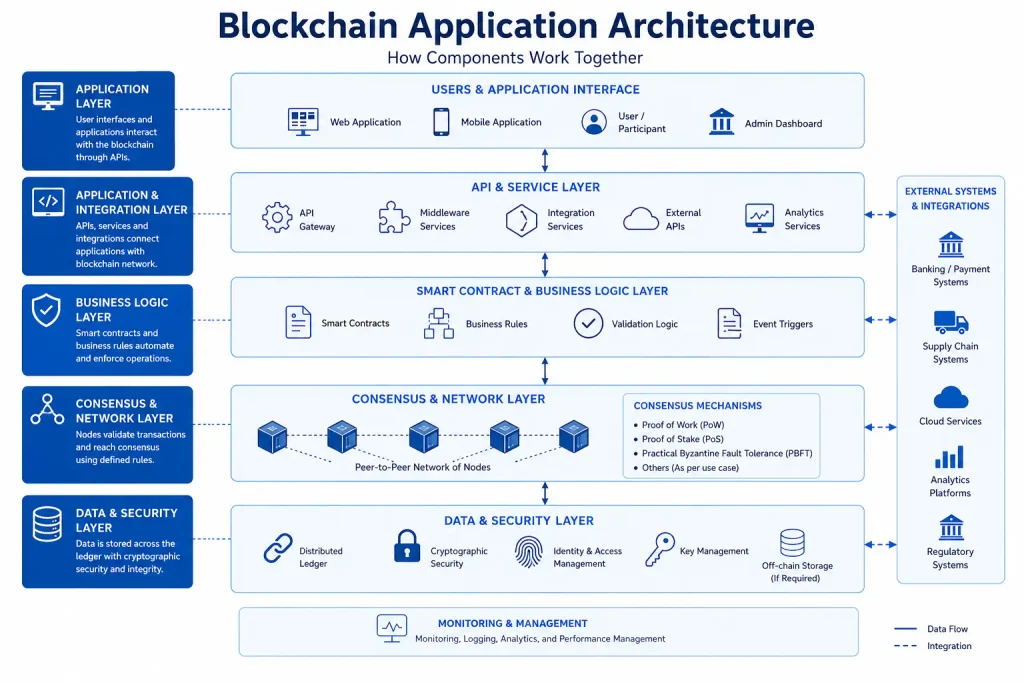
Blockchain application architecture describes the underlying technical structure that enables a blockchain application to function. The architecture includes network, data, application and security layers, along with supporting components.
At its core, blockchain uses distributed ledger technology to maintain transaction records across multiple participants. Instead of relying entirely on one central database, the network allows authorised participants to verify and share records according to agreed rules.
For example, a blockchain system would enable manufacturers, suppliers and logistics companies to track product movements. All parties can access and verify the relevant data, rather than having to depend on a single company to keep the records.
The purpose of blockchain architecture design is not to put every business activity on a ledger. It is to identify where shared records, transparency and automated verification can solve a genuine operational problem.
What Are the Different Types of Blockchain Architecture?
Which network you select will depend on your requirements for access, control, privacy, and participation. Understanding the different types of blockchain architecture can help you make a more informed decision.
1. Public Blockchain
A public blockchain means anyone can join as long as they follow the rules of the network. Ethereum is an example of an open blockchain network. Public blockchains can support decentralised applications (dApps), digital assets and platforms that require open participation. Transaction fees, public data visibility and network congestion should be considered.
2. Private Blockchain
Access is limited to approved participants, allowing an organisation to manage network permissions, control participation and oversee how the system operates.
Private blockchains can be tailored to manage internal records, private business processes and applications where access must be tightly controlled.
3. Hybrid Blockchain
A hybrid blockchain combines elements of public and private networks. A firm can keep sensitive information within a private environment while publishing selected transaction proofs or data on a public network for independent verification.
This approach supports use cases such as asset tracking and supply chain verification.
4. Consortium Blockchain
Consortium blockchains are governed by a group of selected organisations rather than a single organisation or the general public. This type of network is suitable for trade finance, industrial collaboration, and sharing medical information among multiple authorised organisations.
Explore more: Blockchain technology for app development
What Are the Key Elements in Blockchain Applications?
A blockchain solution relies on several blockchain application components working together. Each serves a different purpose and should be selected according to the project’s requirements.
1. Network and Nodes
The network connects participating computers that maintain or verify the ledger. Blockchain nodes store records, validate transactions or help maintain network operations, depending on their configuration.
A well-planned blockchain network architecture defines node responsibilities, communication rules, permissions and how participants join or leave the network. Many systems operate through a peer-to-peer network, allowing participating nodes to exchange information directly.
2. Consensus and Transaction Validation
Consensus mechanisms define how the network participants will agree on valid transactions and blocks. Various mechanisms exist depending on the network’s security, throughput and governance needs.
Validation of a transaction confirms that the transaction complies with the rules of the network before being added to the ledger. This process ensures that only transactions meeting the network’s validation rules are added to the ledger.
3. Smart Contracts and Business Logic
A smart contract encodes business rules into executable code on a blockchain. It can trigger payments when conditions are met, validate the transfer of ownership, or automate specific conditions of a transaction.
Smart contracts require careful specification, development and testing because coding errors or vulnerabilities can result in financial losses, disrupt business operations or compromise transaction execution.
4. Data and Security Layer
Blockchain records rely on cryptographic techniques to protect their integrity. Cryptographic hashing creates a digital fingerprint of information, helping identify changes to recorded data.
However, blockchain security involves more than protecting ledger records. Identity management, access permissions, key protection, secure coding and monitoring remain essential.
Businesses should also plan blockchain data storage carefully. Sensitive documents and large files generally belong in secure off-chain storage, with only necessary references or proofs recorded on the ledger.
5. Application and Integration Layer
The application layer provides the interface through which users interact with blockchain functionality. It connects blockchain functionality to the applications users interact with. It can include web portals, backend services and mobile applications that allow users to access blockchain functionality remotely or from on-premises environments.
API integration enables the application to share data with existing CRM, ERP, payment, and inventory systems. This is important when businesses want blockchain to improve existing operations rather than create another isolated platform.
Choosing the Right Blockchain Technology Stack
The technology stack should support business requirements rather than dictate them. Your blockchain technology stack may include the following:
| Component | Common options | What to consider |
| Blockchain platform | Ethereum, Hyperledger Fabric, Polygon | Access, fees, governance and ecosystem |
| Smart contract languages | Solidity, Rust | Contract complexity and developer expertise |
| Backend | Node.js, Python, Java | Business logic and integrations |
| Frontend | React, Angular, Vue | User experience and dashboards |
| Database | PostgreSQL, MongoDB | Off-chain records and reporting |
| Infrastructure | Cloud, managed nodes, self-hosted nodes | Availability, monitoring and control |
Projects based on Ethereum can use the Ethereum Virtual Machine (EVM) for executing smart contracts. Enterprise projects may require a permissioned platform and another set of development tools.
When selecting a blockchain platform, compare the cost of transactions, maturity of the network, dedicated developer support, privacy capabilities, and integration possibilities. You should not choose a platform merely based on its popularity.
How to Choose the Right Components for Your Project
A successful blockchain development architecture starts with the business problem, not the choice of programming language or network.
1. Start With the Business Objective
Define the objective you want the application to achieve. Do you want to create traceable ownership records, automate transactions or reduce reconciliation between organisations? If a traditional database can handle the task more efficiently, implementing blockchain may be unnecessary.
2. Evaluate Users and Permissions
Determine who will use the network, who can validate transactions and what data each participant can access. Enterprise blockchain architecture often supports a defined group of organisations, requiring clear permission levels, access controls and governance rules. A public application needs different controls from a platform built for trusted business partners.
3. Assess Privacy and Compliance
Determine which information must be visible to participants and which should remain confidential. Consider applicable data protection, financial and industry requirements before deciding what belongs on-chain.
4. Plan for Transaction Volume
Estimate expected transactions, peak usage, response times and future demand. Blockchain scalability depends on network capacity, transaction design, storage growth and the potential need for additional processing layers. Some networks support layer 2 solutions to help reduce transaction costs and improve throughput. Their suitability depends on the chosen platform and application requirements.
5. Check Integration and Future Flexibility
Conduct a review of the software, data resources, and business flows prior to development. A modular architecture makes upgrades easier, supports additional integrations and allows new participants to join without requiring a complete redesign of the application.
A comprehensive blockchain application development process should involve requirements gathering, architecture and design, prototyping, development, testing, deployment and monitoring.
Explore more: Blockchain security testing before launch
How Much Does Blockchain Application Development Cost?
The cost depends on application complexity, network choice, integrations, security requirements and development effort. The following figures are indicative planning estimates in US dollars, not fixed quotations.
| Project type | Estimated development cost |
| Proof of concept | $10,000–$30,000 |
| Focused blockchain MVP | $30,000–$75,000 |
| Mid-complexity application | $75,000–$180,000 |
| Enterprise platform | $180,000–$400,000+ |
A reliable blockchain application development company can assess these requirements and provide a project-specific estimate based on the required features, technical complexity and long-term support needs. Starting with a focused first release can help control costs while allowing businesses to validate the solution before expanding it.
Additional expenses may include security audits, hosting, node management, transaction fees, compliance reviews and ongoing maintenance. Starting with a focused first release can help control costs while allowing businesses to validate the solution before expanding it.
Key Characteristics of Reliable Blockchain Architecture
Blockchain architecture should accommodate future business and technical requirements rather than focus solely on initial deployment.
- Scalability: Accommodate increased transaction volumes without having to redesign.
- Blockchain Performance: Achieve satisfactory transaction speed, data access times, and consistent response times.
- Security: The identities, keys, records, and application interfaces must be secured.
- Interoperability: Enable blockchain interoperability with other networks and business systems.
- Maintainability: Enable testing, upgrading and monitoring of components.
- Governance: Define participation rules, roles, responsibilities, authorisations and decision-making processes.
These characteristics should be assessed during planning rather than added after development.
The Future of Blockchain App Architecture
The direction of blockchain development is towards more modular, interoperable and application-specific systems. Businesses are exploring ways to connect blockchain with AI, IoT, digital identity and existing enterprise platforms.
As these systems mature, blockchain infrastructure will need to support more complex integrations, stronger governance and changing transaction demands. The focus will increasingly shift from adopting blockchain for its own sake to building systems that deliver measurable operational value.
Conclusion
The success of a blockchain solution depends on more than the technology behind it. The right architecture must support your business goals, protect sensitive data, handle expected transaction volumes and connect smoothly with existing systems.
Before development begins, define the problem you want to solve, identify who will use the application and select components that serve a clear purpose. A well-planned structure helps avoid unnecessary costs, simplifies future upgrades and gives the application room to scale.
With the right technical planning and development approach, businesses can build blockchain applications that deliver practical value today and remain adaptable as their needs evolve.