


The real estate industry handles valuable assets, sensitive records, and complex transactions. Yet many processes still depend on fragmented databases and manual verification. Blockchain real estate apps can create a more trusted digital environment for these workflows. By combining a decentralised ledger with smart contracts, businesses can improve the way they manage property data, transactions, and ownership.
The value of blockchain for real estate apps goes beyond cryptocurrency. It can support verified property information, automated agreements, transparent transactions, and digital ownership models. Modern platforms can also connect blockchain with maps, payment gateways, identity systems, CRM tools, and property databases.
The technology does not remove every challenge. Legal rules, data accuracy, privacy, scalability, and integration still require careful planning. The strongest solutions use blockchain where it creates measurable value rather than adding it simply because it is available.
Benefits of Blockchain Technology in Real Estate
1. Greater transparency and trust
Traditional property transactions often involve buyers, sellers, agents, lenders, lawyers, and government authorities. Each party may maintain separate records. This can create delays and disagreements when information differs. Blockchain creates a shared record that authorized participants can verify.
This approach supports transparent property transactions because participants can trace relevant events without relying on multiple disconnected databases. A well-designed blockchain system can also create secure property transactions by combining cryptographic controls with permission management.
However, blockchain security does not guarantee that the original property data is accurate. Businesses still need strong verification processes.
2. Faster property transactions
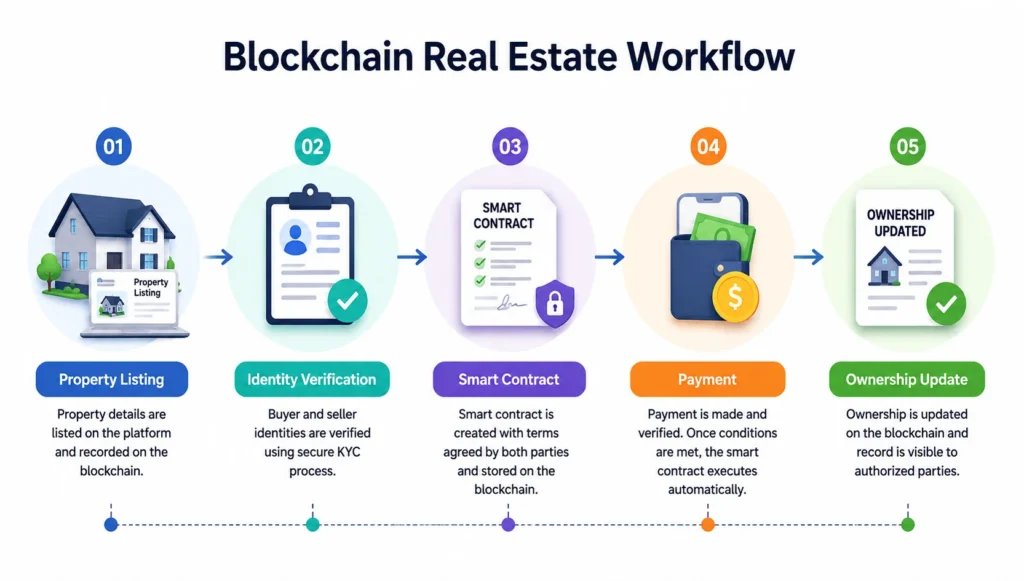
Property transactions can involve repeated document checks, approvals, signatures, and payment confirmations. Smart contracts can automate predefined actions when agreed conditions are satisfied. For example, smart contracts in real estate could release a payment after required verification steps are completed. The contract can also record the transaction event and notify relevant participants.
This model supports automated real estate transactions and can reduce repetitive administrative work. Research into blockchain-based land registration also highlights automation, transparency, and immutable ownership records as potential benefits.
3. Reliable property records
Property information needs long-term integrity. Changes to ownership, transfers, liens, and other events can create complex histories. Blockchain can maintain digital property records with time-stamped transaction histories. Once validated information enters the network, unauthorized alteration becomes significantly harder.
This creates a stronger foundation for property ownership records and can reduce disputes caused by inconsistent documentation. A blockchain-based registry can also provide controlled access to relevant parties.
Explore more: Best blockchain technology for your app
4. Reduced dependence on intermediaries
Real estate transactions traditionally involve several intermediaries. Blockchain cannot eliminate every intermediary because legal and regulatory roles remain important. However, it can reduce the need for repetitive coordination among participants.
A shared decentralized ledger allows authorized parties to access the same transaction history. This can reduce duplicate data entry and improve coordination between agencies, lenders, buyers, and sellers.
5. New investment opportunities
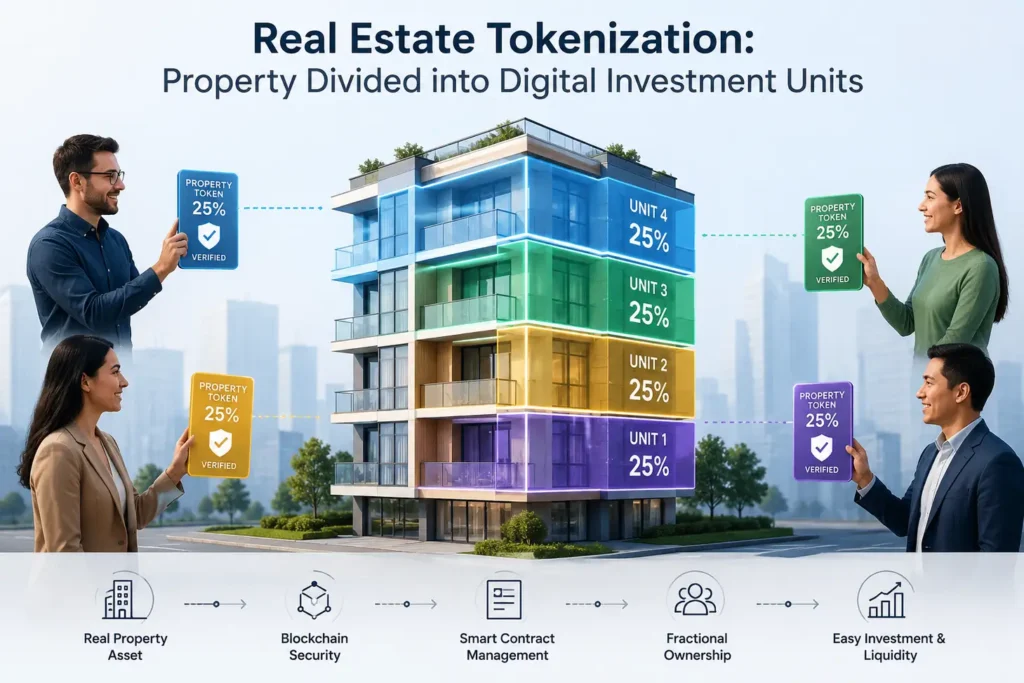
Blockchain can change how investors access property markets. Real estate tokenization allows certain economic interests connected with property to be represented digitally. This model can support property tokenization and potentially enable fractional property ownership. Investors may gain access to smaller investment units instead of purchasing an entire property.
However, tokenization does not automatically transfer legal ownership. The token must connect to an appropriate legal structure and enforceable rights. Current industry explanations emphasize the distinction between blockchain tokens and tokenized ownership
Explore more: Blockchain app development guide
Features of Blockchain Real Estate Apps
1. Blockchain-based property verification
A blockchain property platform can verify important property information before transactions proceed. The system can connect verified property details with ownership and transaction histories. A strong blockchain for real estate platform should separate public information from confidential records. Sensitive documents can remain in secure storage while blockchain stores hashes or verification references.
2. Smart contract automation
Smart contracts can manage agreements based on predefined conditions. Common workflows include deposits, payment milestones, lease agreements, ownership transfers, and investor distributions. The app should include clear contract status indicators. Users need to understand whether a contract is pending, active, completed, or rejected.
3. Identity verification
Real estate platforms must establish who owns a property and who participates in a transaction. Identity verification can connect verified user credentials with blockchain-based transaction records. This feature can reduce impersonation risks and strengthen compliance workflows. A decentralized identity model can also reduce repeated verification across connected services.
4. Property title management
Property records can become difficult to track when ownership changes multiple times. Property title management through blockchain can provide a chronological record of relevant transfers. A land registry blockchain model can connect government verification with blockchain records. Research published in 2026 describes blockchain-enabled land registration as a way to improve transparency and protect ownership records.
5. Immutable transaction history
Blockchain creates immutable records that make unauthorized historical changes difficult. This feature is particularly useful for transaction auditing and ownership histories. The app can show authorized users when a record was created, updated, or transferred. Such visibility can improve accountability without exposing confidential information.
6. Digital payments and rental management
Blockchain platforms can connect payment systems with property workflows. For example, tenants could make rental payments through integrated digital payment services. Property managers could automatically reconcile payment events with lease records. Smart contracts may also distribute income to eligible stakeholders when contractual conditions are met.
7. Token and asset management
Modern platforms can support digital assets in real estate when the underlying legal and regulatory framework permits them. Token management can include issuance, ownership tracking, transfer restrictions, and investor records.
This area connects real estate with the growing market for real-world assets (RWAs). Tokenized real estate commonly represents economic rights connected to a property rather than placing the physical property itself directly on-chain.
Explore more: How much does blockchain app development cost
Use Cases of Blockchain in Real Estate
1. Property buying and selling
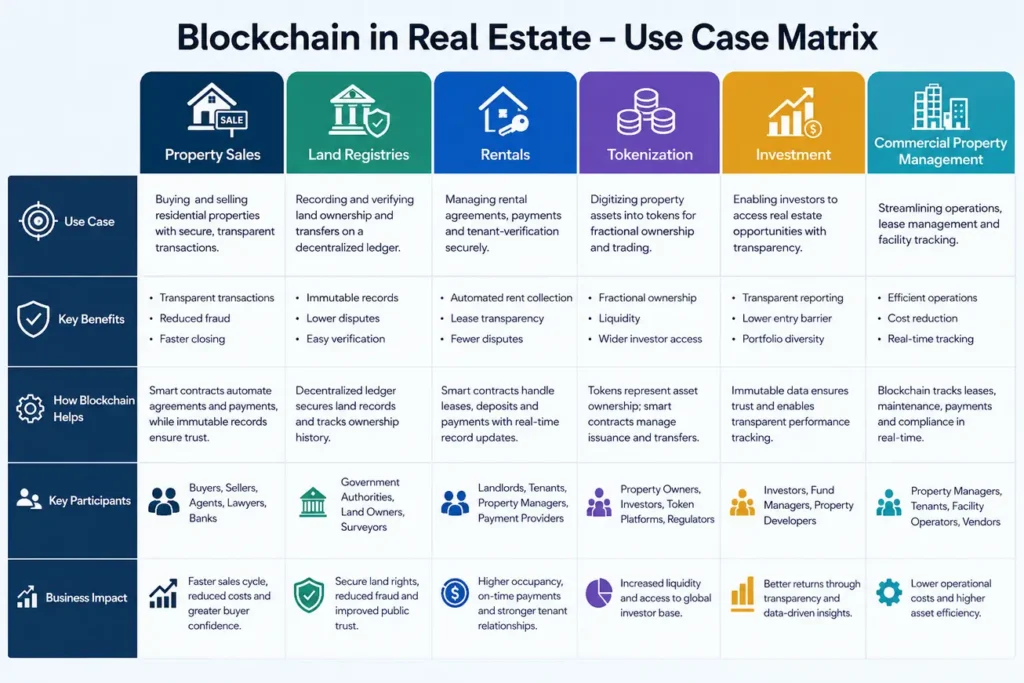
One of the strongest applications involves improving property transaction workflows. Buyers can review verified information, complete identity checks, and execute contractual steps through one platform. This approach makes blockchain real estate applications useful for marketplaces that want stronger transaction verification. It can also help participants track each stage of a property sale.
2. Land and title registries
Government agencies can explore blockchain to strengthen land registration systems. A verified registry could create a consistent transaction history for properties. Blockchain-based land systems are being studied for reducing document inconsistencies, unauthorized alterations, and inefficient registration processes.
However, governments must carefully define how blockchain records interact with existing legal registries. Blockchain should complement legal authority rather than assume that a technical record automatically creates legal ownership.
3. Fractional property investment
Tokenized property platforms can divide qualifying investment interests into smaller digital units. This can make selected opportunities more accessible to investors. The model can support real estate investment while giving property owners another potential route to raise capital. Compliance, investor eligibility, custody, taxation, and securities rules must remain central to the platform design.
4. Rental and property management
Property managers can use blockchain to maintain lease records, payment histories, maintenance events, and deposit information. A connected platform could trigger predefined actions after rent confirmation. This can reduce manual reconciliation and give landlords and tenants a clearer transaction history.
5. Commercial real estate
Commercial properties involve multiple investors, lenders, tenants, and service providers. Blockchain can provide a shared data layer for selected workflows. For example, an investment platform could track ownership interests, income distributions, compliance checks, and transfer restrictions. This creates opportunities for more efficient institutional property management.
6. Real estate marketplaces
A marketplace can combine property discovery with blockchain-based verification. Users could view property details while the platform validates ownership and transaction status. This creates a practical direction for real estate app blockchain solutions. The blockchain layer works behind the user interface while familiar marketplace features remain easy to use.
Businesses planning such platforms should work with specialists experienced in blockchain app development and real estate workflows. A capable top real estate app development company can help connect blockchain functionality with marketplace, payment, mapping, and administrative systems.
Explore more: Real estate mobile app development cost
Future of Blockchain in Real Estate
The future of blockchain in real estate will likely focus on practical integration rather than blockchain adoption for its own sake. Real estate businesses will need systems that connect blockchain with existing databases, identity services, payment networks, government records, and compliance tools. Tokenization is another area worth watching.
As legal frameworks mature, more property-related interests may become digitally represented. Maharashtra, for example, has recently explored legislation aimed at enabling blockchain-based real estate tokenization. AI can further strengthen blockchain platforms by analyzing property data, identifying anomalies, and improving search and valuation workflows.
Blockchain can provide trusted transaction histories while AI extracts useful insights from available data. Interoperability will also matter. Future platforms may connect multiple blockchain networks rather than depend on one ecosystem. Better privacy technologies could allow businesses to verify information without exposing unnecessary personal data.
Businesses evaluating blockchain technology in real estate should begin with a specific operational problem. They should then determine whether blockchain offers a clear advantage over conventional databases. Development costs will depend heavily on scope. Current market estimates place blockchain app development costs at around $40,000 for straightforward products, while complex enterprise systems can exceed $300,000.
A real estate platform with smart contracts, tokenization, security audits, multiple integrations, compliance workflows, and mobile applications will require a larger budget. Businesses should therefore define the MVP before committing to advanced functionality.
The right technology partner can also make a major difference. Companies comparing a best blockchain app development company should evaluate blockchain experience, smart contract security, integration skills, compliance awareness, and post-launch support.
For broader projects, teams may also seek expert custom app development solutions that combine blockchain with conventional application architecture. This hybrid approach often provides a more practical foundation for real estate businesses.
Explore more: Blockchain application security checklist
Conclusion
Real estate needs trust, accurate records, efficient transactions, and clear ownership histories. Blockchain can strengthen these areas when businesses apply it to the right workflows. The strongest blockchain real estate apps will not simply place existing features on a blockchain. They will redesign selected processes around verification, automation, transparency, and controlled data sharing.
Successful adoption also requires legal planning, secure architecture, reliable integrations, and user-friendly interfaces. Businesses should start with measurable goals and build the blockchain layer around genuine operational needs.
With thoughtful implementation, blockchain for real estate apps can support more efficient marketplaces, property management systems, investment platforms, and digital ownership models. The technology is promising, but its real value will come from solving practical real estate problems.