


The success of a mobile app often depends on decisions made before development begins. One of the most important is selecting the right framework, as it directly impacts performance, scalability, development speed, maintenance, and overall project cost. This is why the Flutter vs React Native debate remains a key consideration for startups, enterprises, and growing businesses planning cross-platform applications.
Today, Flutter by Google and React Native by Meta are the leading cross-platform frameworks, enabling developers to build Android and iOS applications from a single codebase. However, selecting the right framework involves more than reducing development costs. A leading app development company evaluates performance, scalability, ecosystem maturity, and long-term business goals before recommending the right technology. This comparison guide explores their strengths, limitations, and real-world use cases to help you choose the best solution for your business goals.
What is Flutter?
Flutter is Google’s open-source UI toolkit for building natively compiled applications from a single codebase. It allows developers to build applications for multiple platforms using a single codebase, enabling businesses to minimize development time while maintaining a consistent user experience. The Flutter framework focuses on building the entire user interface rather than depending on native UI components.
For example, Google Pay uses Flutter to deliver secure payments across Android and iOS, BMW uses Flutter to power parts of its customer app with a premium user experience, and Nubank relies on Flutter to build reliable digital banking applications.
Another crucial advantage is Flutter’s performance. Since it compiles directly into native machine code, applications deliver smooth animations, faster rendering, and highly responsive user experiences. Collaborating with a expert Flutter app development company supports businesses in taking full advantage of these capabilities while developing scalable, secure, and future-ready applications.
Advantages of Flutter
- An extensive collection of widgets helps build attractive and consistent user interfaces rapidly.
- Hot reload allows developers to test changes immediately and accelerate development.
- Perfect for developing visually rich apps with smooth animations and excellent user experience.
Explore more: Flutter vs native app development
Disadvantages of Flutter
- It uses the Dart programming language, which has a smaller developer community than JavaScript.
- Some third-party libraries and plugins are less mature than those available for React Native.
What is React Native?
If Flutter is known for highly customizable user interfaces, React Native is recognized for enabling fast cross-platform development using JavaScript and React. React Native enables cross-platform development to build applications for Android and iOS while sharing a significant portion of the code across both platforms.
It uses native platform components to deliver a native look and feel while allowing developers to leverage existing JavaScript skills. React Native is trusted by some of the world’s best-known brands, including Facebook, Instagram, Discord, and Walmart.
One of React Native’s biggest strengths is its rich developer ecosystem. It has access to millions of open-source libraries and community-supported packages that make it easier to integrate features such as maps, payment systems, authentication, analytics, and push notifications. Combined with strong React Native performance for most business applications, it has become a popular choice for startups and enterprises alike.
Many organisations also collaborate with providers offering React Native development services to boost product delivery.
Advantages of React Native
- Large JavaScript developer community.
- Wide third-party plugin ecosystem.
- Easy integration with existing React web applications.
- Strong community backed by Meta.
Disadvantages of React Native
- Performance may vary for graphics-intensive applications.
- UI consistency can differ across platforms.
- Reliance on external libraries for specific features.
- Frequent framework updates may need additional maintenance.
Explore more: Complete guide to Flutter app development
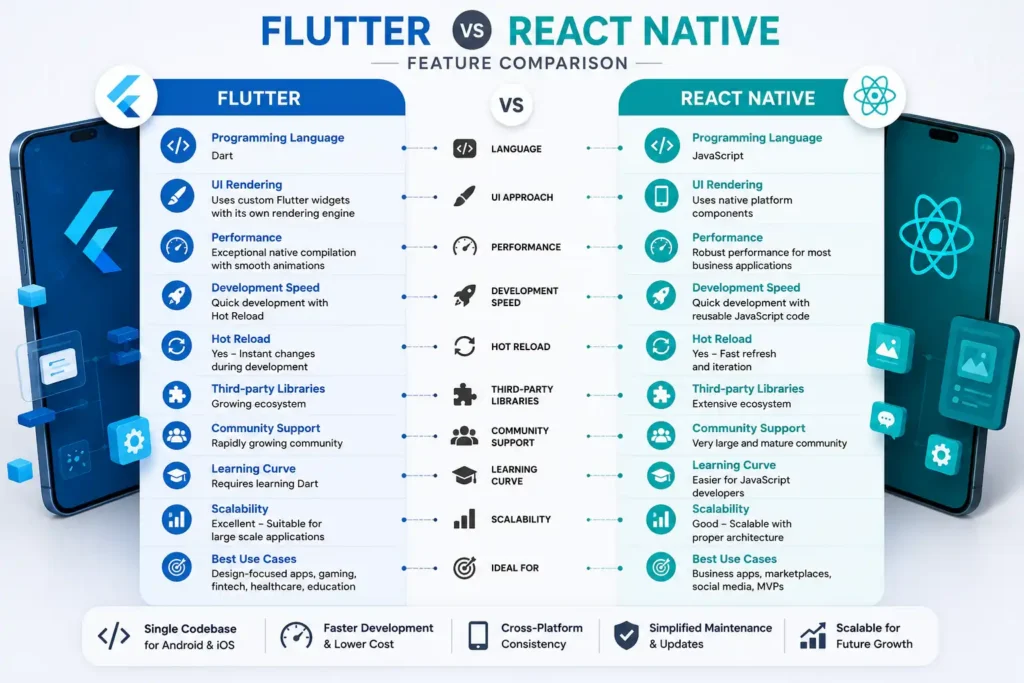
Flutter vs React Native Comparison
Both frameworks support cross-platform mobile app development; they vary in architecture, performance, development approach, and long-term scalability.
Flutter vs React Native for mobile app development comparison focuses on where each framework performs best.
| Factor | Flutter | React Native |
| Programming Language | Dart | JavaScript |
| UI Approach | Uses custom Flutter widgets | Uses native platform components |
| Performance | Exceptional native compilation with smooth animations | Robust performance for most business applications |
| Development Speed | Quick with Hot Reload | Quick with reusable JavaScript code |
| UI Flexibility | Impressive for highly customized interfaces | Best for native-looking interfaces |
| Third-party Libraries | Growing ecosystem | Extensive ecosystem |
| Community Support | Rapidly growing | Very large and mature |
| Learning Curve | Requires learning Dart | Easier for JavaScript developers |
| Ideal for | Design-focused apps, gaming, fintech, healthcare | Business apps, marketplaces, social media, MVPs |
Factors to Consider Before Choosing Between Flutter and React Native
Selecting between Flutter vs React Native for mobile app development requires assessing your business goals, technical requirements, and long-term product strategy. While both are leading choices for cross-platform app development, the right mobile app development framework depends on your project’s complexity, timeline, and user expectations.
1. Project Requirements
If your application needs highly customized interfaces, wide animations, and engaging mobile app UI development, Flutter is often the better choice. React Native framework is the best option, making React Native perfect for projects that prioritise rapid delivery.
2. Performance Expectations
Applications involving real-time animations and interactive dashboards often benefit from strong Flutter performance, thanks to its native rendering engine. Meanwhile, React Native’s performance is more than sufficient for most business applications, marketplaces, consumer portals, and social media platforms. Irrespective of your choice, mobile app performance optimisation should remain a priority throughout development to ensure smooth user experiences.
3. Development Team Expertise
Organisations already working with React for web applications often find React Native easier to adopt because developers can reuse their JavaScript knowledge. Working with experienced Flutter development services or React Native app development services can accelerate development while minimizing project risks.
4. Scalability and Maintenance
Both frameworks support development from a shared codebase, making it simpler to maintain cross-platform mobile applications while reducing long-term development efforts. Understanding the Flutter advantages, Flutter limitations, React Native advantages, and React Native limitations will help you to choose a framework that aligns with your future roadmap and maintenance expectations.
5. Budget and Time to Market
Every project works within financial and time constraints. Both frameworks reduce development effort by supporting Android and iOS through a shared codebase instead of maintaining separate applications. Conducting an app development cost analysis helps estimate budgets more accurately.
Explore more: React Native app development cost guide
App Development Cost Comparison
The cost of developing a Flutter or React Native application depends on factors such as project scope, design complexity, integrations, backend development, and ongoing support. Here’s a general cost comparison.
| Cost Factor | Flutter | React Native |
| Developer hourly rate | $70 – $110/hour | $60 – $100/hour |
| Simple MVP | $8,000 – $35,000 | $15,000 – $32,000 |
| Mid-size MVP | $20,000 – $75,000 | $25,000 – $70,000 |
| Complex app | $50,000 – $150,000+ | $65,000 – $140,000+ |
| Annual maintenance | $8,000 – $20,000 | $10,000 – $25,000 |
| Developer onboarding cost | Moderate to higher | Lower to moderate |
| Best budget fit | UI-heavy apps, long-term value | JS teams, faster hiring |
Explore more: Flutter app development cost guide
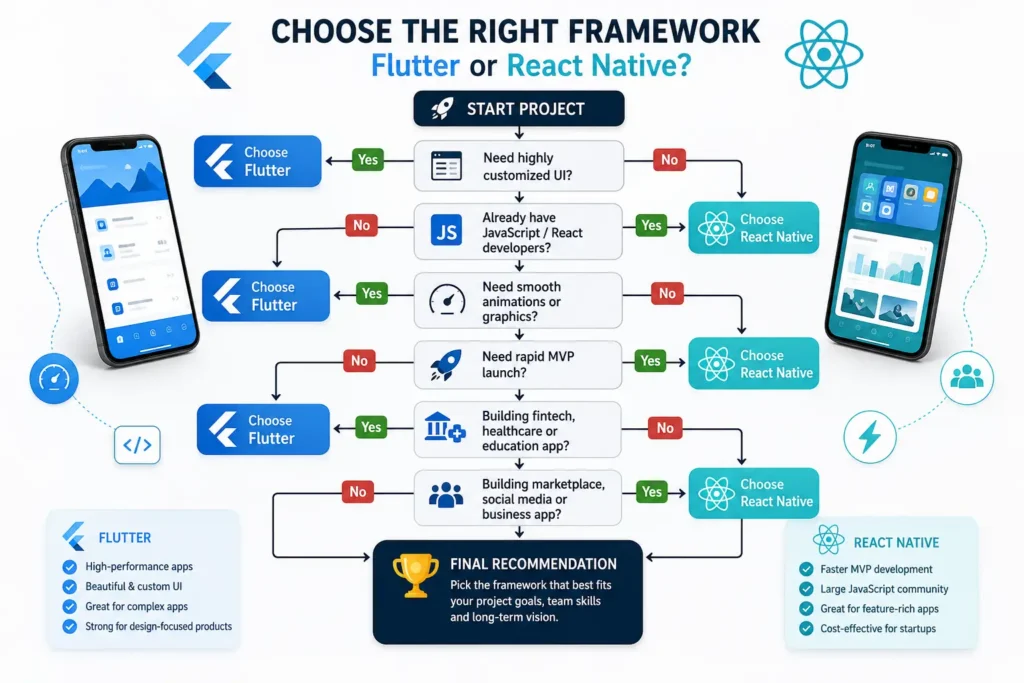
Which Framework Should You Choose?
The right framework depends on your business goals, budget, project complexity, and long-term vision.
Choose Flutter if you:
- Need a highly customised UI with consistent branding across platforms.
- Want smooth animations and high-performance rendering.
- Plan to build mobile, web, and desktop applications from a single codebase.
- Developing fintech, healthcare, education, or eCommerce applications.
- Require complete control over your application’s visual design.
- Expect your product to scale across additional platforms in the future.
Choose React Native if you:
- Already have a team experienced in React or JavaScript.
- Need to launch an MVP or product quickly.
- Want access to a mature ecosystem of third-party libraries.
- Are building social networking apps, marketplaces, business platforms, or customer-facing applications.
- Need a cost-effective solution backed by a large developer community and ongoing ecosystem support.
Explore more: Best cross-platform app development framework
Why Choose IIH Global for Flutter & React Native Development?
Every mobile app has multiple requirements, which is why selecting the right framework should be based on your business objectives, expected growth, budget, and the experience you want to provide to your users.
IIH Global helps startups, SMEs, and enterprises build scalable mobile applications that deliver real business value. Whether you’re looking for Flutter app development services or React Native app development services, our team works closely with you from strategy and UI design to development, testing, deployment, and ongoing support.
Contact IIH Global today to build a high-performance application that delivers exceptional user experiences and supports long-term business growth.
Ending Note
There is no one-size-fits-all answer to the Flutter vs React debate. Every project has unique goals, budgets, and technical requirements. The best framework for mobile apps is the one that matches your business goals, what users expect and your plan for long-term growth.
Choosing the right app development technologies from the start also makes mobile app performance optimization easier, making your app perform well. This helps you give users a reliable app. It also reduces long-term development effort and maintenance costs.