


The cost to build a food delivery app like Uber Eats depends on several factors, including app complexity, technology stack, and development approach. Today, the average food delivery app development cost ranges from $30,000 to over $250,000, depending on business goals and feature requirements. Whether you are building a startup platform or expanding an existing restaurant business, understanding the investment helps you plan better and avoid unexpected expenses.
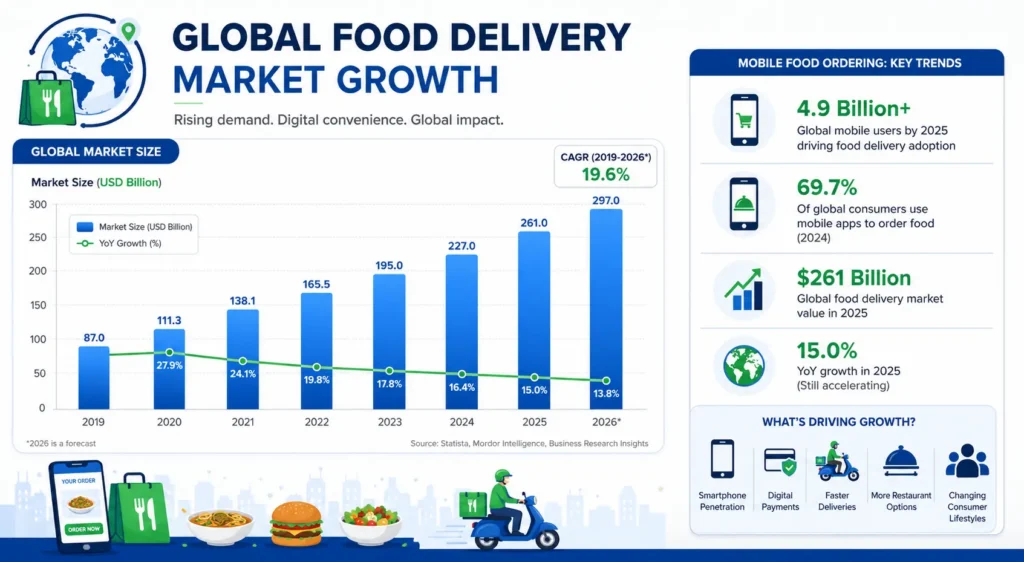
The global online food delivery market continues to grow as customers expect faster service and digital convenience. According to industry reports, millions of users now order meals through mobile apps every day. This growing demand creates excellent opportunities for businesses that invest in a reliable and user-friendly delivery platform.
Building a successful application requires more than attractive screens. You need a smooth ordering experience, intelligent logistics, secure payments, and scalable technology. Every feature influences the overall budget, making careful planning essential before development begins.
This guide explains the cost to build a food delivery app like Uber Eats, the features you need, the factors that affect pricing, and the complete development process. By the end, you will understand where your budget goes and how to make smart investment decisions.
Understanding the Basic Functionality of Uber Eats
Uber Eats connects customers, restaurants, and delivery partners through one digital ecosystem. Instead of operating as a simple ordering application, it acts as a complete online food delivery platform that manages orders from placement to doorstep delivery.
Behind the scenes, several applications work together to provide a seamless customer experience.
1. Customer Application
The customer food ordering app allows users to browse nearby restaurants, explore menus, add meals to the cart, make secure payments, and monitor deliveries in real time. Modern users also expect personalized restaurant suggestions, saved payment methods, loyalty rewards, and quick reordering options.
2. Restaurant Application
Restaurants receive incoming orders, update menus, manage preparation times, and monitor customer requests through a dedicated restaurant management panel. This dashboard helps restaurants reduce manual work while improving order accuracy and customer satisfaction.
3. Delivery Partner Application
The delivery partner app enables drivers to accept orders, navigate efficiently, communicate with customers, and complete deliveries without unnecessary delays. Integrated navigation improves delivery speed while helping drivers optimize routes during busy hours.
4. Admin Panel
Every food delivery business needs an intelligent admin dashboard to monitor platform performance. Administrators manage users, restaurants, promotions, delivery partners, commissions, analytics, customer support, and financial reports from one centralized system.
5. How Orders Flow
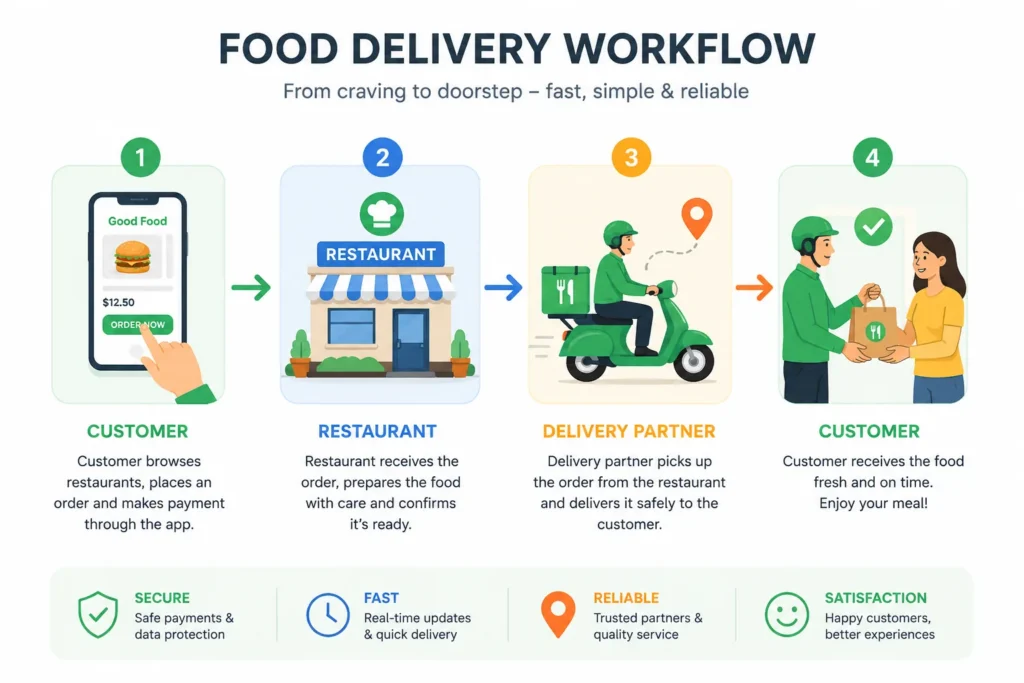
A typical ordering process follows these steps:
- Customer places an order.
- Restaurant confirms preparation.
- Delivery partner accepts the request.
- The restaurant prepares the meal.
- The driver collects the order.
- Customer tracks delivery.
- Payment is completed successfully.
This automated workflow depends on a reliable food ordering system that keeps every participant connected throughout the delivery journey. Customers also expect real-time order tracking, allowing them to monitor each delivery stage without contacting customer support.
To improve navigation accuracy, developers integrate GPS tracking, which continuously updates delivery locations and estimated arrival times. Secure checkout remains another critical component. Businesses normally implement payment gateway integration to support credit cards, digital wallets, and contactless payment methods while protecting user information.
Timely communication also improves customer satisfaction. Smart push notifications keep users informed about order confirmations, preparation status, driver arrival, and promotional offers. Many leading delivery platforms now use AI-powered recommendations to suggest restaurants, cuisines, and meal combinations based on browsing behavior and previous purchases.
These intelligent features increase customer engagement while improving average order value.
Key Features of a Successful Food Delivery App
The success of any delivery platform depends on user experience rather than the number of features. Businesses should focus on solving customer problems while keeping the application simple and fast.
A successful application combines convenience, speed, and reliability.
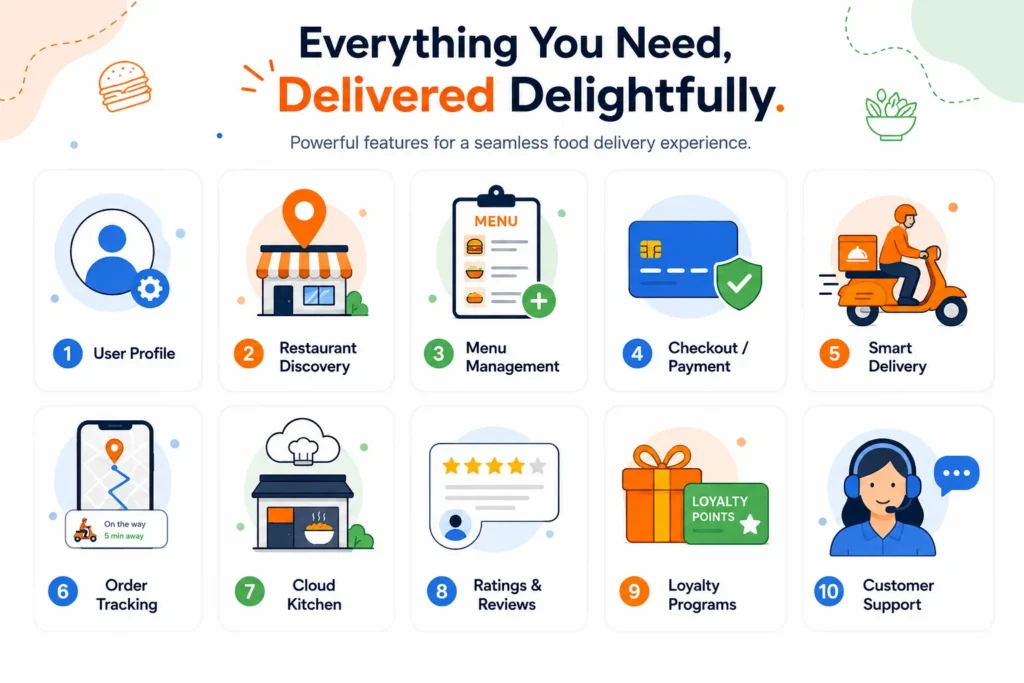
1. User Registration and Profiles
Customers should register using email, phone numbers, or social accounts. Simple onboarding reduces abandonment and improves user acquisition.
2. Restaurant Discovery
Users expect advanced search filters based on cuisine, ratings, delivery time, dietary preferences, and pricing. Smooth restaurant onboarding also allows new restaurants to join the platform with minimal effort.
3. Menu Management
Restaurants need flexible menu editing tools to update pricing, availability, and seasonal items instantly.
4. Shopping Cart and Checkout
A streamlined checkout process reduces abandoned carts and improves conversion rates. Businesses should support discount codes, wallet payments, and multiple payment options.
5. Smart Delivery Operations
An efficient delivery management system assigns drivers based on distance, availability, and estimated delivery time. Automated dispatch reduces delays while increasing delivery efficiency.
6. Order Monitoring
Restaurants require effective order management capabilities to handle incoming orders without confusion during peak hours. Customers also appreciate transparent delivery updates throughout the process.
7. Cloud Kitchen Support
Many startups now partner with virtual restaurants through cloud kitchen integration, expanding menu options without opening physical locations. This business model reduces operational costs while increasing service coverage.
8. Ratings and Reviews
Verified reviews improve trust and help customers make informed decisions before placing orders.
9. Loyalty Programs
Reward points, referrals, and exclusive discounts encourage repeat purchases while increasing customer lifetime value.
10. Customer Support
Live chat, FAQs, and ticket systems improve customer satisfaction during payment or delivery issues.
11. Technology Choices Matter
Building premium applications also requires selecting the right development approach. Businesses targeting both Android and iOS often choose cross-platform development to reduce initial investment and accelerate launch. Companies seeking maximum performance may invest in native app development, especially for enterprise-scale platforms requiring advanced device capabilities.
An intuitive UI/UX design significantly improves customer engagement. Clean navigation and minimal checkout steps encourage higher conversions. Developers also rely on robust API integration to connect payment providers, mapping services, SMS gateways, and restaurant management software. Modern applications depend heavily on reliable cloud infrastructure, ensuring high availability during peak ordering hours.
Additional third-party integrations support customer analytics, marketing automation, CRM systems, loyalty programs, and fraud detection tools. Businesses planning long-term expansion should prioritize scalable app architecture. A scalable foundation supports growing traffic without affecting performance.
Factors Affecting the Food Delivery App Development Cost
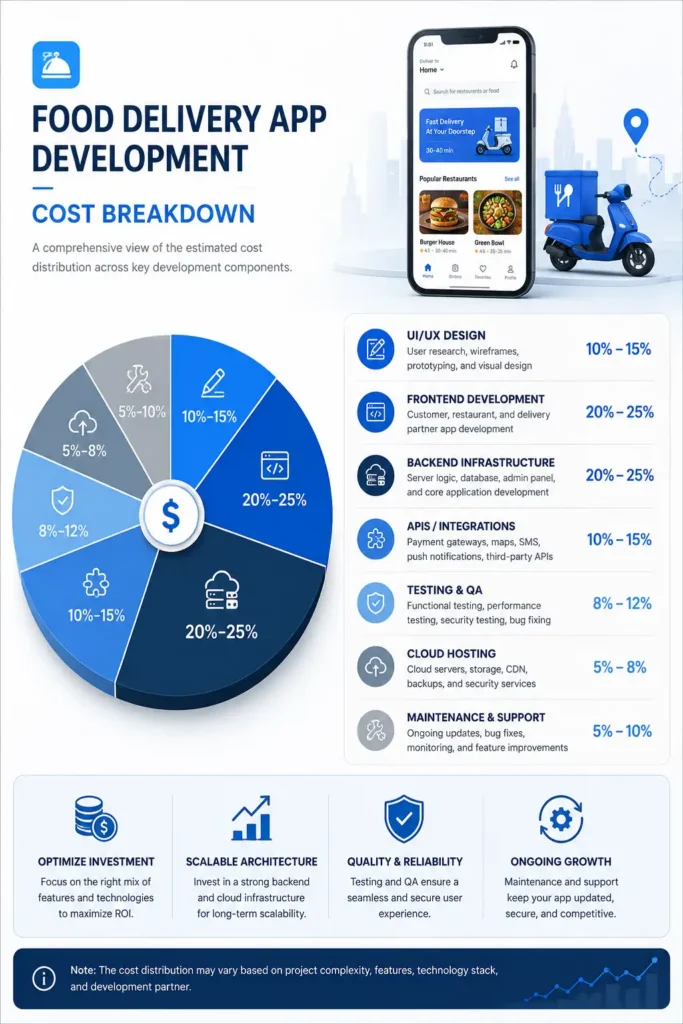
Several variables determine the final food delivery app development cost. Understanding these factors helps businesses allocate budgets wisely and avoid expensive redesigns later.
1. App Complexity
The biggest pricing factor is application complexity. A basic MVP with core ordering features costs significantly less than a feature-rich platform supporting AI recommendations, loyalty systems, and advanced analytics.
Typical market estimates include:
| Development Level | Estimated Cost (USD) |
|---|---|
| MVP | $30,000–$60,000 |
| Medium Complexity | $60,000–$120,000 |
| Enterprise Platform | $120,000–$250,000+ |
Choosing MVP development allows startups to validate ideas before investing in premium functionality.
2. Platform Selection
Developing Android and iOS applications separately increases both development time and budget. Cross-platform frameworks reduce costs initially, while native solutions deliver stronger performance for complex applications.
3. Feature Requirements
Every additional feature adds development hours.
Examples include:
- Loyalty programs
- Live chat
- Multiple payment methods
- AI recommendations
- Driver optimization
- Advanced analytics
Feature prioritization keeps budgets under control.
Explore more: Food delivery app development cost
4. Design Complexity
Simple interfaces require fewer development hours than fully customized experiences. Interactive animations, personalized dashboards, and premium branding increase design investment.
5. Backend Infrastructure
Large delivery businesses require scalable servers capable of handling thousands of simultaneous users. Reliable backend systems also improve security, uptime, and transaction speed.
6. Development Team
The location and expertise of your development partner significantly influence pricing. Businesses looking for food delivery app development services UK often benefit from experienced teams specializing in enterprise-level delivery platforms and regulatory compliance. However, hourly rates in the UK generally remain higher than offshore development options.
Choosing an experienced technology partner also reduces long-term risks because experienced developers build scalable systems from the beginning. After defining business requirements, many companies search for the best mobile app development agency that offers strategy, design, development, testing, and post-launch support under one roof.
Selecting the right partner often proves more valuable than choosing the lowest quote.
7. Technology Stack
Modern applications require mapping APIs, payment systems, cloud hosting, analytics, messaging services, and security solutions. These technology choices directly influence the food delivery app cost, especially when premium third-party services require recurring subscription fees.
8. Maintenance and Upgrades
Development does not end after launch. Businesses should allocate app maintenance cost for server monitoring, bug fixes, feature updates, security patches, operating system compatibility, and performance optimization. Annual maintenance typically represents 15% to 25% of the initial development investment.
9. Development Partner
Experience matters when building enterprise-grade applications. Many international businesses prefer working with an established food delivery app development company USA for large-scale digital transformation projects requiring advanced architecture, compliance, and long-term technical support.
The ideal development partner understands business strategy as much as software engineering. A well-planned investment always delivers better long-term returns than rushing development with limited planning.
Development Process for a Food Delivery App
Building a successful delivery platform requires a structured approach. Every phase contributes to product quality, scalability, and long-term business growth. Skipping any stage often results in delays, technical debt, or higher development expenses later.
1. Business Discovery and Planning
Every successful project starts with market research and business planning. Begin by identifying your target audience, service area, revenue model, and competitors. Analyze what leading platforms offer and discover gaps that your app can fill.
Some businesses focus on restaurant partnerships, while others target grocery deliveries or cloud kitchens. Your strategy should define the scope before development begins. If your goal is to create an Uber Eats alternative app, highlight unique value. Faster deliveries, subscription benefits, eco-friendly delivery options, or AI-based personalization can help your platform stand out.
2. Requirement Analysis
The next step is documenting functional and technical requirements. Create a detailed list of user roles, app screens, workflows, integrations, and business rules. This document becomes the blueprint for designers and developers. Requirement analysis also helps estimate the cost to develop a food delivery app more accurately by reducing scope changes during development.
3. UI/UX Design
After planning, designers build wireframes and interactive prototypes. The design should simplify every step, from restaurant discovery to checkout. Customers should place orders within a few taps. A clean interface improves engagement and encourages repeat purchases. Accessibility also matters. Large buttons, readable fonts, and intuitive navigation create a better experience for users of all ages.
4. App Development
Once designs receive approval, developers begin coding the application. This stage includes frontend development, backend programming, database creation, and server configuration. A modern food delivery mobile app development project normally consists of multiple applications working together, including customer, restaurant, delivery partner, and admin modules.
Development teams also build secure APIs, notification services, authentication systems, and payment processing during this phase.
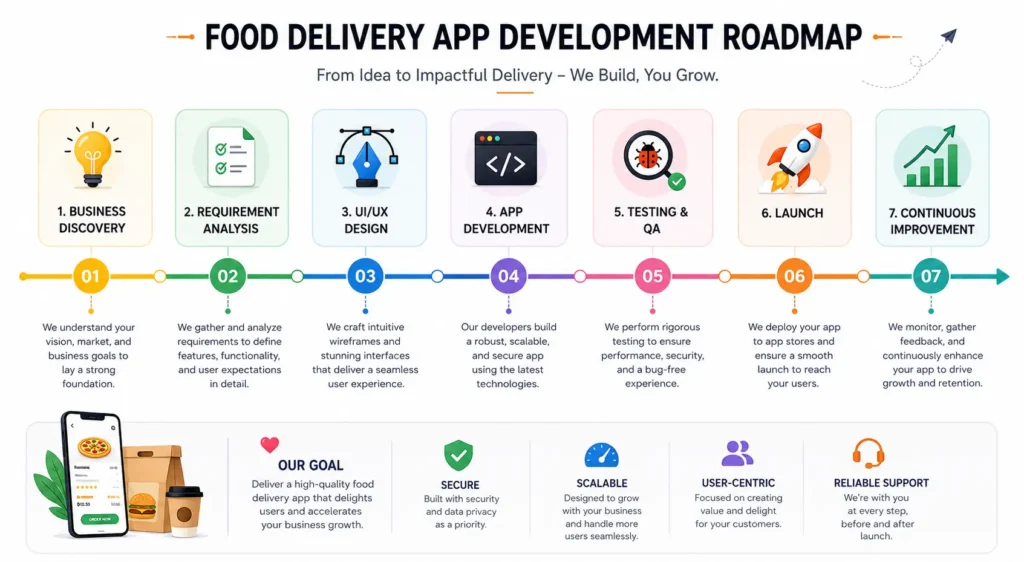
5. Testing and Quality Assurance
Quality assurance prevents bugs from reaching production. Testers evaluate performance, security, usability, payment flows, and device compatibility before launch. Load testing also ensures the application performs well during busy hours when thousands of users place orders simultaneously.
6. Launch and Continuous Improvement
Launching the application is only the beginning. Monitor user behavior, collect reviews, and release regular updates based on customer feedback. New features, performance improvements, and security updates help maintain customer trust while supporting business growth.
Tips for Marketing and Promoting a Food Delivery App
A great application needs an equally strong marketing strategy. Without effective promotion, even the best product struggles to attract users.
1. Build Awareness Before Launch
Start marketing several weeks before launch. Share product teasers, landing pages, and early registration campaigns through social media and email marketing. Early sign-ups help generate excitement and build an initial customer base.
2. Partner with Local Restaurants
Strong restaurant partnerships increase menu variety and customer trust. Offer promotional packages to encourage restaurants to join your platform during the launch phase. Exclusive restaurant partnerships also differentiate your app from competitors.
3. Invest in App Store Optimization
Optimize your app title, screenshots, keywords, and descriptions for both Google Play and the App Store. Higher rankings improve organic downloads without increasing advertising costs.
4. Offer Referral Rewards
Referral programs remain one of the most cost-effective customer acquisition strategies. Reward both existing users and new customers with discounts or loyalty points. Satisfied customers naturally recommend reliable services to friends and family.
5. Run Targeted Digital Campaigns
Use paid advertising across search engines and social media platforms. Target users based on location, food preferences, and purchase behavior to maximize marketing ROI.
6. Encourage Customer Reviews
Positive reviews improve credibility and influence new users. Request ratings after successful deliveries instead of immediately after installation. Authentic customer feedback builds long-term trust.
Explore more: How mobile apps are transforming the food industry
Challenges and Solutions for Building a Food Delivery App
Every delivery platform faces technical and operational challenges. Planning helps businesses minimize risks while improving customer satisfaction.
1. Managing High Order Volumes
Order spikes often occur during weekends, holidays, and meal times. Solution: Build a scalable backend that automatically handles increasing traffic without slowing the application.
2. Finding Enough Delivery Partners
Driver shortages increase delivery times and reduce customer satisfaction. Solution: Offer competitive incentives, flexible schedules, and efficient driver routing to improve partner retention.
3. Maintaining Fast Delivery Times
Customers expect quick and predictable deliveries. Solution: Use intelligent route optimization, live tracking, and automated dispatching to reduce travel time.
4. Handling Multiple Restaurant Systems
Restaurants often use different POS and inventory software. Solution: Build flexible integrations that synchronize menus, pricing, and inventory automatically.
5. Ensuring Payment Security
Payment fraud can damage customer confidence. Solution: Use encrypted payment processing, multi-factor authentication, and regular security audits.
6. Keeping Customers Engaged
Acquiring customers costs more than retaining them. Solution: Introduce loyalty rewards, personalized promotions, and seasonal campaigns that encourage repeat orders.
7. Scaling the Business
Many startups underestimate future growth. Solution: Invest in reliable architecture that supports expansion into multiple cities without rebuilding the platform. Businesses that choose experienced partners for custom food delivery app development often avoid expensive redesigns because scalable architecture is planned from the beginning.
Likewise, organizations investing in professional restaurant delivery app development can add new services, delivery zones, and restaurant partners with fewer operational challenges. Companies seeking broader digital transformation often combine delivery platforms with other on-demand app solutions, creating a connected ecosystem that supports multiple customer services from one technology foundation.
Conclusion
The cost to build a food delivery app like Uber Eats depends on your business vision, feature set, technology choices, and development strategy. Most modern platforms require an investment between $30,000 and $250,000+, while enterprise-level solutions may cost even more. Instead of focusing only on the initial budget, consider long-term scalability, security, and customer experience. A well-planned application delivers higher returns by improving user retention and operational efficiency.
Working with an experienced development partner helps you choose the right technology stack, prioritize essential features, and reduce future maintenance costs. Whether you launch with an MVP or a full-featured platform, building a flexible solution creates opportunities for sustainable growth.
Careful planning also keeps your food delivery app development cost under control while ensuring your application remains competitive in a rapidly evolving market.