


Choosing the right mobile technology can influence product quality, budget, launch speed, and long-term growth. Flutter vs native app development for UK businesses is therefore an important decision for startups, SMEs, and established companies planning a mobile product. Both approaches can deliver reliable apps, but they solve different business needs.
Flutter helps teams build iOS and Android apps from one shared codebase. Native development focuses on platform-specific technologies and deeper device integration. The better option depends on your app’s features, audience, budget, performance expectations, and plans.
The Flutter vs native app development decision should start with business requirements rather than technology preference. A clear comparison helps stakeholders choose a development path that supports commercial goals without creating unnecessary technical limitations.
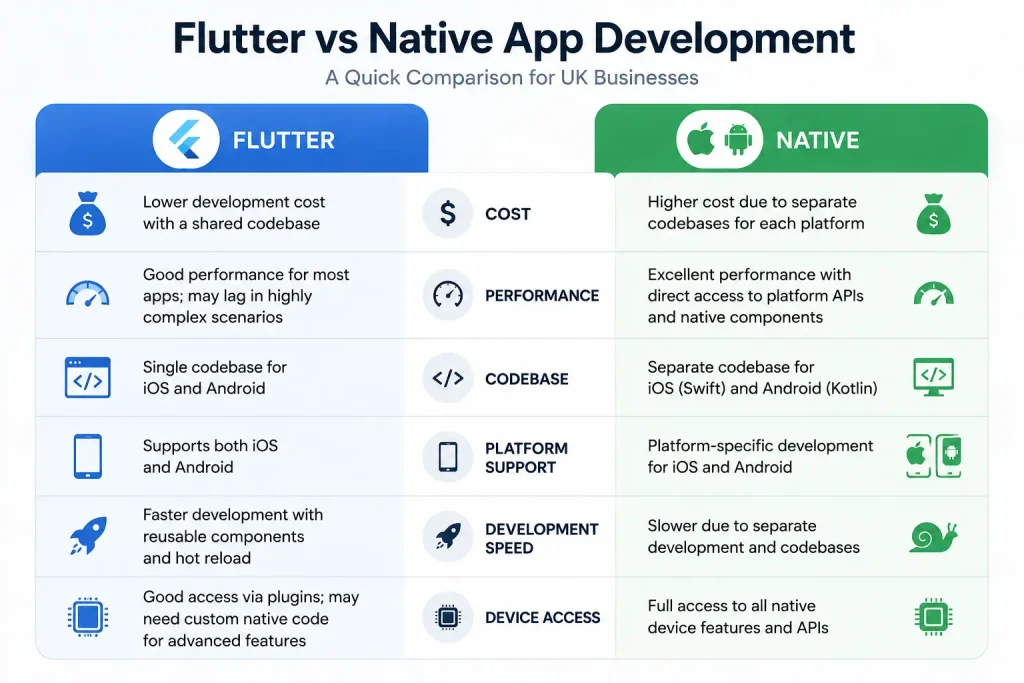
What Is Flutter and Native App Development?
Flutter is Google’s UI toolkit for building applications across multiple platforms. Developers use the Dart programming language to create interfaces, application logic, and shared functionality. A single project can target iOS and Android while retaining a consistent visual experience.
Flutter’s biggest advantage is shared development. Teams can reuse much of their code across platforms instead of maintaining separate projects. This approach makes code reusability particularly useful when a business wants similar functionality on multiple devices.
Native development takes a platform-specific route. iOS applications commonly use Swift, while Android applications commonly use Kotlin. Developers work directly with the tools, libraries, and capabilities provided by each operating system.
This approach gives teams detailed control over platform behaviour. It can also simplify access to specialised device capabilities when an application depends heavily on operating-system features.
The Flutter vs native app choice therefore involves more than programming languages. It affects architecture, testing, staffing, release management, maintenance, and the way future features are introduced.
Explore more: Flutter app development guide
Pros and Cons of Flutter for UK Businesses
Flutter offers a practical option for businesses targeting both major mobile platforms. It can reduce duplicated development work and help teams maintain consistent interfaces across devices.
Advantages of Flutter Development
Faster product delivery: A shared codebase can reduce duplicated implementation. Teams can develop common features once and adapt platform-specific areas when required.
Lower development overhead: Businesses often need fewer developers compared with maintaining two completely separate applications. This can reduce the overall app development cost, particularly for smaller teams.
Consistent interface: Flutter provides a rich collection of widgets and controls. Developers can create consistent designs across iOS and Android without rebuilding every interface separately.
Efficient testing: Shared business logic can reduce the amount of duplicated testing. Teams still need device-specific testing, but common functionality can follow a unified process.
Strong fit for startups: Companies validating an idea can launch on both platforms without creating two independent products from the beginning.
Limitations of Flutter Development
Flutter is not automatically the right choice for every application. Some advanced features may require platform-specific code or custom plugins.
Applications with demanding graphics, specialised hardware requirements, or deep operating-system integration may benefit from native technologies.
Teams must also consider plugin quality. A third-party package can accelerate development, but its maintenance, documentation, and compatibility should be reviewed before adoption.
Pros and Cons of Native App Development for UK Businesses
Native development provides direct access to platform-specific capabilities. Developers can use official frameworks and tools designed specifically for each operating system.
Advantages of Native Development
Strong performance: Native applications can deliver excellent app performance because they communicate closely with platform frameworks and device resources.
Deep device integration: Native projects are well suited to applications that depend on advanced sensors, Bluetooth, biometrics, cameras, location services, or other native device features.
Platform-specific experiences: Developers can follow Apple’s and Google’s interface standards more closely. This can support a polished user experience that feels natural on each platform.
Advanced functionality: Native technologies can provide early access to new operating-system capabilities. This matters when a product depends on emerging platform features.
Mature development ecosystems: Native platforms have extensive documentation, testing tools, libraries, and developer communities.
Limitations of Native Development
The main drawback is duplicated development when a business needs both platforms. Separate iOS and Android applications can require different specialists, testing cycles, and release processes.
This can increase development effort and make feature parity harder to manage. A feature released on one platform may need separate implementation and testing on the other.
Native development can also require a larger technical team. Businesses must consider whether they can support specialists across both platforms over the product lifecycle.
Explore more: Flutter vs React Native: a complete comparison
Which One Is Better for UK Businesses?
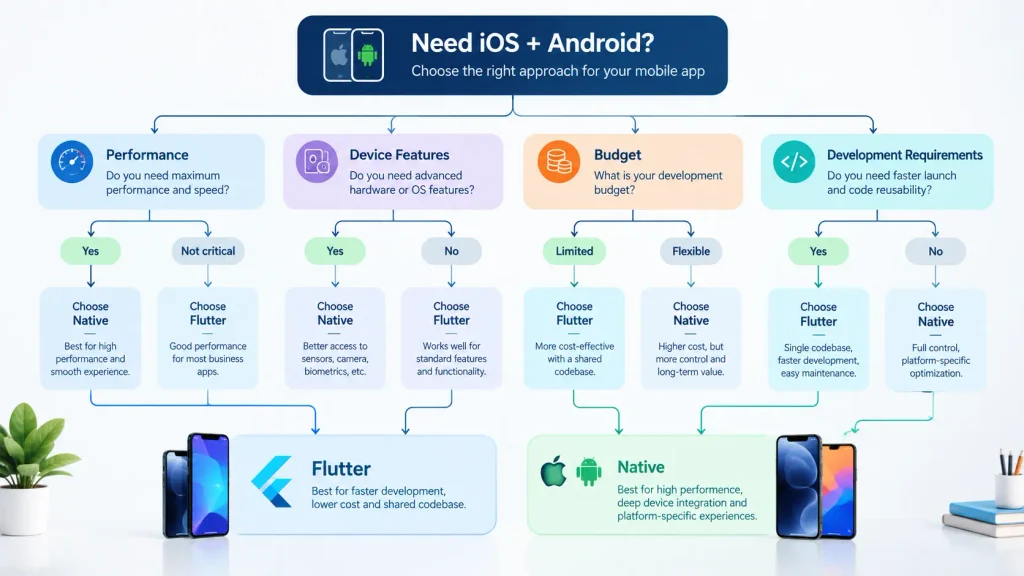
There is no universal winner in Flutter vs native app development. The right choice depends on what the application needs to accomplish.
Flutter often suits businesses that need iOS and Android apps with similar functionality. It works particularly well for marketplaces, booking platforms, customer portals, retail apps, business tools, and many consumer services.
Native development becomes more attractive when performance, hardware access, or platform-specific functionality sits at the centre of the product. High-end graphics, advanced camera applications, complex Bluetooth functionality, and specialised enterprise solutions may justify separate native applications.
Businesses should also assess their internal skills and hiring plans. A company already operating strong iOS and Android teams may find native development easier to manage. Another business may prefer a shared technology stack to simplify recruitment and delivery.
For companies exploring mobile app development in the UK, the decision should also consider the target audience. UK consumers commonly use both iOS and Android devices, so platform coverage matters.
A practical approach is to list every critical feature before selecting the technology. Mark each feature as shared, platform-specific, performance-sensitive, or dependent on external services. This creates a clearer technical picture.
Explore more: Flutter app development cost in the UK
Cost and Time Considerations for UK Businesses
Cost depends more on scope than the framework alone. Features, design complexity, backend systems, integrations, testing, compliance, and team location can significantly affect the final price.
Current UK market estimates vary widely. Recent 2026 pricing guides place many standard business applications around £30,000 – £100,000, while complex enterprise products can exceed £100,000.
Flutter can reduce duplicated work when both platforms require similar functionality. Some 2026 UK estimates suggest cross-platform projects may cost substantially less than separate native builds, although savings vary by project.
Native development can require separate specialists and platform-specific testing. This may increase the budget when a business needs equivalent functionality on iOS and Android.
Development time also depends on requirements. A simple cross-platform MVP may take several weeks, while complex applications can take several months. Current UK guides commonly place standard projects within roughly 12 – 24 weeks, depending on scope.
Businesses should request a feature-based estimate instead of comparing hourly rates alone. A cheaper hourly rate does not necessarily mean a lower project cost.
Scalability and Future-Proofing for UK Businesses
Technology decisions should support the product beyond its first release. Scalability depends on architecture, backend design, database structure, code quality, infrastructure, and development practices.
Flutter can support product growth when the architecture separates presentation, business logic, services, and data layers. Shared code can also simplify the introduction of common features across platforms.
Native development provides strong flexibility when future requirements depend heavily on platform-specific capabilities. Teams can optimise each application independently as operating systems evolve.
Businesses should also plan for maintenance and updates from the beginning. Mobile operating systems change regularly, while APIs, security requirements, libraries, and store policies can evolve.
Security deserves similar attention. Strong authentication, encrypted data, secure APIs, access controls, dependency management, and regular testing all contribute to app security.
Third-party services can affect future costs too. Payment gateways, analytics tools, maps, CRM systems, authentication providers, and other third-party integrations should have reliable documentation and long-term support.
A business considering a Flutter app development company in UK should therefore evaluate technical expertise, testing practices, architecture, and post-launch support. Choosing a development partner based only on the initial quotation can create problems later.
Explore more: Benefits of Flutter app development
Conclusion
The right technology should support business objectives rather than dictate them. Flutter can offer faster cross-platform delivery, shared code, and potentially lower development overhead. Native development can provide deep platform integration, strong performance, and maximum control.
For businesses with broadly shared iOS and Android requirements, Flutter can be an efficient choice. For products requiring advanced platform capabilities, native development may provide greater technical flexibility.
The best Flutter vs native app development decision comes from evaluating features, users, budget, performance, integrations, and long-term plans together. A structured technical assessment can help UK businesses invest in the right approach from the start.