


A startup can spend months building an app, only to realise that the chosen platform does not support the devices its target customers primarily use. The features work, the design looks right, but reaching the intended audience now requires another development cycle and additional investment. This is a costly mistake, yet it often happens because businesses choose technology before studying their users. Choosing the right mobile app platform involves more than comparing features and development costs.
This guide explains how to make an informed decision based on your business strategy, whether you are considering iOS app development first or planning for both platforms. It begins with understanding which devices your target audience uses.
Understanding the Mobile App Platform Landscape
Mobile apps present significant business opportunities, but the two major platforms offer different advantages. Google Play accounted for 73.5% of global app downloads in 2025, while Apple’s App Store generated around 70% of consumer spending. Average consumer spending per download also differed considerably, at approximately $3.21 on the App Store compared with $0.47 on Google Play.
These figures highlight an important distinction: Android offers greater download reach, while iOS can provide stronger revenue potential in certain markets. Understanding these differences will help you choose the right mobile app platform for your audience and business goals, whether you are considering iOS or Android development.
What Does Your Mobile Application Platform Choice Actually Decide?
Your choice of mobile app platform will influence several aspects of your project, including development costs, timelines, technical requirements, distribution options and revenue potential. Native development provides greater control over platform-specific features and performance, but requires separate development efforts for iOS and Android.
Cross-platform development can help reduce duplicated development effort while allowing you to target both iOS and Android users through a shared codebase. Both approaches have advantages and limitations. Your decision should depend on your business objectives, customer expectations, available resources and product requirements. Knowing the differences between the two will help you make an informed choice.
How to Choose the Right Mobile App Platform for Your Business
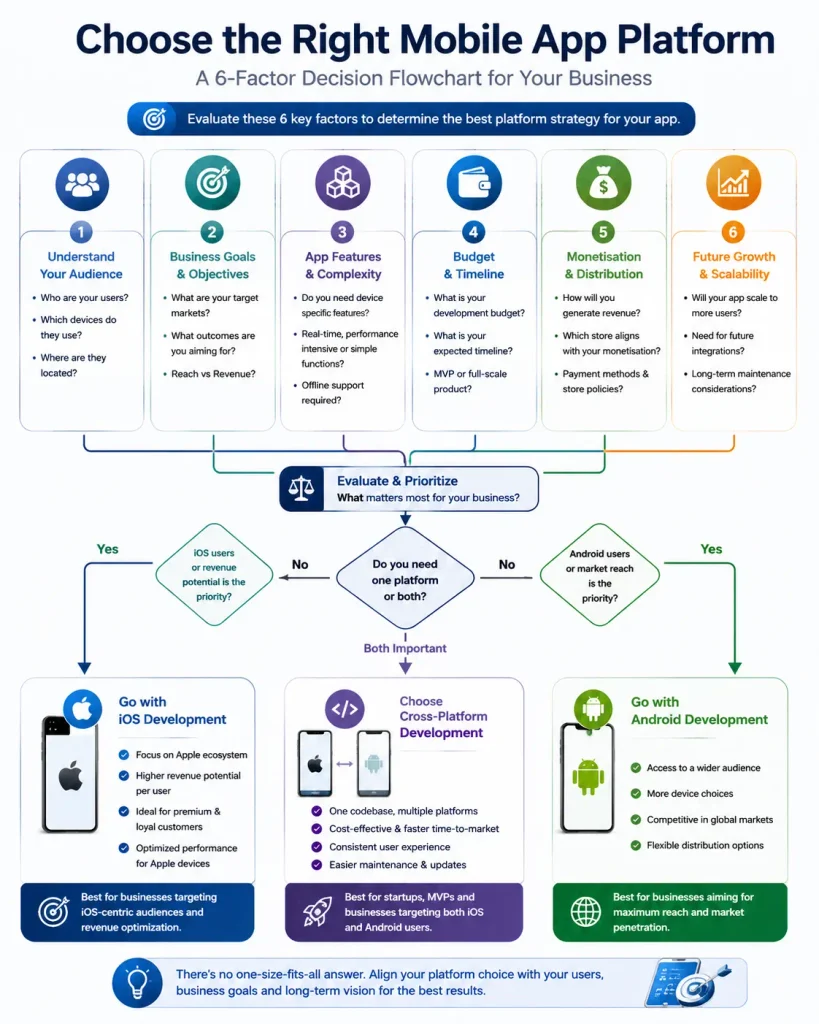
No single mobile app development platform is suitable for every business. Your decision should take into account your customers, product features, budget, and long-term goals. Consider these six factors before committing to a development approach.
1. Understand Your Audience
Identify who will use your app and which devices they prefer. Analyse website traffic, customer data and surveys to understand user demographics, location, device preferences and purchasing behaviour. If most customers use Apple devices, an iOS-first launch may make sense. If they favour Android, prioritising that ecosystem could offer better reach.
2. Compare iOS and Android Against Your Business Goals
The choice between iOS and Android should depend on your target markets, audience preferences and product objectives. When evaluating iOS vs Android app development, consider where your potential customers are most active, which devices they use and how you plan to generate revenue. This will help you decide whether to prioritise one platform or launch on both.
| Consideration | iOS | Android |
| Development tools | Swift and Apple’s tools | Kotlin and Android Studio |
| Device ecosystem | Apple’s supported devices | Multiple manufacturers |
| Testing | Apple device range | Wider device variety |
| Distribution | Apple App Store | Google Play and other options |
3. Match the Development Approach to Your Features
Your app’s functionality should determine its development approach.
- Native app development: Separate applications are built for each OS, offering greater control over device features and platform-specific performance.
- Cross-platform app development: A shared codebase supports multiple platforms, reducing duplicated development effort when features are similar. React Native is one option for building applications for both iOS and Android using a shared codebase.
4. Set a Realistic Budget and Timeline
Mobile app development costs depend on feature complexity, design requirements, integrations, testing and ongoing support. Establishing your app development budget will help you determine which features to prioritise for your initial app launch. You should also consider the time required for development, including design, testing and app store approval.
If you’re developing an app for a startup, launching a minimum viable product (MVP) can help you validate market demand before investing in additional features.
5. Consider Monetisation and Distribution
Your app monetisation strategy will influence your platform focus. Decide how you plan to generate revenue through subscriptions, in-app purchases, premium downloads or advertising. You should also consider available payment methods, platform rules and app store distribution requirements.
6. Plan for Future Growth and Maintenance
Your app architecture should support increasing user demand, new features and future integrations as your business grows. Evaluate app scalability to ensure the architecture can accommodate additional users, features and integrations. Consider app maintenance requirements, including security updates, bug fixes, OS platform changes and ongoing device testing.
Understanding Mobile App Development Cost Before Choosing a Platform
Mobile app development costs depend on your application’s complexity, required features and the technologies selected during platform planning.
Typical Cost Ranges
- Basic app: £10,000 – £25,000 – Core features and simple functionality.
- Mid-level app: £25,000 – £60,000 – Custom features, API integrations and authentication.
- Advanced app: £60,000 – £150,000+ – Complex workflows, advanced security and multiple integrations.
These figures are indicative estimates of what you might expect to pay. The price will depend on a number of factors, including your platform requirements, development skillset, testing and maintenance.
Explore more: Build vs buy mobile app solutions
Which Technologies for Mobile App Development Should You Think About?
A number of technologies exist for developing mobile apps. The ideal choice hinges on your business needs, the features you want, your technical requirements and the long-term goals for the product.
| Technology | What It Offers | Suitable For |
| Swift | Apple’s primary programming language for iOS | iOS-focused applications |
| Kotlin | A modern language for Android development | Android-focused applications |
| Flutter | Google’s UI toolkit using Dart | Apps requiring a shared codebase and consistent interface |
| React Native | A framework using React and JavaScript | Cross-platform applications built with shared development resources |
When Should You Choose iOS, Android or Cross-Platform Development?
For your first mobile app development, the right approach depends on your audience, features and budget. After reviewing these factors, you can narrow down the most suitable development route.
Choose iOS First When:
- Your market research indicates strong demand for your app among Apple device users.
- Your initial launch targets markets where most of your customers use iOS.
- The product depends on functionality that exists within the Apple ecosystem.
- You want to validate your product with an initial launch on the iOS platform.
Choose Android First When:
- Your market research indicates that your target audience prefers the Android platform.
- Your product needs to support users across a wide range of Android devices and hardware configurations.
- Your target markets have a higher proportion of Android users.
- Your product needs to reach users across a wide range of Android devices.
Choose Cross-Platform Development When:
- You want to launch on iOS and Android without maintaining two entirely separate codebases.
- Your core features and workflows are similar across platforms.
- Your budget and launch schedule favour shared development.
- You are considering frameworks such as Flutter to build applications for multiple platforms using a shared codebase.
- Your technical requirements allow effective cross-platform compatibility.
The best mobile app platform is one that meets your customers’ needs and business requirements without introducing unnecessary complexity.
Common Mistakes to Avoid During Selection of Mobile Application Platform
A rushed decision can create problems that become expensive to fix later. Watch out for these common mistakes:
- Following trends instead of customer insights: Popular technologies may not necessarily suit your target audience or business requirements.
- Focusing only on initial costs: A cheaper development approach may lead to higher long-term expenses if significant upgrades or redevelopment are required.
- Ignoring user experience: An app may perform well technically, but confusing navigation and poor design can discourage users.
- Overlooking device testing: Differences in devices, screen sizes and operating system versions can affect app performance and stability.
- Ignoring long-term requirements: Platform limitations may create challenges when adding new features, integrations or third-party services.
- Choosing technology before defining product requirements: Your technology choices should support your product objectives rather than dictate them.
Explore more: What businesses should consider before launching a mobile app
Things to Consider Before Choosing a Mobile App Platform
Consider how your choice will affect the long-term future of your platform. Ensure the technologies used can provide a stable user experience and can grow with your business objectives.
- App performance: Assess if the platform is capable of managing the workload and other functions of the app without affecting its performance.
- Platform compatibility: See if the app has to be designed for specific devices, display sizes, and software platforms.
- Compatibility across multiple platforms: Determine if cross-platform development can meet your functional requirements when targeting both iOS and Android customers.
- Security issues and integration: Consider data security requirements and compatibility with payment gateways, APIs and other third-party services.
- App support: Estimate how much effort it will take to update the app, fix bugs and make other modifications.
- Flexibility in the future: Select technology which can be used for adding new features and integrations.
Evaluating these factors before development helps prevent technical limitations and ensures your platform supports the app’s long-term business objectives.
Benefits of Choosing the Right Platform for a Mobile App
Choosing the right platform from the beginning offers benefits beyond simplifying the development process. It helps businesses build applications that meet customer expectations and support long-term growth.
- Enhanced user experience: Matching the platform to customer needs will result in an enhanced user experience.
- Controlled development expenses: Choosing the right technology helps minimise development costs, avoid duplicated work and reduce unnecessary expenditure.
- Enhanced application performance: The right development approach can improve loading speeds, application responsiveness and overall performance.
- Increased coverage of customers: Choosing the right platform helps businesses reach their intended audiences more effectively.
- Ease of maintenance: An appropriate technology stack makes it easier to maintain, update and improve the application.
- Prospects for business development: Scalable technology allows businesses to expand their applications, introduce new features and support growing customer demand.
Final Thoughts
Choosing the right platform for your first mobile app comes down to understanding your audience, business goals and available resources. iOS, Android and cross-platform development each offer distinct advantages, so avoid making the decision based on trends or assumptions. Evaluate your requirements, consider future growth and select an approach that delivers genuine value to users.