


Choosing between an MVP and a complete application can shape your product’s budget, launch timeline, and future growth. The MVP vs full app decision depends on how much you know about your customers and what you need to prove. For many startups, MVP app development offers a practical way to test an idea before committing to a larger investment.
However, an MVP is not simply a cheaper version of a full application. It focuses on solving one important user problem with a limited set of features. A full app supports a broader range of needs, workflows, and business operations.
Understanding these differences helps founders choose a development approach that fits their current goals. The right decision should balance customer value, available resources, technical needs, and long-term plans.
What Is an MVP (Minimum Viable Product)?
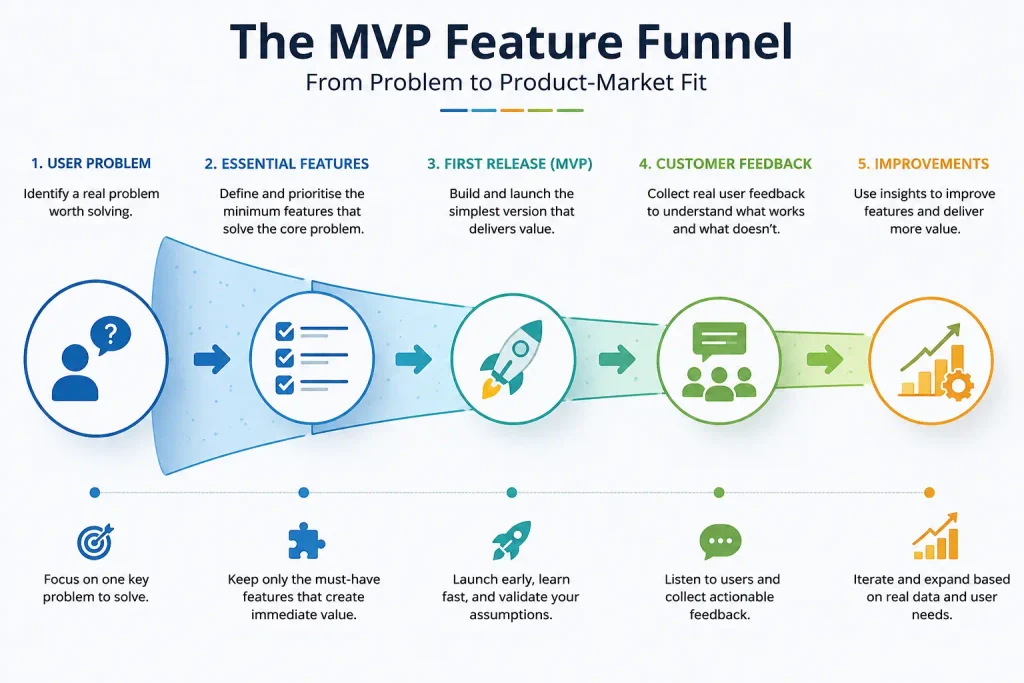
A minimum viable product (MVP) is an early version of an application that solves a specific user problem. It includes enough functionality to deliver value and gather meaningful feedback.
The idea behind Minimum viable product development is to test important assumptions before investing in extensive development. Instead of building every planned feature, teams focus on the smallest useful product they can release.
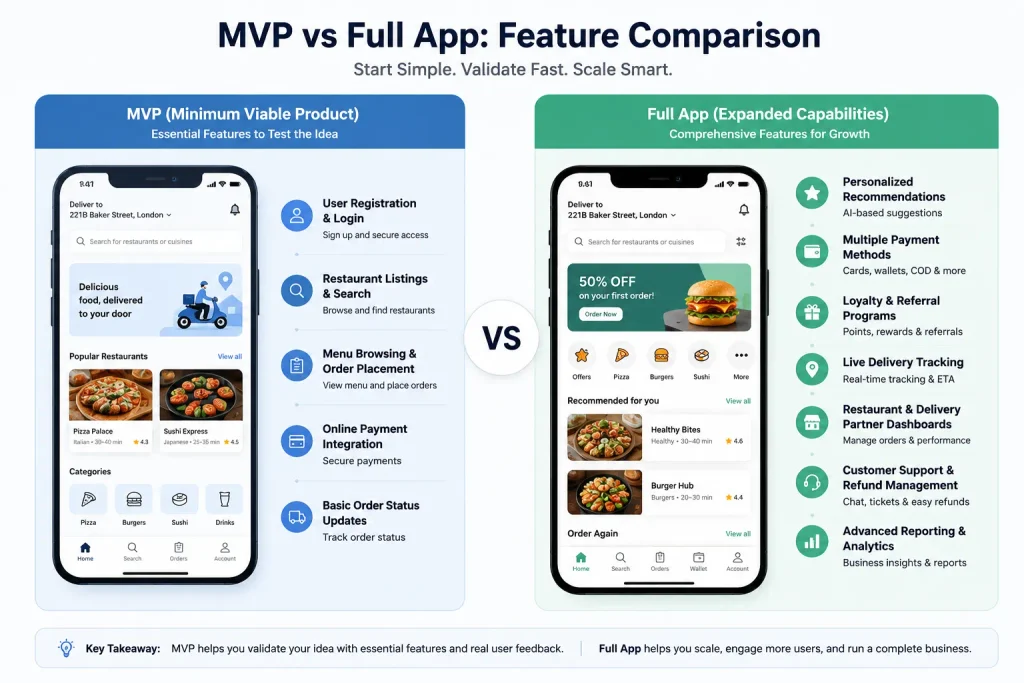
For example, consider a startup planning a food delivery platform. Its first release might include:
- Customer registration and login.
- Restaurant listings and basic search.
- Menu browsing and order placement.
- Online payment integration.
- Basic order status updates.
The first version may exclude loyalty programmes, advanced recommendations, subscription plans, and complex delivery analytics. These limitations are deliberate. The team wants to understand whether customers will use the service and complete orders. Feedback can then guide the next development decisions.
A successful MVP still needs reliable performance, secure data handling, and a clear user journey. Minimum scope should never mean poor quality.
What Is a Full-Fledged App?
A full-fledged app provides a broader set of features and supports more complete user journeys. It usually addresses multiple customer needs, business workflows, and operational requirements.
For the food delivery example, a mature application might include:
- Personalised restaurant recommendations.
- Multiple payment methods and digital wallets.
- Loyalty points and referral programmes.
- Live delivery tracking and estimated arrival times.
- Restaurant and delivery partner dashboards.
- Customer support and refund management.
- Advanced reporting and business analytics.
Unlike an early MVP, a complete product may serve different user roles. It also needs stronger integration between its frontend, backend, databases, and external services. Full-scale app development often requires more detailed planning and testing. Teams must consider performance, security, maintenance, and future expansion.
This approach suits businesses with validated demand, defined workflows, and sufficient resources. It can also suit established companies replacing outdated systems or launching products with clear operational requirements.
However, building every possible feature from the beginning can increase complexity. A larger product does not automatically create a better customer experience.
Explore more: Things to consider before launching a mobile app
MVP vs Full App: What Are the Key Differences?
The main difference lies in scope, investment, and the initial release’s purpose. Understanding MVP development vs full app development helps businesses decide how much functionality they need today.
| Comparison area | MVP | Full app |
|---|---|---|
| Primary goal | Test an idea | Deliver a complete product |
| Feature scope | Essential functionality | Broader feature set |
| Initial investment | Usually lower | Usually higher |
| Development effort | More limited | More extensive |
| User feedback | Guides early decisions | Supports ongoing improvements |
| Integrations | Essential integrations | Multiple or advanced integrations |
| Target users | Early adopters | Wider customer base |
| Updates | Frequent learning-led changes | Planned product improvements |
| Business readiness | Validates demand | Supports established operations |
Does an MVP mean a basic or unfinished product?
No. An MVP should deliver a complete experience for one carefully selected use case. Users should be able to complete its main task without confusion or unnecessary obstacles.
The difference between an MVP and a full product is breadth of functionality, not quality standards. A smaller product can still offer thoughtful design, reliable performance, and strong security.
For example, a booking MVP might support searching, selecting, and confirming appointments. Advanced calendar integrations and automated loyalty rewards can follow later.
MVP vs Full App: Which Is Better for Your Business?
There is no universal winner in the MVP vs full app decision. Your business stage, customer expectations, market conditions, and product complexity should guide the choice.
When should you choose an MVP?
An MVP usually makes sense when:
- You have an idea but limited evidence of customer demand.
- Your startup needs to test a new business model.
- Your budget cannot support a complete product.
- You need early feedback before expanding functionality.
- Competitors or market conditions may change quickly.
For example, a new fitness startup could launch workout planning and progress tracking first. It can study engagement before investing in coaching marketplaces or wearable integrations.
This approach supports product validation and helps teams understand which features matter most. It also reduces the risk of spending heavily on assumptions.
When should you build a full app?
A complete application may be more suitable when:
- Customers already demonstrate clear demand.
- Your business needs several connected workflows.
- You operate in a regulated or security-sensitive industry.
- Existing systems require extensive integrations.
- Your product must support complex user roles.
A banking application, for example, cannot launch with an incomplete approach to essential account security. It needs reliable authentication, transaction handling, compliance controls, and customer support.
Some businesses also have contractual or operational requirements that demand a complete feature set. In these cases, a smaller release may not meet the actual business need.
The right mobile app development strategy should reflect the product’s risk and purpose. Choose the smallest scope that can safely deliver the intended business value.
How Much Does It Cost to Build an MVP vs a Full App?
The MVP app development cost depends on the number of features, design complexity, backend requirements, integrations, and testing effort. A smaller scope generally requires fewer development hours, but every project needs a detailed estimate.
For a current market reference, GoodFirms’ September 2026 research places basic apps at $15,000 – $40,000. Mid-level apps range from $40,000 – $120,000, while advanced apps can reach $100,000 – $250,000 or more. These figures reflect app complexity, not fixed MVP or full-app prices.
Clutch’s September 2026 pricing guide reports that most reviewed app projects fall between $10,000 and $49,999. Its listed company rates commonly range from $25 to $49 per hour.
For practical planning, consider these indicative ranges:
| Project scope | Indicative development budget | Typical requirements |
|---|---|---|
| Focused MVP | $15,000 – $40,000 | Core workflows, basic backend, essential integrations |
| Mid-level application | $40,000 – $120,000 | Multiple workflows, payments, dashboards, reporting |
| Advanced full application | $100,000 – $250,000+ | Complex integrations, multiple roles, automation, advanced security |
These are planning estimates, not guaranteed quotations. A focused MVP with complex payments or regulatory requirements can cost more than a straightforward full application.
The full app development cost also depends on future expansion, infrastructure, and ongoing maintenance. Businesses should include testing, hosting, third-party services, security updates, and support in their budgets.
The overall app development cost can rise when teams add features during development. Clear requirements and agreed priorities help control these changes.
Explore more: Build or buy a mobile app for your business
How to Decide What to Build First: 6 Practical Steps
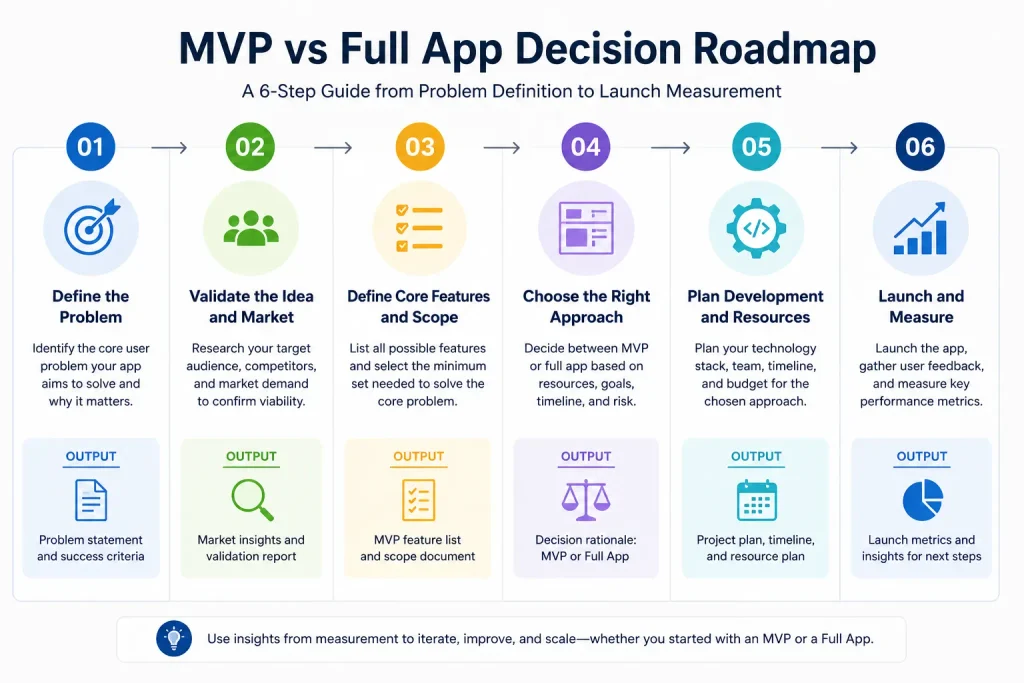
A structured decision helps prevent unnecessary spending and unclear product scope. Use these six steps before finalising your development plan.
1. Define the problem you want to solve
Start with the specific problem your application will address. Avoid beginning with a long list of features. Speak with potential users and understand their current difficulties. A clear problem statement gives your team a practical basis for deciding what belongs in the first release.
2. Understand your target audience
Identify who will use the application and what they expect from it. Consider their needs, technical comfort, buying behaviour, and common frustrations. Useful conversations can reveal which features users consider essential. They can also expose assumptions that require further investigation.
3. Conduct market research
Study competitors, existing alternatives, customer expectations, and market gaps. Look at what competing products offer and where users still experience problems. Market research should inform your decisions, not encourage you to copy every competitor feature. Focus on opportunities that support your product’s main purpose.
4. Prioritise features by business value
List all proposed features and group them by importance. Separate essential functionality from improvements that can follow after launch.
A simple priority framework can help:
- Must have: Required to complete the main user task.
- Should have: Improves the experience but does not block launch.
- Could have: Adds convenience or differentiation.
- Later: Requires more validation or investment.
This app feature prioritisation exercise keeps the first release focused. It also makes discussions between founders, designers, and developers more productive.
5. Plan the technology and future growth
Your initial architecture should support the product’s likely direction. Choose a technology stack that matches your performance, integration, security, and maintenance needs. A scalable app architecture can reduce expensive restructuring as usage grows. However, avoid paying for complex infrastructure before the product needs it.
Your MVP development process should include clear requirements, design, development, testing, release, and feedback collection. Treat these stages as connected activities rather than isolated tasks.
6. Set measurable goals before launch
Decide what success should look like before releasing the product. Track meaningful indicators such as registrations, completed transactions, repeat usage, and customer retention. Use user feedback alongside analytics to understand why people behave in certain ways. These findings can guide future releases and help you assess product-market fit.
Also consider your expected app development timeline and available team capacity. A realistic schedule should include testing, launch preparation, and post-launch improvements.
Common Mistakes to Avoid When Choosing Between an MVP and a Full App
Even well-planned projects can lose direction when teams make decisions based on assumptions. Avoid these common mistakes:
- Building too many features: Extra functionality can delay launch without proving customer value.
- Confusing an MVP with a prototype: A prototype demonstrates an idea. An MVP must support a real user task.
- Ignoring quality: Limited scope does not justify weak security, poor usability, or unreliable performance.
- Copying competitors: Their feature set may not match your customers or business model.
- Underestimating maintenance: Every release needs monitoring, updates, and technical support.
- Choosing technology without a plan: Consider integrations, security, and future development before selecting tools.
- Skipping feedback: Launching without learning goals makes it harder to decide what comes next.
Remember that startup app development involves more than delivering code. Teams must balance customer needs, business priorities, and technical decisions. A reliable software development lifecycle should support testing and improvement at every stage. It should also give stakeholders visibility into progress, risks, and changing requirements.
MVP vs Full App: Which Development Approach Should You Choose?
The best approach depends on how much uncertainty surrounds your idea and how much functionality your business needs at launch.
An MVP makes sense when you need to validate demand, test essential workflows, and learn from real users. A full application is more appropriate when requirements are established and the product needs broader functionality from day one. For many founders, a phased approach offers a sensible middle ground. Start with essential features, measure customer response, and expand when evidence supports further investment.
Work with your team to define the scope, budget, technical foundation, and release goals. A suitable development partner can help translate those decisions into a realistic plan. Ultimately, the goal is not to build the biggest application first. It is to make a sound investment, deliver genuine user value, and create a product that can grow with your business. MVP app development can provide that starting point when validation matters more than launching every planned feature.