


The online shopping market is expected to be worth more than $6.8 trillion by 2028. This makes retail one of the fastest-growing industries in the world. As more businesses compete online, choosing the right platform for your online store is one of the most important business decisions you’ll make. The platform you choose affects customer experience, website performance, scalability, operating costs, and ultimately, your profitability.
Many businesses compare Shopify vs Magento vs WooCommerce. These three platforms dominate the eCommerce ecosystem. Each platform offers unique features, but they are suited for different types of businesses, budgets, and growth plans.
In this eCommerce platform comparison, we will look at areas such as cost, ease of use, customization options, SEO, security, and maintenance. By the end of this guide, you will know which is the best platform for eCommerce website development for your business goals.
Overview of Shopify vs Magento vs WooCommerce
The best e-Commerce platform comes with unique advantages and disadvantages. Your ability to balance these advantages and disadvantages with your company’s goals will be crucial to the success of your online store.
Let’s first examine the main advantages, disadvantages, and optimal use scenarios for Magento vs. Shopify vs. WooCommerce:
1. Shopify
Founded in 2006, Shopify is a fully hosted, subscription-based eCommerce platform designed to simplify online store development for businesses of all sizes. As a Software-as-a-Service (SaaS) solution, Shopify manages hosting, security, software updates, and maintenance, allowing merchants to focus on sales and eCommerce business growth.
Shopify subscription plans range from $39 to $2,300 per month, though pricing varies by region and may change periodically. Shopify also supports m-commerce with responsive themes, mobile-optimized checkout, and integrated payment solutions. This enables businesses to deliver seamless shopping experiences across smartphones, tablets, and other connected devices.
With the help of a Shopify development company, a business owner doesn’t have to worry about hosting. You can purchase a custom domain through the platform. It offers several advantages, including: infinite merchandise creation, unlimited file storage, discount codes, two accounts for admins, 24×7 support, and much more. As business requirements evolve, many organizations hire Shopify developers to build custom features, integrate third-party tools, and optimize store performance for long-term scalability.
2. WooCommerce
Founded in 2011, WooCommerce is a WordPress plugin. It has become very popular for building platforms for WooCommerce development. Today, it powers more than 6 million live websites. This makes it a strong contender in the ongoing Shopify vs WooCommerce debate for businesses looking to build flexible & scalable eCommerce platforms.
As a powerful eCommerce CMS, WooCommerce transforms any WordPress website into a fully functional online store. Its biggest advantage is flexibility. Businesses retain complete ownership of their data, hosting environment, and store architecture. Making it an ideal self-hosted eCommerce platform for brands that require extensive website customization and long-term control. Companies looking for tailored functionality often rely on experienced WooCommerce development services to build custom themes & seamless third-party connections.
A basic WooCommerce store can be launched quickly. With flexibility comes more responsibility. Users must manage hosting, security, performance, backups, and updates.It also gives businesses control over a customized and scalable eCommerce solution.
Explore more: Shopify vs WooCommerce comparison
3. Magento
Founded in 2008, Magento is an open-source eCommerce platform that helps companies and developing brands require advanced Magento development capabilities. Designed as an enterprise eCommerce solution, it offers exceptional flexibility and the scalability needed to support extensive product catalogs.
According to Magento, more than 93k websites worldwide are powered by the platform, making it a trusted choice for businesses focused on long-term eCommerce business acceleration. As a self-hosted solution, its core strength is its modular architecture. Many businesses are also using Magento extension development services to add custom functionality, automate operations, and enhance customer experiences without rebuilding their entire platform.
As a self-hosted eCommerce solution, Magento’s greatest strength lies in its modular architecture and native multi-store functionality. This allows businesses to manage multiple storefronts from a single backend.
Although Magento does not include built-in point-of-sale (POS) capabilities, it offers unmatched flexibility through APIs and third-party compatibility. Businesses seeking custom eCommerce solutions often partner with a trusted Magento development company that provides expert Magento development services. For more complex projects, many organizations also choose to hire Magento developers who can build, customize, and optimize Magento stores to meet evolving business requirements.
Shopify vs WooCommerce vs Magento: Comparison Table
The eCommerce platform comparison below breaks down the key differences between Shopify vs Magento vs WooCommerce, helping businesses identify the best solution.
| Factors | Shopify | WooCommerce | Magento |
| Pricing | Monthly subscription fees plus potential transaction fees and app costs. | Generally, lower upfront costs as the core plugin is free, but expenses can arise from hosting, premium extensions, themes, etc. | Variable costs based on the edition chosen, hosting, and development needs. |
| Ease of use | Extremely user-friendly, easy for beginners. | User-friendly with WordPress integration. Moderate learning curve. | Steeper learning curve. Better suited for users with technical expertise. |
| Design | Professionally designed themes. Easily customizable for a streamlined look. | Inherits diverse WordPress themes. Provides ample design options. | Extensive design flexibility. Suitable for businesses with unique branding needs. |
| SEO | Built-in SEO features. Fitting for basic SEO needs. | Inherits powerful SEO capabilities from WordPress. Suitable for advanced SEO strategies. | Advanced SEO customization capabilities. Ideal for businesses focused on search engine dominance. |
| Customization | Customizable, but with some limitations. Extensive app ecosystem. | Highly customizable, extensive flexibility with WordPress integration. | Highly customizable, offering advanced customization options. |
| Performance | Optimized performance out of the box, reliable hosting by Shopify. | Performance depends on hosting quality. Need to choose a reliable host. | Powerful but may require more server resources. High-quality hosting is crucial. |
| Scalability | Suitable for smaller to medium-sized businesses; easy scalability. | Scalable, but performance depends on hosting quality. Good for medium-sized businesses. | Highly scalable. Ideal for large enterprises with complex needs. |
| Security | Secure environment with updates, SSL, and PCI compliance handled by Shopify. | Security depends on hosting; it requires a reliable host for secure transactions. | Open source allows greater control over security. Requires diligent maintenance and robust hosting. |
| Starting Monthly Cost | ~$39 | ~$10–20 (hosting only) | $2,000+ |
| Payment Gateways | Shopify Payments + 100+ | 100+ | 300+ |
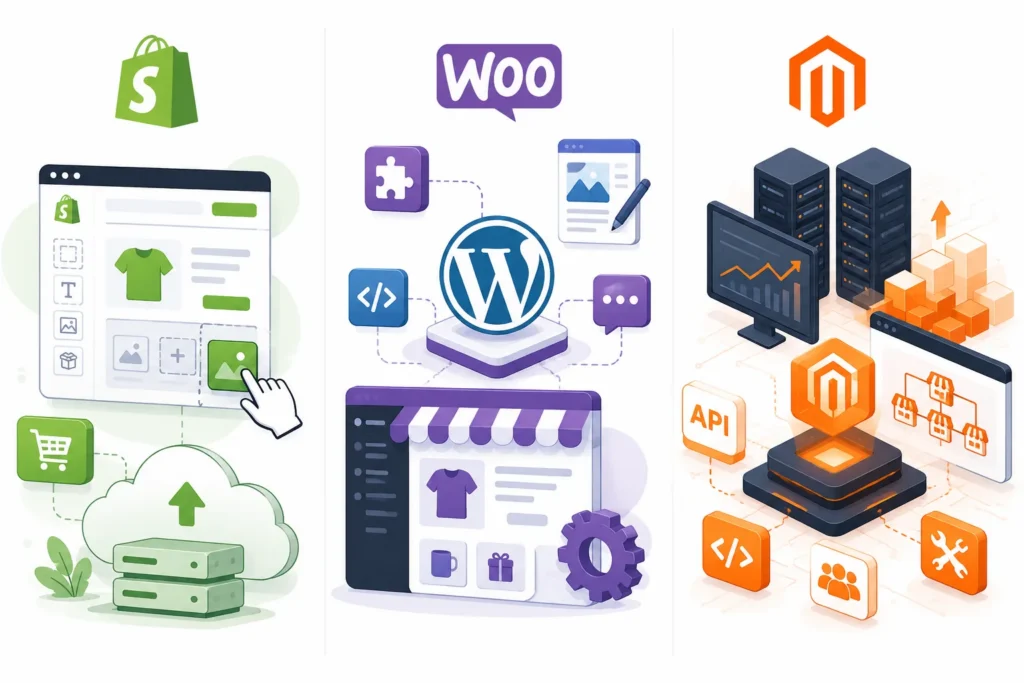
Which Platform is Best for Your Business?
The correct eCommerce platform depends on your current business stage and long-term objectives.
Select Shopify If:
- You want to start selling fast.
- You do not have a support team.
- You like to know how much you will pay each month.
- You want built-in tools for store performance optimization with minimal technical effort.
- You are looking for a small business eCommerce platform
Choose Magento If:
- You manage multiple brands.
- You need advanced B2B functionality.
- You require enterprise scalability.
- You operate globally.
- You need complete backend flexibility.
Choose WooCommerce If:
- You already use WordPress.
- SEO and blogging are central to your marketing strategy.
- You want complete ownership of your website.
- You need extensive customization at a lower initial cost.
Explore more: eCommerce website development cost guide
Essential eCommerce Platform Features to Consider Before Choosing
The right solution should offer the eCommerce platform capabilities required for your current operations while remaining flexible enough to scale with your business in the future.
1. Ease of Store Management
A platform should simplify everyday operations, including product management, inventory updates, order processing, and customer management. Efficient eCommerce store management tools help businesses save time while improving operational accuracy.
2. Customization and Scalability
Every business is different and has its own needs. You need to find a platform that lets you customize your website a lot with themes that can be changed and custom plugins. The platform should also be able to grow with your business so you do not have to start over again.
3. Payment Gateway Integration
Payment gateway setup enables secure, flexible payments with multiple currencies and providers, improving checkout experiences, reducing cart abandonment, and increasing conversions.
4. Security and Compliance
Protect customer data by choosing a platform with built-in security features like SSL, PCI DSS compliance, fraud protection, secure payments, and regular updates.
5. Third-Party Integrations
A reliable eCommerce platform should support integrations with CRM, ERP, marketing, shipping, accounting, and analytics tools to streamline day-to-day operations.
6. Mobile Commerce and Performance
A fast, responsive website helps create a better online shopping experience, leading to higher customer satisfaction and improved conversion rates.
Explore more: eCommerce app development cost guide
Build an eCommerce Store That Supports Your Business Goals with IIH Global
Choosing between Shopify, Magento and WooCommerce is the start. The real key to making a store successful is how well you set it up, make it your own and get it working just right for your business.
We help companies, brands that are getting bigger and big businesses turn their online store ideas into websites that really work. Our eCommerce website development services are made to deliver scalable, secure, and conversion-focused solutions that grow alongside your business. Talk to our eCommerce specialists to discuss the right platform for your business.
Concluding
When you have to choose between Shopify, Magento and WooCommerce, you should not just look for the one that has the things it can do. You need to find the one that’s really good for your business and what you want to achieve.
If you want to get started fast and do not want to spend a lot of time taking care of your website, Shopify is a great choice. If you need a lot of control over how your website looks and works, and you have a business, Magento is better. WooCommerce is good for people who want to change things and have a website that’s all about the content and the products they sell, and who want to own it completely.
Ultimately, the best choice is the one that supports your operations today and grows with your business tomorrow. Pairing the right platform with reliable web development solutions ensures your online store remains secure, scalable, and ready to deliver a better customer experience as your business evolves.