


Choosing Shopify or WooCommerce is one of the most important decisions when launching an online store. The right platform shapes your website’s performance, flexibility, and future growth. If you want the best eCommerce platform for your business, you need to compare features, pricing, ease of use, and long-term value. Both solutions power thousands of successful stores, yet each serves different business needs. Understanding their strengths helps you invest wisely and build an online store that supports sustainable success.
Whether you are launching a startup or upgrading an existing website, your platform should match your business goals. Some businesses prefer an all-in-one solution, while others want complete customization. This guide explains everything you need to know before making a decision.
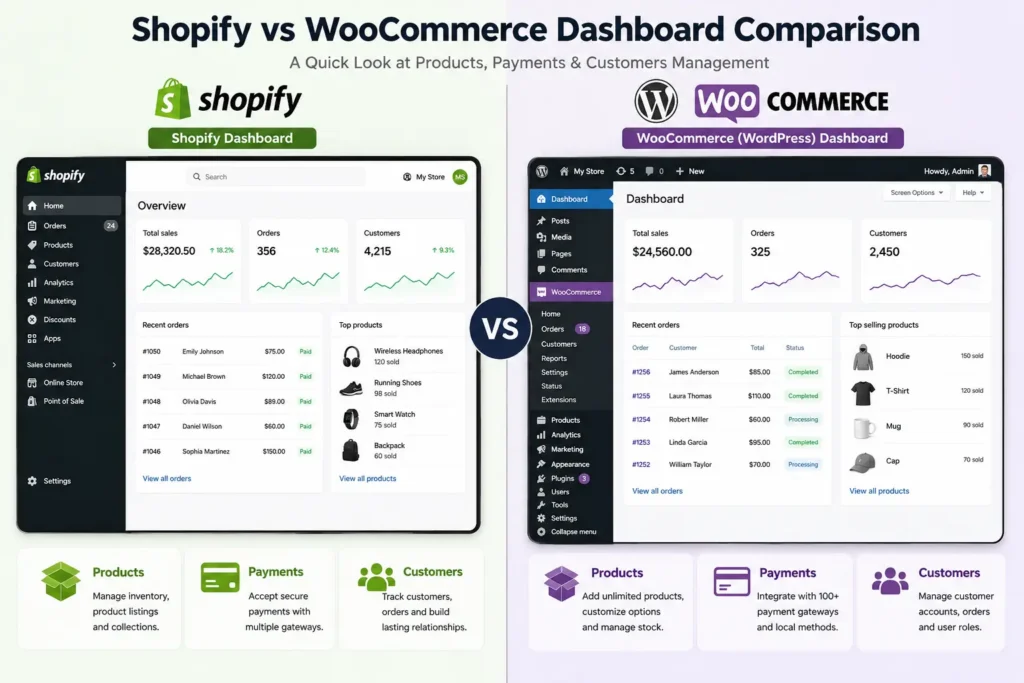
Understanding Shopify and WooCommerce
Shopify eCommerce Platform: Features and Pricing
The Shopify eCommerce platform is a fully managed solution designed for businesses that want to launch quickly without handling technical tasks. Since it is a hosted eCommerce platform, Shopify manages hosting, security updates, software maintenance, and performance optimization.
Shopify offers an intuitive dashboard, making it suitable for beginners and growing businesses alike. Merchants can design attractive stores using professional themes and extend functionality with thousands of apps.
Shopify features:
Some of the most valuable Shopify features include:
- Easy drag-and-drop store customization
- Secure checkout
- Built-in SSL certificate
- Mobile-responsive themes
- Multiple payment options
- AI-assisted product management
- Marketing and SEO tools
- Abandoned cart recovery
- Analytics dashboard
- Global selling capabilities
One of the biggest Shopify benefits is simplicity. Business owners spend less time maintaining technology and more time selling products.
Shopify Pricing:
Shopify offers several subscription plans. Current market pricing generally includes:
| Plan | Estimated Monthly Cost | Best For |
|---|---|---|
| Basic | Around $39 | New businesses |
| Grow | Around $105 | Growing stores |
| Advanced | Around $399 | High-volume businesses |
| Plus | Custom pricing | Enterprise brands |
Besides the monthly subscription, businesses should also consider:
- Premium themes
- Third-party apps
- Transaction fees, depending on payment provider
- Premium integrations
Although Shopify has recurring costs, many businesses value the predictable expenses and minimal maintenance requirements.
WooCommerce eCommerce Platform: Features and Pricing
The WooCommerce eCommerce platform is a powerful plugin built specifically for WordPress WooCommerce websites. Unlike Shopify, WooCommerce gives complete ownership of your website and data.
WooCommerce is considered an open-source eCommerce platform, allowing developers to customize almost every aspect of the shopping experience. Businesses that need advanced functionality often choose WooCommerce because of its flexibility.
WooCommerce features:
Popular WooCommerce features include:
- Unlimited product listings
- Flexible checkout customization
- Extensive design control
- Large plugin ecosystem
- Advanced shipping rules
- Tax configuration
- Product variations
- SEO-friendly architecture
- Customer account management
- Developer-friendly customization
Among the biggest WooCommerce benefits is complete control. Store owners decide how their website works without platform restrictions.
WooCommerce Pricing:
WooCommerce itself is free to install. However, operating costs depend on several additional services.
Typical expenses include:
| Cost Component | Estimated Annual or Monthly Cost |
|---|---|
| Domain | $10–20 yearly |
| website hosting for WooCommerce | $15–100+ monthly |
| Premium themes | $50–200 one-time |
| Extensions | Varies |
| Developer support | Based on project scope |
Because pricing varies significantly, businesses should evaluate total ownership costs instead of focusing only on software licensing.
Explore more: Find the best eCommerce expert for your business
Best eCommerce Platform for Your Business: Comparing Shopify vs WooCommerce
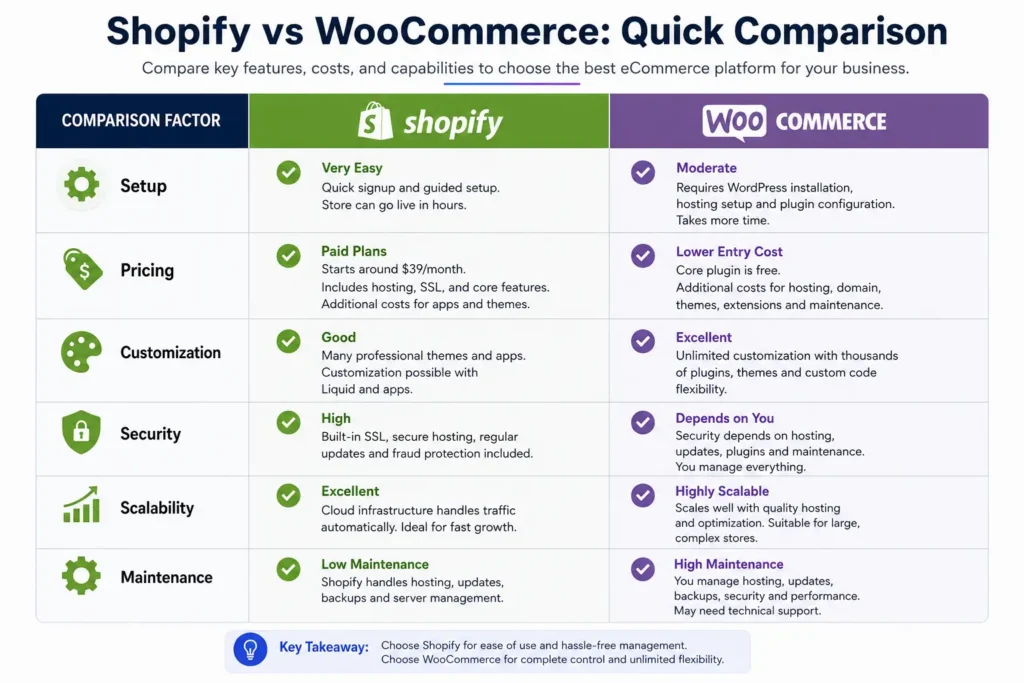
Selecting the best eCommerce platform for your business depends on your priorities. Some companies value convenience, while others prioritize flexibility and customization. This Shopify vs WooCommerce comparison highlights the most important factors.
1. Ease of Setup
Shopify offers a guided onboarding process that helps users launch quickly. Most stores become operational within hours because hosting, security, and software installation already exist.
WooCommerce requires installing WordPress, configuring hosting, and adding the plugin. Although setup takes longer, experienced users gain much greater flexibility.
Businesses without technical experience often prefer Shopify. Developers usually appreciate WooCommerce’s customization options.
2. Customization and Design
Shopify offers hundreds of themes and a large collection of Shopify apps that extend functionality without coding.
WooCommerce supports thousands of WooCommerce plugins, themes, and custom development options. This flexibility makes it easier to create a truly custom eCommerce website tailored to unique business requirements.
Companies needing advanced branding often prefer WooCommerce because design limitations remain minimal. The leading eCommerce development company can further enhance store design, user experience, and custom functionality based on specific business requirements.
3. Pricing Comparison
Many buyers search for Shopify pricing vs WooCommerce pricing before selecting a platform.
Shopify delivers predictable monthly expenses with included hosting and maintenance.
WooCommerce has lower entry costs but additional expenses can accumulate through hosting, premium extensions, security tools, and ongoing maintenance.
Neither option is automatically cheaper. Total costs depend on business size, traffic, customization, and technical requirements.
4. Performance and Security
Shopify optimizes servers automatically and maintains security without user intervention. Businesses receive regular updates and infrastructure improvements as part of their subscription.
WooCommerce performance depends largely on your hosting provider and website optimization. Choosing quality hosting significantly improves loading speed and reliability.
Both platforms can operate as a secure online store when configured correctly. Shopify includes built-in protection, while WooCommerce users manage their own security measures.
5. Payment Options
Modern online stores require reliable payment gateway integration for customer convenience.
Shopify supports Shopify Payments alongside many international payment providers.
WooCommerce supports hundreds of payment gateways through official and third-party extensions. Businesses needing specialized regional payment methods often appreciate this flexibility.
6. Scalability
As businesses expand, platform flexibility becomes increasingly important.
Shopify offers excellent eCommerce scalability with cloud infrastructure that automatically handles increasing traffic.
WooCommerce also scales effectively when paired with high-performance hosting and optimized infrastructure. Larger businesses often invest in dedicated servers or managed WordPress hosting for consistent performance.
The right choice depends on available technical resources and long-term expansion plans.
Explore more: Shopify vs Magento vs WooCommerce comparison
Pros and Cons of Both Platforms
Every business has different priorities. Some focus on speed, while others value flexibility. Understanding the strengths and limitations of each platform helps you make a smarter investment.
Shopify Pros
Shopify works well for businesses that want an easy-to-manage solution.
Advantages:
- Fast and simple setup
- Reliable hosting and security included
- Regular software updates
- Excellent customer support
- Large app marketplace
- Strong built-in sales and marketing tools
- Suitable for beginners and growing businesses
These benefits reduce technical work and let owners focus on online business growth instead of website maintenance.
Shopify Cons
Despite its convenience, Shopify has a few drawbacks.
Limitations:
- Monthly subscription costs continue as your business grows.
- Advanced customization often requires Shopify Liquid knowledge.
- Many premium apps increase operating costs.
- Switching platforms later may require additional migration work.
Businesses with highly specialized requirements sometimes outgrow Shopify’s built-in capabilities.
WooCommerce Pros
WooCommerce appeals to businesses that want full ownership and flexibility.
Advantages:
- Free core software
- Unlimited customization
- Complete ownership of website data
- Huge extension marketplace
- Strong SEO capabilities
- Excellent blogging support
- Flexible product management
- Suitable for complex business models, including multi-vendor eCommerce
Many companies building unique shopping experiences prefer WooCommerce because almost every feature can be customized.
WooCommerce Cons
WooCommerce requires more technical involvement than Shopify.
Limitations:
- Hosting management remains your responsibility.
- Security and updates require regular attention.
- Performance depends on hosting quality.
- Premium extensions may increase long-term costs.
- Beginners may face a steeper learning curve.
Businesses without technical resources may need professional assistance for ongoing maintenance.
Explore more: Choose the right Shopify expert
Factors to Consider When Choosing Between Shopify and WooCommerce
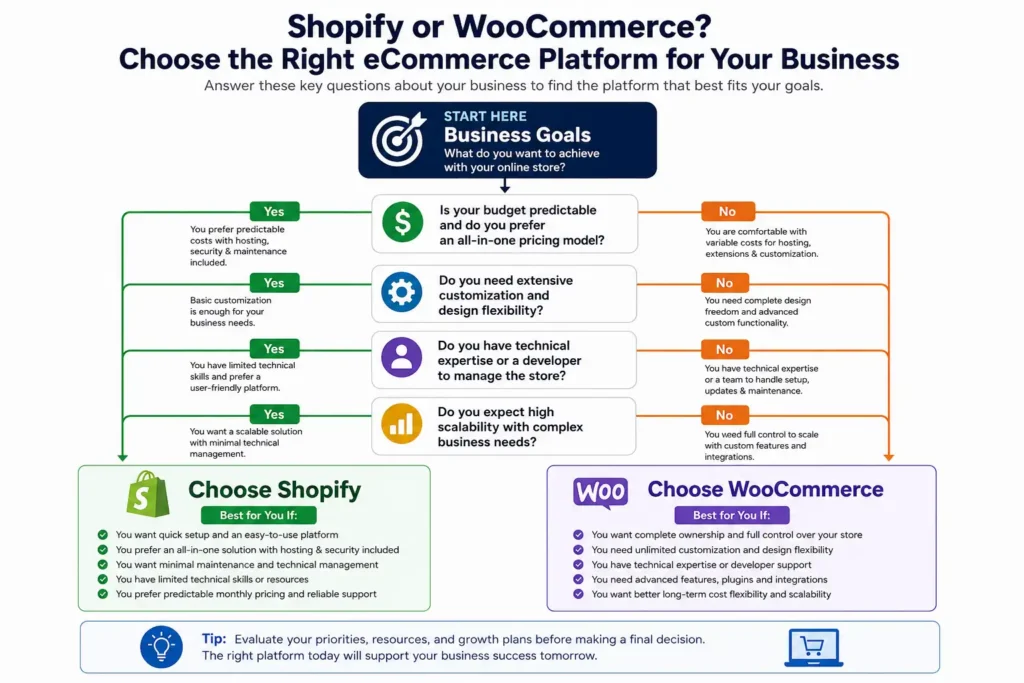
There is no universal winner. The right choice depends on your goals, budget, and technical capabilities.
1. Business Size
If you are evaluating Shopify or WooCommerce for a small business, Shopify offers a smoother starting point. Its managed environment reduces setup time and ongoing maintenance. Growing businesses with unique workflows may benefit from WooCommerce because it allows unlimited customization.
2. Technical Expertise
Shopify works well for non-technical users. WooCommerce suits businesses with internal developers or agencies managing the website. If your team lacks technical experience, Shopify usually delivers a faster launch.
3. Customization Requirements
Some businesses need advanced product configurators, membership systems, or complex pricing models. WooCommerce offers unmatched flexibility through thousands of eCommerce plugins and custom coding opportunities. Businesses seeking a fully tailored shopping experience often choose custom online store development rather than relying only on pre-built templates.
4. Store Management
Managing products efficiently becomes increasingly important as catalogs grow. Both platforms offer excellent inventory management capabilities. Shopify includes inventory tools within its dashboard. WooCommerce provides inventory controls through its core plugin while allowing additional extensions for advanced warehouse management.
5. Long-Term Costs
Initial expenses rarely tell the full story. Shopify provides predictable monthly pricing. WooCommerce may cost less initially but requires spending on hosting, premium extensions, maintenance, and technical support over time. Consider ownership costs over three to five years instead of focusing only on launch expenses.
6. Business Growth Plans
Your platform should support future expansion without requiring a complete rebuild. If you expect rapid product growth, international selling, or increasing customer traffic, evaluate how each platform supports scaling. Businesses planning aggressive expansion should prioritize flexibility alongside performance.
7. Development Support
Some businesses prefer working with experienced development partners instead of managing everything internally. When planning eCommerce website development, partnering with a professional web development company helps reduce implementation risks and improves long-term performance.
Professional guidance also ensures better architecture, security, and future scalability.
8. Future Enhancements
As your business evolves, new features become necessary. Many companies eventually require loyalty programs, subscriptions, advanced reporting, or marketplace functionality. Businesses using Shopify often work with a leading Shopify development agency when custom features exceed standard capabilities.
Similarly, companies needing complex WooCommerce customization frequently rely on expert WooCommerce development services to extend functionality while maintaining performance. Around this stage, organizations often evaluate whether to hire dedicated WooCommerce developers or invest in dedicated WooCommerce specialists based on future technical requirements.
Which Platform Should You Choose?
Many entrepreneurs eventually ask, which is better: Shopify or WooCommerce? The answer depends entirely on your business priorities.
Choose Shopify if you want:
- Fast deployment
- Minimal maintenance
- Reliable hosting
- Predictable monthly costs
- Excellent customer support
Choose WooCommerce if you want:
- Complete ownership
- Unlimited customization
- Advanced development flexibility
- Deep WordPress integration
- Greater control over long-term infrastructure
Neither platform is universally superior. Each serves different business goals effectively.
Explore more: eCommerce website development cost guide
Conclusion
Choosing Shopify or WooCommerce comes down to balancing convenience, flexibility, and long-term business objectives. Shopify simplifies store management with an all-in-one solution, while WooCommerce offers unmatched customization and ownership. Businesses that need deeper Shopify customization can hire dedicated Shopify developers to build advanced features and create a store experience tailored to their customers.
Consider your budget, technical expertise, expected growth, and operational needs before making a decision. If your goal is finding the best eCommerce platform for your business, compare the total cost of ownership instead of only the initial investment.
The right platform should support your products, customers, and future expansion without limiting innovation. Whether you need a simple shopping cart solution or a highly customized store, both platforms provide the tools to build the best platform for online store success when implemented correctly.